My blog has moved!

You should be automatically redirected in 5 seconds. If not, visit
http://thegirlrevolution.com
and update your bookmarks.

Showing posts with label emotional inheritance. Show all posts

Wednesday, September 3, 2008

Face Off - Self Esteem vs. Body Dysmorphia

We went to the Exploratorium in San Francisco.

One particular exhibit had a disconcerting effect on me for days.

You sit in between two mirrors and look at your self.

DSC03846071520080002.jpg

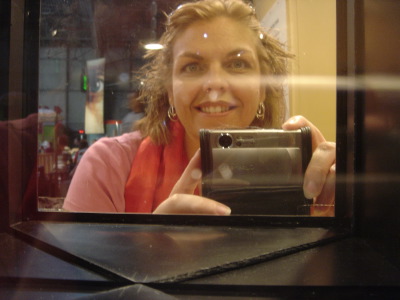
One is a regular mirror and show's you how you see yourself every day. The top photo is how I see myself.
DSC03848071520080001.jpg

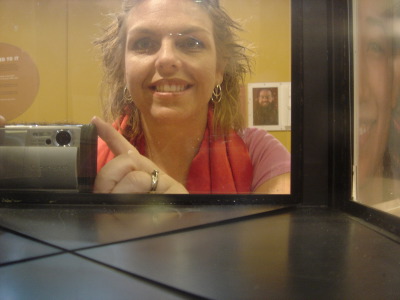
The other shows you what other people see every day. It shows you what you really look like.

Do you see a minute difference between the top photo and the bottom photo?

I've been fascinated by my own emotional reaction. Truly, it was unsettling to see my reflection differently than I do everyday.

The top photo, what I see in the mirror is more attractive to me.

My eyes are uneven in the second photo. The right eye, when looking at it, is slightly lower than the left one.

I find I hold my head slightly tilted in a way that makes my features more even. I think I also hold that eyebrow higher to make the eyes look more symmetrical. I compensate for the flaw I've really only noticed once in a photo when I was pregnant with Zack.

Since you are other people and it's not your face I really have no clue how you are perceiving the attractiveness of the two photos or whether you see the unevenness of my eyes at all. For all I know, everyone who sees me, may choose to make the same correction that I do for myself.

It strikes me as a kindness to myself that my subconscious mind chooses to correct my minor flaw so that I not only feel more attractive, but literally see myself as more attractive.

It also strikes me that people who suffer from eating disorders, like anorexia and bulimia or the emotional disorder of body dysmorphia for some reason they aren't subconsciously fixing their features in their minds.

They are not only seeing their minor flaw - they are focusing on it and magnifying it.

Its also likely they are expecting the outside world, other people, to treat them the way they treat themselves. Did you see how I assumed that others would treat me with the same kindness as I show myself and that others would correct or overlook the minor flaw in their own perceptions, rather than focus on it and magnify it? This assumption is likely a result of my habit of doing such a kindness for myself and for others.

Were I unkind to myself, and if I made a habit of focusing on the minor flaws of other people, I would likely assume that others were also doing so to me.

That's my theory anyway, based on everything I've read about self-esteem, self-worth, and eating disorders and related emotional disorders.

It follows then that maybe we can teach our daughters to serve their own mental health and self-esteem.

Cutting ourselves, our daughters and others some slack for our minor physical flaws teaches, by example, our daughters this emotional skill vital to their self-preservation.

Treating ourselves, our daughters, and others - especially other girls and women - with kindness is also a teachable habit.

Self-love and self-acceptance is a skill. One we learn and one we can teach.

Friday, August 1, 2008

Y's Letter to My Body

Yvonne from Joy Unexpected read this as the Community Keynote at BlogHer.

I don't ever want my daughter to feel the way that I have felt most of my adult life about my body.

Bravo Y.

If you can't watch her read it, you should read her Life Change Words.

Thursday, July 24, 2008

Self-Loathing Sin Bank

Vacation Rerun


by Tracee Sioux

I am going to put a self-loathing sin piggy-bank (pardon the pun) on my kitchen table.

Naomi Wolf has a great quote which is taped on my bathroom mirror, "The mother who radiates self-love and self-acceptance vaccinates her daughter against low self-esteem."

I accept this as a self-evident truth. In psychology circles I think they call it "mirroring" when our children look at us as a sort of reflection of themselves. A practical example would be, "my mother thinks she's fat, therefore I too am fat." A mother who is not actually fat, but repeatedly calls herself fat must then bear the responsibility when her daughter adopts an eating disorder like anorexia, bulimia or overeating.
More posts on Dove's Campaign for Real Beauty
Beauty & Reality
Self-Loathing Sin Bank
More posts on hair:
Pink Hair Fiasco
Pink Hair Fiasco Take 2
Curl Maintenance
The Meaning of Hair

The child's perception of herself is obviously flawed using this mirroring if she looks at her thin body in the mirror and sees fat. And it breaks any mother's heart when she sees her child look at her own beautiful self with disdain, criticism or self-loathing. I think God put in us an inherent ability to see goodness and beauty in our children, whether or not they are actually beautiful.

However, I believe the function of mirroring can be done reversely with what is sometimes painful accuracy. I think when my daughter looks at her legs and says, "my legs are fat" she's telling me in a very loud voice that this is a true reflection of how she thinks I feel about my own body image.

When I had my first baby I never lost the weight because I figured I would just have to lose it after the second one. On the second one I was in my 30s and my metabolism had slowed down and I was nearing the dreaded 200 pound mark. When I realized I was going to hit 200 in a couple of months and the doctor had me on a heart monitor because of dizzy spells I decided I had to make a complete and total lifestyle change. (My heart, it turns out is just fine.) The whole family was getting chubby and I decided we had to eat healthier and get more active rather than living the lifestyle of a Kobe calf (Tajima-ushi cattle reportedly receive regular massages with Japanese rice wine and are fed hops for a well-marbled texture and tenderness).

The weight is coming off at a slow and steady rate and the muscle is bulking up and I've never felt better. This is obviously a great example to my daughter, who is now 5 and, according to her pediatrician, in the "red zone" for her BMI (body mass index).

Except for one thing. The thinner I get, the more she seems to be focusing on her own perceived flaws. The other day she said she hated her legs because they were fat.

OUCH!! Like a knife in the gut I realized that I talk about my body in a negative way to motivate myself to get to the gym. Not only that, but I use self-deprecating humor to make people laugh and to illustrate that I have the ability to laugh at myself.

When speaking directly to her I use all the healthy phrases like suggesting she eat a healthy snack. Or explain that we're eating vegetables and fish for dinner because it's a healthier choice. Directly to her I am proactive about explaining that we're off to the gym so that I can be stronger and have a healthier heart.

But to others. . . .

She has heard me call myself Kobe Beef. (Yes, I'm a fan of the esoteric references to amuse myself.) She has also heard me complain about buying the "largest girdle underwear they make, only to find out it was too small." I have bragged about going down in pants sizes, "it's taken me 8 freaking months to make it down to a size 12." I have touted the fact that I have lost "20 pounds of pure fat." I have complained about how I simply can't find shirts long enough to cover my stomach, "which wouldn't be so bad if I weren't so fat and no one needs to see blubber hanging out of my clothes." I have touted my measurements, "losing 15 inches of ugly fat, back fat, flabby boob fat, thigh fat, belly fat." She's has heard me complain about my clothes that make me "look like a total cow." I have complained that it's going to take me "40 more weeks to get rid of my fat at the rate of a pound a week." She's heard me say how surprised I am that "my neck even lost an inch of fat allowing me to wear my pearl choker again."

The thing is, I don't loath my self or my body. I wasn't even aware of how fat I was until I started seeing positive changes in my body. I still dream of myself as thin. I still think of myself as "the thin cute blond" one when I'm with my girlfriends. I have been blind to my own fat. Heck, I'm fairly sure my daughter was blind to my fat. I don't look in the mirror and hate what I see, because I don't even see what's really there - I literally look in the mirror and see myself as I was in college.

Yet, I realize that my daughter can't determine the difference between how I feel about my body and what I say about my body. To her, she will only internalize that I say I feel fat and that I say I hate my body. She only hears me criticize my looks, my self. And that is what is inevitably effecting how she will see herself for the rest of her life.

It's tragic really. It breaks my heart. It feels like damage that can't be reversed. It makes me loath myself.

My vow is to change this negative behavior. It is not worth a few laughs for the self-deprecating humor. I feel I have to hold myself accountable to her for this behavior so that she is explicitly aware that it is not okay for me to be unkind to myself, and therefore I can expect her to show her own self the kindness I want for her.

So, I'm going to put a self-loathing sin beauty bank on the kitchen table and deposit say, a quarter (hey, we're on a strict budget around here) for every self-deprecating, self-loathing remark I make about my body or my self. I will ask her to catch me calling myself unkind names. I will require her to deposit the same when she makes negative comments about herself.

To avoid making it another exercise in self-loathing (I suck so bad, I can't believe I said I'm fat again, I'm such an idiot!) it will be a requirement to write a positive attribute about our bodies to put in the bank along with the quarters. Then after a month we'll take the jar of good thoughts and our quarters and we'll go out for Chinese food and talk about our progress and how much we love our own bodies.

Alarming statistics from Dove's Campaign for Real Beauty Study
http://www.campaignforrealbeauty.com/

* 42% of 1st-3rd grade girls want to be thinner. (Collins, 1991)
* 81% of 10 year olds are afraid of being fat. (Mellin et al., 1991)
* The average American woman is 5'4" tall and weighs 140 pounds. The average American model is 5'11" tall and weighs 117 pounds. Most fashion models are thinner than 98% of American women. (Smolak, 1996)

*51% of 9 and 10 year old girls feel better about themselves if they are on a diet. (Mellin et al.,1991)
* 91% of women recently surveyed on a college campus had attempted to control their weight through dieting, 91% dieted "often" or "always." (Kurth et al., 1995)
* 95% of all dieters will regain their lost weight in 1-5 years. (Grodstein, 1996)
* 35% of "normal dieters" progress to pathological dieting. Of those, 20-25% progress to partial or full-syndrome eating disorders. (Shisslak & Crago, 1995)
* 25% of American men and 45% of American women are on a diet on any given day. (Smolak, 1996)
* Americans spend over $40 billion on dieting and diet-related products each year. (Smolak, 1996)

http://www.campaignforrealbeauty.com/DoveBeyondStereotypesWhitePaper.pdf

I've entered this article in Babylune's writing contest about parenting mistakes and lessons learned. Follow the link to enter one of your own.

Saturday, July 19, 2008

Mirrors: Ours, The Media’s, Our Cultures’ and Our Kids’

1myview.jpg

So I had my big BlogHer08 speaking panel, Mirrors: Ours, The Media’s, Our Cultures’ and Our Kids’ speaking panel yesterday and it was a rush.

The panelists were Laurie Toby Edison of Body Impolitic, Tracee Sioux of Empowering Girls: So Sioux Me, Kelly Wickham of Mocha Momma, and Glennia Campbell of The Silent I (also Mom-o-crats and Kimchi Mamas).

Laurie Toby published the transcript on her blog and I'd love if you would hop over and read it. I think it went really, really well.

Tracee: I write about empowering girls, specifically daughters. How girls internalize the media and what we as parents can do to give them tools to fight that. Daughters inherit our emotions about our bodies. So many women self-deprecate for humor; I used to do it all the time. When my 4-year-old said “I hate my fat thighs,” I said “What have I done?” Women use this to bond–I’m not perfect, you’re not perfect. I was joking, but my daughter couldn’t tell it was a joke. Daughters feel that when you criticize yourself you’re criticizing their DNA.

Truly, I had the best time. It was so encouraging to see how many women are thinking about the complex world our daughters live in and how best to approach the building/moulding of their selves.

Friday, July 18, 2008

Empowering Girls: Criticize Daughters' DNA

mybeautifulmommy.jpg

A mother who radiates self-love and self-acceptance vaccinates her daughter against low self-esteem. Naomi Wolf

The reverse is also true.

Divorce expert M. Gary Neuman says the worst thing any parent can do to their child is to criticize their other parent. Because children hear this as criticism of self. You criticize a child's DNA when you criticize their parent.

The same holds true when daughters hear their mothers criticize their own appearance. This is obvious if they share the criticized feature. Even if they don't, a "not pretty enough" feeling passes from one generation to the next.

As life coach Martha Beck says, Children feel about themselves the way we feel about ourselves. We only wish they felt about themselves the way we feel about them.

Wishing it doesn't make it so.

My Beautiful Mommy, a children's book, written by a plastic surgeon, who is incidentally depicted as a superhero who manages to make Mommy "pretty" (as both God and Mother Nature evidently could not) with a nose job, implied boob job and tummy tuck, has prompted media criticism.

As a parent, this book touches something inside us that we know intuitively is bad for kids.

What is plastic surgery if it's not the ultimate self-criticism?

What is plastic surgery if it's not the ultimate in criticizing both our children's and our parents' DNA?


The premise of this book is that we can resolve our self esteem and low self worth issues with surgery, and that we have the ability to articulate that to our children with a story book.

This can never, ever work.

What we CAN do, is grow a self esteem and teach our children how to grow a self esteem too.

The first step in feeling good about one's own reflection is to stop criticizing it. If we can learn to love how we look, our children will intuitively inherit a good self esteem.

I make it a point to compliment my own features as beautiful, especially those I share with my daughter.

Your hair is thick like mine, I love my hair.

We have perfect bow lips.

You're lucky you got my eyes, they are one of our best features.

I do it because I want to actively vaccinate my daughter against a low self esteem as Naomi Wolf suggests.

Try it. As with anything it takes practice, feels awkward at first but quickly becomes a habit.

If self-deprecation is becoming a problem in your house please read My Face/Her Face and Self-Loathing Sin Bank.

My Face/Her Face


by Tracee Sioux

I am deeply struck by this photograph which I found on About Face, a non-profit company which combats negative images of women in the media.

Without taking a right or wrong stance about plastic surgery, this photograph of a mother and her daughters speaks volumes about what self-hatred, self-criticism and self-loathing costs the collective conscience of femininity.

Remember when we found out on Friends that Rachel had a nose job? It seemed like a kind enough thing to do for herself when she was single and a completely autonomous person. But, then she had a baby girl and the issue came up again. It was quite funny to watch her consider, "What if the baby gets my old nose?"

Funny. But, in a practical sense what if she does? What if she gets your old nose? How much harder is it to learn to love yourself if you go through life with a nose even your own mother finds unacceptable?

Who then is responsible for the daughter's self esteem issue about her nose? While many might come back to a post like this and say, "Well, just give the daughter a nose job." Sure, eventually. But, she has to hate her nose until it stops growing in her late teens.

My hypothesis is that it's much more effective to learn to love our own nose, face, and breasts than to combat poor self worth in our daughters, created by our own feelings of self-loathing.

It is also notable that the feelings about my own appearance have become significantly more positive now that I can look at my daughter's face and see the beauty there. To me, she has not one single flaw. The features she shares with me have become more attractive to me by virtue of being on her.

That said, many women will get plastic surgery to fix what they perceive as "flaws." I don't want to argue the moral position that you shouldn't, certainly you have to make your own decision.

That said, I do think it's worth asking, what then do you plan to say to your daughter if she shares the same perceived flaw?

Read more about how our feelings about our own appearance deeply effect our daughters feelings about themselves in Self-Loathing Sin Bank.

Tuesday, January 29, 2008

Maternal Emotional Inheritance


Please, please, please take the time to watch the second video of How to Look Good Naked if you have ever uttered any words like, "I hate my freaking thighs."

This episode (click on the second one down) illustrates how girls develop negative body image from listening to their mother's criticize themselves.

The good news is that we, as mothers, have the power to pass positive self esteem down to our daughters by developing it in ourselves.

Easy? Maybe not. But, considering the consequences (eating disorders and self-loathing in our daughters) of passing on a negative emotional inheritance, definitely worth the effort.

Showing posts with label emotional inheritance. Show all posts

Wednesday, September 3, 2008

Face Off - Self Esteem vs. Body Dysmorphia

We went to the Exploratorium in San Francisco.

One particular exhibit had a disconcerting effect on me for days.

You sit in between two mirrors and look at your self.


DSC03846071520080002.jpg

One is a regular mirror and show's you how you see yourself every day. The top photo is how I see myself.

DSC03848071520080001.jpg

The other shows you what other people see every day. It shows you what you really look like.

Do you see a minute difference between the top photo and the bottom photo?

I've been fascinated by my own emotional reaction. Truly, it was unsettling to see my reflection differently than I do everyday.

The top photo, what I see in the mirror is more attractive to me.

My eyes are uneven in the second photo. The right eye, when looking at it, is slightly lower than the left one.

I find I hold my head slightly tilted in a way that makes my features more even. I think I also hold that eyebrow higher to make the eyes look more symmetrical. I compensate for the flaw I've really only noticed once in a photo when I was pregnant with Zack.

Since you are other people and it's not your face I really have no clue how you are perceiving the attractiveness of the two photos or whether you see the unevenness of my eyes at all. For all I know, everyone who sees me, may choose to make the same correction that I do for myself.

It strikes me as a kindness to myself that my subconscious mind chooses to correct my minor flaw so that I not only feel more attractive, but literally see myself as more attractive.

It also strikes me that people who suffer from eating disorders, like anorexia and bulimia or the emotional disorder of body dysmorphia for some reason they aren't subconsciously fixing their features in their minds.

They are not only seeing their minor flaw - they are focusing on it and magnifying it.

Its also likely they are expecting the outside world, other people, to treat them the way they treat themselves. Did you see how I assumed that others would treat me with the same kindness as I show myself and that others would correct or overlook the minor flaw in their own perceptions, rather than focus on it and magnify it? This assumption is likely a result of my habit of doing such a kindness for myself and for others.

Were I unkind to myself, and if I made a habit of focusing on the minor flaws of other people, I would likely assume that others were also doing so to me.

That's my theory anyway, based on everything I've read about self-esteem, self-worth, and eating disorders and related emotional disorders.

It follows then that maybe we can teach our daughters to serve their own mental health and self-esteem.

Cutting ourselves, our daughters and others some slack for our minor physical flaws teaches, by example, our daughters this emotional skill vital to their self-preservation.

Treating ourselves, our daughters, and others - especially other girls and women - with kindness is also a teachable habit.

Self-love and self-acceptance is a skill. One we learn and one we can teach.

Friday, August 1, 2008

Y's Letter to My Body

Yvonne from Joy Unexpected read this as the Community Keynote at BlogHer.

I don't ever want my daughter to feel the way that I have felt most of my adult life about my body.

Bravo Y.

If you can't watch her read it, you should read her Life Change Words.

Thursday, July 24, 2008

Self-Loathing Sin Bank

Vacation Rerun


by Tracee Sioux

I am going to put a self-loathing sin piggy-bank (pardon the pun) on my kitchen table.

Naomi Wolf has a great quote which is taped on my bathroom mirror, "The mother who radiates self-love and self-acceptance vaccinates her daughter against low self-esteem."

I accept this as a self-evident truth. In psychology circles I think they call it "mirroring" when our children look at us as a sort of reflection of themselves. A practical example would be, "my mother thinks she's fat, therefore I too am fat." A mother who is not actually fat, but repeatedly calls herself fat must then bear the responsibility when her daughter adopts an eating disorder like anorexia, bulimia or overeating.
More posts on Dove's Campaign for Real Beauty
Beauty & Reality
Self-Loathing Sin Bank
More posts on hair:
Pink Hair Fiasco
Pink Hair Fiasco Take 2
Curl Maintenance
The Meaning of Hair

The child's perception of herself is obviously flawed using this mirroring if she looks at her thin body in the mirror and sees fat. And it breaks any mother's heart when she sees her child look at her own beautiful self with disdain, criticism or self-loathing. I think God put in us an inherent ability to see goodness and beauty in our children, whether or not they are actually beautiful.

However, I believe the function of mirroring can be done reversely with what is sometimes painful accuracy. I think when my daughter looks at her legs and says, "my legs are fat" she's telling me in a very loud voice that this is a true reflection of how she thinks I feel about my own body image.

When I had my first baby I never lost the weight because I figured I would just have to lose it after the second one. On the second one I was in my 30s and my metabolism had slowed down and I was nearing the dreaded 200 pound mark. When I realized I was going to hit 200 in a couple of months and the doctor had me on a heart monitor because of dizzy spells I decided I had to make a complete and total lifestyle change. (My heart, it turns out is just fine.) The whole family was getting chubby and I decided we had to eat healthier and get more active rather than living the lifestyle of a Kobe calf (Tajima-ushi cattle reportedly receive regular massages with Japanese rice wine and are fed hops for a well-marbled texture and tenderness).

The weight is coming off at a slow and steady rate and the muscle is bulking up and I've never felt better. This is obviously a great example to my daughter, who is now 5 and, according to her pediatrician, in the "red zone" for her BMI (body mass index).

Except for one thing. The thinner I get, the more she seems to be focusing on her own perceived flaws. The other day she said she hated her legs because they were fat.

OUCH!! Like a knife in the gut I realized that I talk about my body in a negative way to motivate myself to get to the gym. Not only that, but I use self-deprecating humor to make people laugh and to illustrate that I have the ability to laugh at myself.

When speaking directly to her I use all the healthy phrases like suggesting she eat a healthy snack. Or explain that we're eating vegetables and fish for dinner because it's a healthier choice. Directly to her I am proactive about explaining that we're off to the gym so that I can be stronger and have a healthier heart.

But to others. . . .

She has heard me call myself Kobe Beef. (Yes, I'm a fan of the esoteric references to amuse myself.) She has also heard me complain about buying the "largest girdle underwear they make, only to find out it was too small." I have bragged about going down in pants sizes, "it's taken me 8 freaking months to make it down to a size 12." I have touted the fact that I have lost "20 pounds of pure fat." I have complained about how I simply can't find shirts long enough to cover my stomach, "which wouldn't be so bad if I weren't so fat and no one needs to see blubber hanging out of my clothes." I have touted my measurements, "losing 15 inches of ugly fat, back fat, flabby boob fat, thigh fat, belly fat." She's has heard me complain about my clothes that make me "look like a total cow." I have complained that it's going to take me "40 more weeks to get rid of my fat at the rate of a pound a week." She's heard me say how surprised I am that "my neck even lost an inch of fat allowing me to wear my pearl choker again."

The thing is, I don't loath my self or my body. I wasn't even aware of how fat I was until I started seeing positive changes in my body. I still dream of myself as thin. I still think of myself as "the thin cute blond" one when I'm with my girlfriends. I have been blind to my own fat. Heck, I'm fairly sure my daughter was blind to my fat. I don't look in the mirror and hate what I see, because I don't even see what's really there - I literally look in the mirror and see myself as I was in college.

Yet, I realize that my daughter can't determine the difference between how I feel about my body and what I say about my body. To her, she will only internalize that I say I feel fat and that I say I hate my body. She only hears me criticize my looks, my self. And that is what is inevitably effecting how she will see herself for the rest of her life.

It's tragic really. It breaks my heart. It feels like damage that can't be reversed. It makes me loath myself.

My vow is to change this negative behavior. It is not worth a few laughs for the self-deprecating humor. I feel I have to hold myself accountable to her for this behavior so that she is explicitly aware that it is not okay for me to be unkind to myself, and therefore I can expect her to show her own self the kindness I want for her.

So, I'm going to put a self-loathing sin beauty bank on the kitchen table and deposit say, a quarter (hey, we're on a strict budget around here) for every self-deprecating, self-loathing remark I make about my body or my self. I will ask her to catch me calling myself unkind names. I will require her to deposit the same when she makes negative comments about herself.

To avoid making it another exercise in self-loathing (I suck so bad, I can't believe I said I'm fat again, I'm such an idiot!) it will be a requirement to write a positive attribute about our bodies to put in the bank along with the quarters. Then after a month we'll take the jar of good thoughts and our quarters and we'll go out for Chinese food and talk about our progress and how much we love our own bodies.

Alarming statistics from Dove's Campaign for Real Beauty Study
http://www.campaignforrealbeauty.com/

* 42% of 1st-3rd grade girls want to be thinner. (Collins, 1991)
* 81% of 10 year olds are afraid of being fat. (Mellin et al., 1991)
* The average American woman is 5'4" tall and weighs 140 pounds. The average American model is 5'11" tall and weighs 117 pounds. Most fashion models are thinner than 98% of American women. (Smolak, 1996)

*51% of 9 and 10 year old girls feel better about themselves if they are on a diet. (Mellin et al.,1991)
* 91% of women recently surveyed on a college campus had attempted to control their weight through dieting, 91% dieted "often" or "always." (Kurth et al., 1995)
* 95% of all dieters will regain their lost weight in 1-5 years. (Grodstein, 1996)
* 35% of "normal dieters" progress to pathological dieting. Of those, 20-25% progress to partial or full-syndrome eating disorders. (Shisslak & Crago, 1995)
* 25% of American men and 45% of American women are on a diet on any given day. (Smolak, 1996)
* Americans spend over $40 billion on dieting and diet-related products each year. (Smolak, 1996)

http://www.campaignforrealbeauty.com/DoveBeyondStereotypesWhitePaper.pdf

I've entered this article in Babylune's writing contest about parenting mistakes and lessons learned. Follow the link to enter one of your own.

Saturday, July 19, 2008

Mirrors: Ours, The Media’s, Our Cultures’ and Our Kids’

1myview.jpg

So I had my big BlogHer08 speaking panel, Mirrors: Ours, The Media’s, Our Cultures’ and Our Kids’ speaking panel yesterday and it was a rush.

The panelists were Laurie Toby Edison of Body Impolitic, Tracee Sioux of Empowering Girls: So Sioux Me, Kelly Wickham of Mocha Momma, and Glennia Campbell of The Silent I (also Mom-o-crats and Kimchi Mamas).

Laurie Toby published the transcript on her blog and I'd love if you would hop over and read it. I think it went really, really well.

Tracee: I write about empowering girls, specifically daughters. How girls internalize the media and what we as parents can do to give them tools to fight that. Daughters inherit our emotions about our bodies. So many women self-deprecate for humor; I used to do it all the time. When my 4-year-old said “I hate my fat thighs,” I said “What have I done?” Women use this to bond–I’m not perfect, you’re not perfect. I was joking, but my daughter couldn’t tell it was a joke. Daughters feel that when you criticize yourself you’re criticizing their DNA.

Truly, I had the best time. It was so encouraging to see how many women are thinking about the complex world our daughters live in and how best to approach the building/moulding of their selves.

Friday, July 18, 2008

Empowering Girls: Criticize Daughters' DNA

mybeautifulmommy.jpg

A mother who radiates self-love and self-acceptance vaccinates her daughter against low self-esteem. Naomi Wolf

The reverse is also true.

Divorce expert M. Gary Neuman says the worst thing any parent can do to their child is to criticize their other parent. Because children hear this as criticism of self. You criticize a child's DNA when you criticize their parent.

The same holds true when daughters hear their mothers criticize their own appearance. This is obvious if they share the criticized feature. Even if they don't, a "not pretty enough" feeling passes from one generation to the next.

As life coach Martha Beck says, Children feel about themselves the way we feel about ourselves. We only wish they felt about themselves the way we feel about them.

Wishing it doesn't make it so.

My Beautiful Mommy, a children's book, written by a plastic surgeon, who is incidentally depicted as a superhero who manages to make Mommy "pretty" (as both God and Mother Nature evidently could not) with a nose job, implied boob job and tummy tuck, has prompted media criticism.

As a parent, this book touches something inside us that we know intuitively is bad for kids.

What is plastic surgery if it's not the ultimate self-criticism?

What is plastic surgery if it's not the ultimate in criticizing both our children's and our parents' DNA?


The premise of this book is that we can resolve our self esteem and low self worth issues with surgery, and that we have the ability to articulate that to our children with a story book.

This can never, ever work.

What we CAN do, is grow a self esteem and teach our children how to grow a self esteem too.

The first step in feeling good about one's own reflection is to stop criticizing it. If we can learn to love how we look, our children will intuitively inherit a good self esteem.

I make it a point to compliment my own features as beautiful, especially those I share with my daughter.

Your hair is thick like mine, I love my hair.

We have perfect bow lips.

You're lucky you got my eyes, they are one of our best features.

I do it because I want to actively vaccinate my daughter against a low self esteem as Naomi Wolf suggests.

Try it. As with anything it takes practice, feels awkward at first but quickly becomes a habit.

If self-deprecation is becoming a problem in your house please read My Face/Her Face and Self-Loathing Sin Bank.

My Face/Her Face


by Tracee Sioux

I am deeply struck by this photograph which I found on About Face, a non-profit company which combats negative images of women in the media.

Without taking a right or wrong stance about plastic surgery, this photograph of a mother and her daughters speaks volumes about what self-hatred, self-criticism and self-loathing costs the collective conscience of femininity.

Remember when we found out on Friends that Rachel had a nose job? It seemed like a kind enough thing to do for herself when she was single and a completely autonomous person. But, then she had a baby girl and the issue came up again. It was quite funny to watch her consider, "What if the baby gets my old nose?"

Funny. But, in a practical sense what if she does? What if she gets your old nose? How much harder is it to learn to love yourself if you go through life with a nose even your own mother finds unacceptable?

Who then is responsible for the daughter's self esteem issue about her nose? While many might come back to a post like this and say, "Well, just give the daughter a nose job." Sure, eventually. But, she has to hate her nose until it stops growing in her late teens.

My hypothesis is that it's much more effective to learn to love our own nose, face, and breasts than to combat poor self worth in our daughters, created by our own feelings of self-loathing.

It is also notable that the feelings about my own appearance have become significantly more positive now that I can look at my daughter's face and see the beauty there. To me, she has not one single flaw. The features she shares with me have become more attractive to me by virtue of being on her.

That said, many women will get plastic surgery to fix what they perceive as "flaws." I don't want to argue the moral position that you shouldn't, certainly you have to make your own decision.

That said, I do think it's worth asking, what then do you plan to say to your daughter if she shares the same perceived flaw?

Read more about how our feelings about our own appearance deeply effect our daughters feelings about themselves in Self-Loathing Sin Bank.

Tuesday, January 29, 2008

Maternal Emotional Inheritance


Please, please, please take the time to watch the second video of How to Look Good Naked if you have ever uttered any words like, "I hate my freaking thighs."

This episode (click on the second one down) illustrates how girls develop negative body image from listening to their mother's criticize themselves.

The good news is that we, as mothers, have the power to pass positive self esteem down to our daughters by developing it in ourselves.

Easy? Maybe not. But, considering the consequences (eating disorders and self-loathing in our daughters) of passing on a negative emotional inheritance, definitely worth the effort.