My blog has moved!

You should be automatically redirected in 5 seconds. If not, visit
http://thegirlrevolution.com
and update your bookmarks.

Showing posts with label body image self esteem. Show all posts

Wednesday, November 19, 2008

Body Competence vs. Body Talk

9F2C354C-2A2B-4FEF-A42A-D6823EA70A39.jpg (photo courtesy: Shaping Youth)

The more I use my body the better I feel about it. The less active I am, the worse I feel about my body. There is a definite cause and effect relationship. My feelings follow my actions.

hike1.jpg

No matter how much time I spend talking about loving my body or telling my daughter to love hers, all the talk in the world won't do as half as much as getting up and taking a hike, learning to run or mastering yoga and insisting my daughter to do the same.

82501D51-FD43-4AF1-8485-FC4D44D551F1.jpg(Photo courtesy: Mims Muddle)

What we usually value about the bodies of boys is competence and skill. Competence in athletics and things they can DO with their bodies. This probably explains why so fewer boys have body image issues that escalate to self-destruction - because their bodies are useful.

B64A6B7E-AF6D-4859-B241-0CBDF1BDE2FE.jpg

It occurs to me that the more opportunities we present to encourage our daughters to use their bodies competently the higher their self-esteem and body image will be.

4F4B797A-A479-4C07-BB9C-559F007E0540.jpg(Photo courtesy: Confessions of an It Girl)

Friday, September 12, 2008

Wednesday, September 3, 2008

Face Off - Self Esteem vs. Body Dysmorphia

We went to the Exploratorium in San Francisco.

One particular exhibit had a disconcerting effect on me for days.

You sit in between two mirrors and look at your self.


DSC03846071520080002.jpg

One is a regular mirror and show's you how you see yourself every day. The top photo is how I see myself.
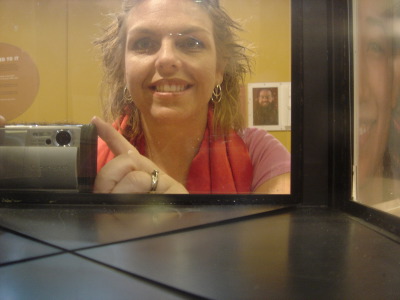
DSC03848071520080001.jpg

The other shows you what other people see every day. It shows you what you really look like.

Do you see a minute difference between the top photo and the bottom photo?

I've been fascinated by my own emotional reaction. Truly, it was unsettling to see my reflection differently than I do everyday.

The top photo, what I see in the mirror is more attractive to me.

My eyes are uneven in the second photo. The right eye, when looking at it, is slightly lower than the left one.

I find I hold my head slightly tilted in a way that makes my features more even. I think I also hold that eyebrow higher to make the eyes look more symmetrical. I compensate for the flaw I've really only noticed once in a photo when I was pregnant with Zack.

Since you are other people and it's not your face I really have no clue how you are perceiving the attractiveness of the two photos or whether you see the unevenness of my eyes at all. For all I know, everyone who sees me, may choose to make the same correction that I do for myself.

It strikes me as a kindness to myself that my subconscious mind chooses to correct my minor flaw so that I not only feel more attractive, but literally see myself as more attractive.

It also strikes me that people who suffer from eating disorders, like anorexia and bulimia or the emotional disorder of body dysmorphia for some reason they aren't subconsciously fixing their features in their minds.

They are not only seeing their minor flaw - they are focusing on it and magnifying it.

Its also likely they are expecting the outside world, other people, to treat them the way they treat themselves. Did you see how I assumed that others would treat me with the same kindness as I show myself and that others would correct or overlook the minor flaw in their own perceptions, rather than focus on it and magnify it? This assumption is likely a result of my habit of doing such a kindness for myself and for others.

Were I unkind to myself, and if I made a habit of focusing on the minor flaws of other people, I would likely assume that others were also doing so to me.

That's my theory anyway, based on everything I've read about self-esteem, self-worth, and eating disorders and related emotional disorders.

It follows then that maybe we can teach our daughters to serve their own mental health and self-esteem.

Cutting ourselves, our daughters and others some slack for our minor physical flaws teaches, by example, our daughters this emotional skill vital to their self-preservation.

Treating ourselves, our daughters, and others - especially other girls and women - with kindness is also a teachable habit.

Self-love and self-acceptance is a skill. One we learn and one we can teach.

Thursday, August 14, 2008

10 Antidotes to Self-Objectification & Sexualization of Girls

1web20080807_0012.jpg

Yesterday, we discussed Self-Objectification and Low Self-Esteem.

I loath problems without solutions and complaints that make us feel powerless. So, here's a list of 10 Antidotes to Self-Objectification and Sexualization of Girls.

* Media Literacy - talk to girls about the images they see. Point it out when there is obvious digital retouching like in Keira Knightly Stands Up for Her Girls and Yours.
Watch Dove's Onslaught campaign with her and discuss it. If it's age-appropriate take her to the Natural Breast Gallery and talk about how different the images of women in media are than the bodies of real women. Tell her about Photoshop and discuss the motives of the media to sell products by misrepresenting women's bodies.

* Athletics - A focus on the body that is nonsexual, athletics focuses on competency, agency and action. As participation in sports increases, participation in risky sexual-activity decreases. Taekwondo and soccer are good choices. The report sites cheerleading and dance as less empowering types of athletics due to the focus on appearance, sexiness, and thinness.

* Extracurricular Activities - Girl Scouts, band, after-school programs like Girls Inc., drama club, band, computer or video gaming clubs give girls an alternative to activities that focus on their appearance.

* Comprehensive Sexuality Education - "A central way to help youth counteract distorted views presented by the media and culture about girls, sex and the sexualization of girls is comprehensive sex education. Programs must include accurate information about reproduction and contraception, the importance of delaying intercourse initiation for young people, and the building of communication skills, and promotes a notion of sexual responsibility that includes respect for oneself and an emphasis on consensual, non-exploitative sexual activity."

* Co-Viewing Media with Parents - Parental comment on media children are exposed to is key to altering the influence of the messages. Watch TV with girls and comment on the messages. Contradict stereo-typical behavior when you see it, share your insights on advertising and media. Co-viewing also reduces the amount of inappropriate material children see.

* Religion, Spirituality and Meditation - organized religious and other ethical instruction actively combat the values conveyed by popular culture. When parents teach girls they are "more than their bodies" girls benefit. Talk to your kids about your idea of her whole self, and that "who they are" makes them valuable outside of their sexuality or gender roles. Insisting that girls remain girls and not be pushed into a precocious sexuality is something many churches do. Encourage meditation, yoga, tai chi, and prayer to teach girls to get in touch with their bodies and themselves as spiritual beings.

* Activism by Parents and Families - encourage girls to become their own activists by being one yourself. Join Campaign for a Commercial-Free Childhood to fight sexualizing and objectifying messages in marketing. Get involved in The Geena Davis Institute on Gender in Media. Take your daughter to a Dove BodyTalk, Campaign for Real Beauty Self Esteem Workshop. Sign your daughter up for the Girl Scouts Uniquely Me program.

* Alternative Media - Cancel the Tiger Beat subscription and subscribe to Girl Zone. Get your daughter involved in writing or producing her own media - a website or blog is simple enough. Stone Soup is a literary magazine written by children. Write your daughter a book about her. Most digital photography websites like Mypublisher.com will allow you to publish a storybook about your daughter, using images of her, in a beautiful hardbound book for $30. Throw out the Disney Princess books and videos and get some empowering alternatives like Princess Bubble.

* Confront Your Body Issues - If you, the mother, have a history of self-objectification or poor body image confront it and deal with it before you pass it down. Refuse to self-deprecate or equate your own value to how thin you are or how you look.

* Be The Empowered Woman - If you find yourself buying into gender-stereotypes in your own life, being too passive, not saying "no", holding yourself to an impossible standard of perfection, running yourself ragged to be everything to everyone - Stop It. She will emulate you. A mother who radiates self-love and self-acceptance vaccinates her daughter against a low self-esteem, said Naomi Wolf.

Compiled from the APA Report on Sexualization of Girls and articles originally published on Empowering Girls: So Sioux Me.

Please subscribe to Empowering Girls: So Sioux Me via RSS or Email in the top-right corner.

Wednesday, August 13, 2008

Self-Objectification and Low Self-Esteem

1web20080807_0014.jpg

We all know how objectification works, some men see women as an object for their sexual pleasure.

But, what happens when girls and women begin to see themselves as an object for men's sexual pleasure?

The Association for the American Psychological Association
(APA) calls this self-objectification and/or self-sexualization in the Report of the APA Task Force on the Sexualization of Girls.

There's a host of evidence that when girls are exposed to too much media that they begin to view themselves less as three dimensional human beings and more as sexual objects. When this occurs, psychologists note the increase of:

* eating disorders

* low self-esteem

* depression or depressed mood

One interesting study noted that teenage girls from Figi had great body image and self esteem - until they were exposed to Western television. Once exposed, they became preoccupied with weight and body shape, purging behavior (throwing up) and body disparagement. Prior to television the Figian culture emphasized a robust body shape and based notions of identity not on body, but on family, community and relationships. The transition between healthy self-image to the increase of eating disorders was only 3 years.

Self-objectification is also directly linked to "diminished sexual health" among adolescent girls. One study found that when girls viewed their own bodies as objects for male pleasure condom use and sexual assertiveness, (saying "no") decreased.

Another study found that "undergraduate women who frequently watched music videos or read women's magazines, who attribute greater realism to media content, or who identify strongly with popular TV characters were also more accepting of sexually objectifying notions of women."

Accepting these sexually stereotypical and objectifying views manifested in negative attitudes toward breastfeeding and negative attitudes about normal body functions like menstruation and sweating.

When I read the APA's definition of self-objectification and self-sexualization it was like a mini-awakening for me.

That explains why, as a teen and young adult, I allowed boyfriends to treat me as their sexual object or plaything. It explains why I crossed many of my own sexual boundaries and didn't want to object "for fear of being rude" on several occasions. It explains why I allowed boys and men to make inappropriate comments about my body and its development from even the earliest age - heck, I didn't even know was "allowed to object."

Do you think you've ever self-sexualized or self-objectified?

Do you worry about this with your daughter?

Read 10 Antidotes to Self-Objectification and Sexualization of Girls for ways to prevent your daughter from objectifying her own body.

Empowering Girls: Marketing Boundaries

APA Reports Sexualization of Girls Devastating
Taekwondo For Girl Power

Saturday, August 9, 2008

It Chick Clothes Photo Contest

B1C5196E-157F-40DA-B713-DA248F8D6612.jpgIt Chick Clothes, an online plus-size clothing store for tween girls, is launching a photo essay contest for young girls, asking them to submit photos that illustrate what it means to be a Tween Girl in America right now.
It Chick Clothes, as a company, believe that girls cannot be labeled or pigeonholed.
They're not just athletes, just pretty, just smart, or just students.
They are a tapestry, and we believe that these girls are the best people to tell us who they are.
They're're giving away a Wii Fit game to the winner.
In addition, they will post the top five entries and the accompanying text on their site at www.itchickclothes.com. The contest is open from August 1st to September 30th.
As part of this contest, they're giving away 10% of back-to-school sales (sales in the months of August and September) to Girls Inc., a national nonprofit dedicated to inspiring all girls to be stong, smart and bold. So enter the contest and shop !
See contest rules here.

Photo Source: It Chick Clothes

Wednesday, January 30, 2008

Super Skinny Me

Tune your DVR to watch Super Skinny Me on the BBC on Sunday at 10 pm to get the truth about what it costs to be a size 0.

Two British journalists, who had never dieted before vowed to lose 6 sizes in 6 weeks.

two average-size British journalists, Louise Burke and Kate Spicer, agree to a radical experiment -- drop five dress sizes in just five weeks. The journalists reported spiraling into depression and feeling worse than they've ever felt in their lives, according to this ABC News story.

It would not be a bad idea to watch this documentary with your daughter and use the opportunity to talk to her about body issues. Unless she lives under a rock, she's not oblivious to the pressure to be thin. Certainly, my six-year-old hasn't missed the message.

Take this opportunity to talk to her about the dangers of eating disorders and the necessity of nutrition. Talk to her about media messages and the size of super models versus normal women.

(Depending on the age of your child you may want to screen the film first to be sure there's nothing completely inappropriate.)

Tuesday, January 8, 2008

How To Look Good Naked


by Tracee Sioux

Did you catch the premier episode of Lifetime's How to Look Good Naked?

I think there is enough evidence that body image is, at least partly, emotionally-inherited.

When mothers feel bad about their bodies, daughters are more likely to feel bad about their bodies. (There are always exceptions, of course.)

Nothing is going to change the fact, however, that mothers being critical about our bodies puts daughters in a more vulnerable position self-image-wise.

How is a daughter to stand up to the onslaught of negative messages about a normal woman's body in this highly sexualized and beauty-conscious culture, if Mom can't learn to love her own body and cut herself some slack?

The problem is self-perpetuating. Mom criticizes self, daughter criticizes self and grows up to become mom who criticizes self.

Women need to get proactive about their own self esteem. It takes work to develop and maintain a self esteem. We need to be honest that self-loathing internal chatter is getting us no where.

Enter metro-homosexual Carson Kressly to help us solve our self-esteem issues. Whatever it takes, right?

I was very pleased with the first episode of How to Look Good Naked. While this appears to be a make-over show it is about making over a woman's insides - her self image. Let's face it, women, as a collective-conscious seem to need an internal self image makeover. A lot of us feel like crap about ourselves and that has a negative impact on our daughter's self image and self esteem.

One particular exercise was brilliant. Three women were shown on a monitor walking down the street. One was dressed in a slouchy over-sized sweater, one was in a boring office outfit and another was in a confident, sexy dress. The woman with poor body image was asked to identify the one that weighed most. She chose the one wearing over-sized clothing. What was revealed was that they were all the same woman. It was only her clothing - screaming about her confidence level - that made others think she was the most overweight.

While this is only a television program, it does seem logical to me that we might expect a cultural cure to a cultural problem. In other words, if we can feel better about ourselves while watching such a program - then we should watch it and implement some of the feel-good psychology suggested.

When we feel good about who we are and what we look like - well that translates into a health self image for our daughters. Which, to my mind, is totally worth the effort.

Showing posts with label body image self esteem. Show all posts

Wednesday, November 19, 2008

Body Competence vs. Body Talk

9F2C354C-2A2B-4FEF-A42A-D6823EA70A39.jpg (photo courtesy: Shaping Youth)

The more I use my body the better I feel about it. The less active I am, the worse I feel about my body. There is a definite cause and effect relationship. My feelings follow my actions.

hike1.jpg

No matter how much time I spend talking about loving my body or telling my daughter to love hers, all the talk in the world won't do as half as much as getting up and taking a hike, learning to run or mastering yoga and insisting my daughter to do the same.

82501D51-FD43-4AF1-8485-FC4D44D551F1.jpg(Photo courtesy: Mims Muddle)

What we usually value about the bodies of boys is competence and skill. Competence in athletics and things they can DO with their bodies. This probably explains why so fewer boys have body image issues that escalate to self-destruction - because their bodies are useful.

B64A6B7E-AF6D-4859-B241-0CBDF1BDE2FE.jpg

It occurs to me that the more opportunities we present to encourage our daughters to use their bodies competently the higher their self-esteem and body image will be.

4F4B797A-A479-4C07-BB9C-559F007E0540.jpg(Photo courtesy: Confessions of an It Girl)

Friday, September 12, 2008

Pro-Girl Book Part 3

pg1 3.jpeg

pg1 5.jpeg

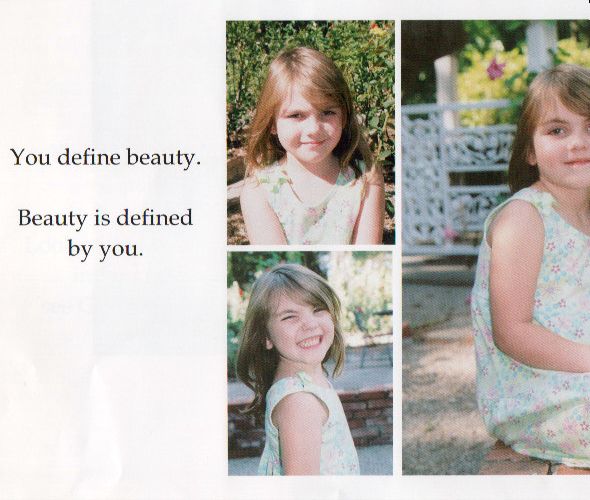
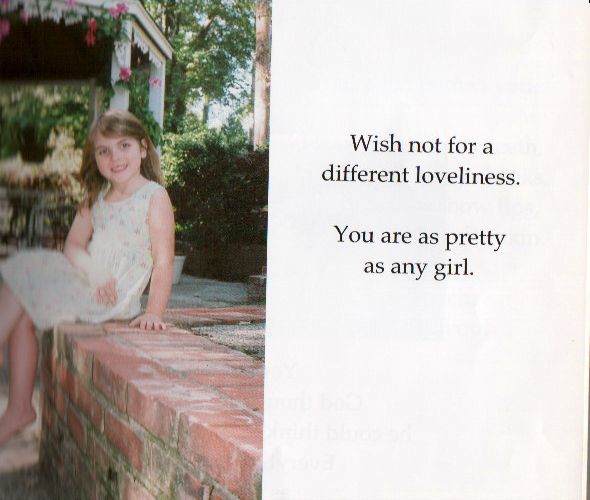
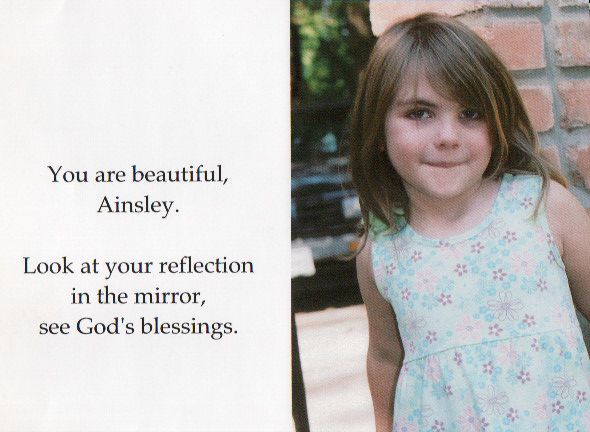
Pages from Ainsley, Perfect You, a book I wrote for my daughter. Steal this idea for Christmas, Please!

Subscribe to my RSS feed and/or email subscription. You don't miss the rest of this series.

Thursday, September 11, 2008

Pro-Girl Book Part 2

pg1 1.jpeg

pg1 2.jpeg

Pages from Ainsley, Perfect You, a book I wrote for my daughter. Steal this idea for Christmas, Please!

Subscribe to my RSS feed and/or email subscription. You don't miss the rest of this series.

Wednesday, September 3, 2008

Face Off - Self Esteem vs. Body Dysmorphia

We went to the Exploratorium in San Francisco.

One particular exhibit had a disconcerting effect on me for days.

You sit in between two mirrors and look at your self.


DSC03846071520080002.jpg

One is a regular mirror and show's you how you see yourself every day. The top photo is how I see myself.

DSC03848071520080001.jpg

The other shows you what other people see every day. It shows you what you really look like.

Do you see a minute difference between the top photo and the bottom photo?

I've been fascinated by my own emotional reaction. Truly, it was unsettling to see my reflection differently than I do everyday.

The top photo, what I see in the mirror is more attractive to me.

My eyes are uneven in the second photo. The right eye, when looking at it, is slightly lower than the left one.

I find I hold my head slightly tilted in a way that makes my features more even. I think I also hold that eyebrow higher to make the eyes look more symmetrical. I compensate for the flaw I've really only noticed once in a photo when I was pregnant with Zack.

Since you are other people and it's not your face I really have no clue how you are perceiving the attractiveness of the two photos or whether you see the unevenness of my eyes at all. For all I know, everyone who sees me, may choose to make the same correction that I do for myself.

It strikes me as a kindness to myself that my subconscious mind chooses to correct my minor flaw so that I not only feel more attractive, but literally see myself as more attractive.

It also strikes me that people who suffer from eating disorders, like anorexia and bulimia or the emotional disorder of body dysmorphia for some reason they aren't subconsciously fixing their features in their minds.

They are not only seeing their minor flaw - they are focusing on it and magnifying it.

Its also likely they are expecting the outside world, other people, to treat them the way they treat themselves. Did you see how I assumed that others would treat me with the same kindness as I show myself and that others would correct or overlook the minor flaw in their own perceptions, rather than focus on it and magnify it? This assumption is likely a result of my habit of doing such a kindness for myself and for others.

Were I unkind to myself, and if I made a habit of focusing on the minor flaws of other people, I would likely assume that others were also doing so to me.

That's my theory anyway, based on everything I've read about self-esteem, self-worth, and eating disorders and related emotional disorders.

It follows then that maybe we can teach our daughters to serve their own mental health and self-esteem.

Cutting ourselves, our daughters and others some slack for our minor physical flaws teaches, by example, our daughters this emotional skill vital to their self-preservation.

Treating ourselves, our daughters, and others - especially other girls and women - with kindness is also a teachable habit.

Self-love and self-acceptance is a skill. One we learn and one we can teach.

Thursday, August 14, 2008

10 Antidotes to Self-Objectification & Sexualization of Girls

1web20080807_0012.jpg

Yesterday, we discussed Self-Objectification and Low Self-Esteem.

I loath problems without solutions and complaints that make us feel powerless. So, here's a list of 10 Antidotes to Self-Objectification and Sexualization of Girls.

* Media Literacy - talk to girls about the images they see. Point it out when there is obvious digital retouching like in Keira Knightly Stands Up for Her Girls and Yours.
Watch Dove's Onslaught campaign with her and discuss it. If it's age-appropriate take her to the Natural Breast Gallery and talk about how different the images of women in media are than the bodies of real women. Tell her about Photoshop and discuss the motives of the media to sell products by misrepresenting women's bodies.

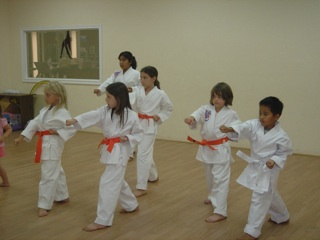
* Athletics - A focus on the body that is nonsexual, athletics focuses on competency, agency and action. As participation in sports increases, participation in risky sexual-activity decreases. Taekwondo and soccer are good choices. The report sites cheerleading and dance as less empowering types of athletics due to the focus on appearance, sexiness, and thinness.

* Extracurricular Activities - Girl Scouts, band, after-school programs like Girls Inc., drama club, band, computer or video gaming clubs give girls an alternative to activities that focus on their appearance.

* Comprehensive Sexuality Education - "A central way to help youth counteract distorted views presented by the media and culture about girls, sex and the sexualization of girls is comprehensive sex education. Programs must include accurate information about reproduction and contraception, the importance of delaying intercourse initiation for young people, and the building of communication skills, and promotes a notion of sexual responsibility that includes respect for oneself and an emphasis on consensual, non-exploitative sexual activity."

* Co-Viewing Media with Parents - Parental comment on media children are exposed to is key to altering the influence of the messages. Watch TV with girls and comment on the messages. Contradict stereo-typical behavior when you see it, share your insights on advertising and media. Co-viewing also reduces the amount of inappropriate material children see.

* Religion, Spirituality and Meditation - organized religious and other ethical instruction actively combat the values conveyed by popular culture. When parents teach girls they are "more than their bodies" girls benefit. Talk to your kids about your idea of her whole self, and that "who they are" makes them valuable outside of their sexuality or gender roles. Insisting that girls remain girls and not be pushed into a precocious sexuality is something many churches do. Encourage meditation, yoga, tai chi, and prayer to teach girls to get in touch with their bodies and themselves as spiritual beings.

* Activism by Parents and Families - encourage girls to become their own activists by being one yourself. Join Campaign for a Commercial-Free Childhood to fight sexualizing and objectifying messages in marketing. Get involved in The Geena Davis Institute on Gender in Media. Take your daughter to a Dove BodyTalk, Campaign for Real Beauty Self Esteem Workshop. Sign your daughter up for the Girl Scouts Uniquely Me program.

* Alternative Media - Cancel the Tiger Beat subscription and subscribe to Girl Zone. Get your daughter involved in writing or producing her own media - a website or blog is simple enough. Stone Soup is a literary magazine written by children. Write your daughter a book about her. Most digital photography websites like Mypublisher.com will allow you to publish a storybook about your daughter, using images of her, in a beautiful hardbound book for $30. Throw out the Disney Princess books and videos and get some empowering alternatives like Princess Bubble.

* Confront Your Body Issues - If you, the mother, have a history of self-objectification or poor body image confront it and deal with it before you pass it down. Refuse to self-deprecate or equate your own value to how thin you are or how you look.

* Be The Empowered Woman - If you find yourself buying into gender-stereotypes in your own life, being too passive, not saying "no", holding yourself to an impossible standard of perfection, running yourself ragged to be everything to everyone - Stop It. She will emulate you. A mother who radiates self-love and self-acceptance vaccinates her daughter against a low self-esteem, said Naomi Wolf.

Compiled from the APA Report on Sexualization of Girls and articles originally published on Empowering Girls: So Sioux Me.

Please subscribe to Empowering Girls: So Sioux Me via RSS or Email in the top-right corner.

Wednesday, August 13, 2008

Self-Objectification and Low Self-Esteem

1web20080807_0014.jpg

We all know how objectification works, some men see women as an object for their sexual pleasure.

But, what happens when girls and women begin to see themselves as an object for men's sexual pleasure?

The Association for the American Psychological Association
(APA) calls this self-objectification and/or self-sexualization in the Report of the APA Task Force on the Sexualization of Girls.

There's a host of evidence that when girls are exposed to too much media that they begin to view themselves less as three dimensional human beings and more as sexual objects. When this occurs, psychologists note the increase of:

* eating disorders

* low self-esteem

* depression or depressed mood

One interesting study noted that teenage girls from Figi had great body image and self esteem - until they were exposed to Western television. Once exposed, they became preoccupied with weight and body shape, purging behavior (throwing up) and body disparagement. Prior to television the Figian culture emphasized a robust body shape and based notions of identity not on body, but on family, community and relationships. The transition between healthy self-image to the increase of eating disorders was only 3 years.

Self-objectification is also directly linked to "diminished sexual health" among adolescent girls. One study found that when girls viewed their own bodies as objects for male pleasure condom use and sexual assertiveness, (saying "no") decreased.

Another study found that "undergraduate women who frequently watched music videos or read women's magazines, who attribute greater realism to media content, or who identify strongly with popular TV characters were also more accepting of sexually objectifying notions of women."

Accepting these sexually stereotypical and objectifying views manifested in negative attitudes toward breastfeeding and negative attitudes about normal body functions like menstruation and sweating.

When I read the APA's definition of self-objectification and self-sexualization it was like a mini-awakening for me.

That explains why, as a teen and young adult, I allowed boyfriends to treat me as their sexual object or plaything. It explains why I crossed many of my own sexual boundaries and didn't want to object "for fear of being rude" on several occasions. It explains why I allowed boys and men to make inappropriate comments about my body and its development from even the earliest age - heck, I didn't even know was "allowed to object."

Do you think you've ever self-sexualized or self-objectified?

Do you worry about this with your daughter?

Read 10 Antidotes to Self-Objectification and Sexualization of Girls for ways to prevent your daughter from objectifying her own body.

Empowering Girls: Marketing Boundaries

APA Reports Sexualization of Girls Devastating
Taekwondo For Girl Power

Saturday, August 9, 2008

It Chick Clothes Photo Contest

B1C5196E-157F-40DA-B713-DA248F8D6612.jpgIt Chick Clothes, an online plus-size clothing store for tween girls, is launching a photo essay contest for young girls, asking them to submit photos that illustrate what it means to be a Tween Girl in America right now.
It Chick Clothes, as a company, believe that girls cannot be labeled or pigeonholed.
They're not just athletes, just pretty, just smart, or just students.
They are a tapestry, and we believe that these girls are the best people to tell us who they are.
They're're giving away a Wii Fit game to the winner.
In addition, they will post the top five entries and the accompanying text on their site at www.itchickclothes.com. The contest is open from August 1st to September 30th.
As part of this contest, they're giving away 10% of back-to-school sales (sales in the months of August and September) to Girls Inc., a national nonprofit dedicated to inspiring all girls to be stong, smart and bold. So enter the contest and shop !
See contest rules here.

Photo Source: It Chick Clothes

Wednesday, April 30, 2008

Empowering Girls: I Love My Body & I'm Not Perfect

Wednesday, January 30, 2008

Super Skinny Me

Tune your DVR to watch Super Skinny Me on the BBC on Sunday at 10 pm to get the truth about what it costs to be a size 0.

Two British journalists, who had never dieted before vowed to lose 6 sizes in 6 weeks.

two average-size British journalists, Louise Burke and Kate Spicer, agree to a radical experiment -- drop five dress sizes in just five weeks. The journalists reported spiraling into depression and feeling worse than they've ever felt in their lives, according to this ABC News story.

It would not be a bad idea to watch this documentary with your daughter and use the opportunity to talk to her about body issues. Unless she lives under a rock, she's not oblivious to the pressure to be thin. Certainly, my six-year-old hasn't missed the message.

Take this opportunity to talk to her about the dangers of eating disorders and the necessity of nutrition. Talk to her about media messages and the size of super models versus normal women.

(Depending on the age of your child you may want to screen the film first to be sure there's nothing completely inappropriate.)

Tuesday, January 8, 2008

How To Look Good Naked


by Tracee Sioux

Did you catch the premier episode of Lifetime's How to Look Good Naked?

I think there is enough evidence that body image is, at least partly, emotionally-inherited.

When mothers feel bad about their bodies, daughters are more likely to feel bad about their bodies. (There are always exceptions, of course.)

Nothing is going to change the fact, however, that mothers being critical about our bodies puts daughters in a more vulnerable position self-image-wise.

How is a daughter to stand up to the onslaught of negative messages about a normal woman's body in this highly sexualized and beauty-conscious culture, if Mom can't learn to love her own body and cut herself some slack?

The problem is self-perpetuating. Mom criticizes self, daughter criticizes self and grows up to become mom who criticizes self.

Women need to get proactive about their own self esteem. It takes work to develop and maintain a self esteem. We need to be honest that self-loathing internal chatter is getting us no where.

Enter metro-homosexual Carson Kressly to help us solve our self-esteem issues. Whatever it takes, right?

I was very pleased with the first episode of How to Look Good Naked. While this appears to be a make-over show it is about making over a woman's insides - her self image. Let's face it, women, as a collective-conscious seem to need an internal self image makeover. A lot of us feel like crap about ourselves and that has a negative impact on our daughter's self image and self esteem.

One particular exercise was brilliant. Three women were shown on a monitor walking down the street. One was dressed in a slouchy over-sized sweater, one was in a boring office outfit and another was in a confident, sexy dress. The woman with poor body image was asked to identify the one that weighed most. She chose the one wearing over-sized clothing. What was revealed was that they were all the same woman. It was only her clothing - screaming about her confidence level - that made others think she was the most overweight.

While this is only a television program, it does seem logical to me that we might expect a cultural cure to a cultural problem. In other words, if we can feel better about ourselves while watching such a program - then we should watch it and implement some of the feel-good psychology suggested.

When we feel good about who we are and what we look like - well that translates into a health self image for our daughters. Which, to my mind, is totally worth the effort.