My blog has moved!

You should be automatically redirected in 5 seconds. If not, visit
http://thegirlrevolution.com
and update your bookmarks.

Showing posts with label beauty ideal. Show all posts

Monday, November 3, 2008

Last (Lovely) Glimpse of Halloween 2008

crystalgable1.JPG

crystal gable2.JPG

Bride of Frankenstein

cheetah.jpg

Cheetah

Ok, I'm no longer taking entries in the contest. I'll give you a few hours to leave comments voting on all the entries I published over the weekend and then I'll announce the winner of the Seagate Go Portable Hard Drive.

Quick jumps on these posts:

  • Real Girls' Costumes IV

  • Real Girls' Costumes V

  • Real Girls' Costumes III

  • Real Girls' Costumes II

  • Real Girls' Costumes

  • halloween 2008.jpg

    Here's a photo of us: We're Chinese. Picked them up in San Francisco's Chinatown this summer.

    halloween contest 1.jpg

    I also took a photo of the town's costume contest and here's what I can report.

    The little girls were not dressed provocatively or in an overtly sexual way.

    There were Princesses, Hannah Montanas, Super Womans, Gabriellas, and Charpeis, Cowgirls and Indians, etc. And while they were very "pretty" and "beautiful" and overtly "feminine" and "girly" - they were also modestly dressed.

    Pretty, beautiful and overtly feminine and girly do not equate to "sexy," "provocative," "slutty," "hootchy" or "sexual."

    I saw 2 very provocative costumes on older teenagers (their mothers were likely hiding at home in shame and horror) and one inappropriately short minidress on a mother who dragged that black velvet dress from her own adolescence, I'm sure. (I had one in the '90s too.)

    I realize my small East Texas town isn't indicative of the whole of America so I'm curious - did you see inappropriately dressed little girls? What about them struck you as inappropriate?

    Wednesday, September 10, 2008

    Steal This Christmas Gift Please!

    cover.jpg

    In everything we've been reading the damaging effects of media has been a central force.

    APA Report on Sexualization of Girls, Girls Inc.'s The Supergirl Dilemma, You're Amazing, Geena Davis Institute on Gender in Media all cite exposure to media as a central force in the girls beginning to define themselves as less than they truly are.

    While every one of these sources cite media as a potentially damaging influence, they also recommend fighting negative media with positive media.

    We have the power to - not just passively ban negative media, which we should definitely do - But we have the power to CREATE positive media for our daughters about girls.

    I can tell you this - my daughter thinks it's pretty cool that she's the Poster Girl for Empowering Girls: So Sioux Me. This is one of the reasons I'm inviting you to send photos of your daughter to be included as a Poster Girl on this site. It is one way to take media from outside of our world to a creative and positive medium that includes them.

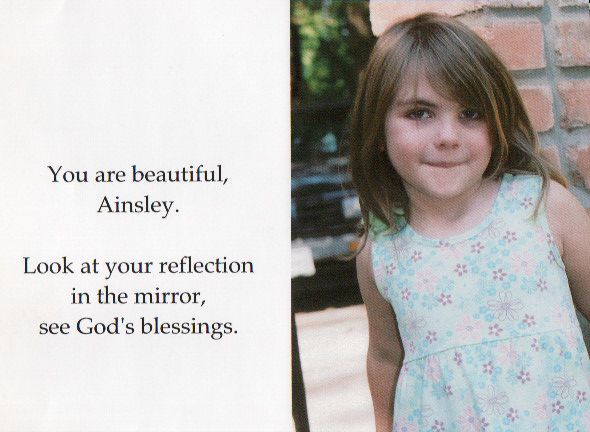
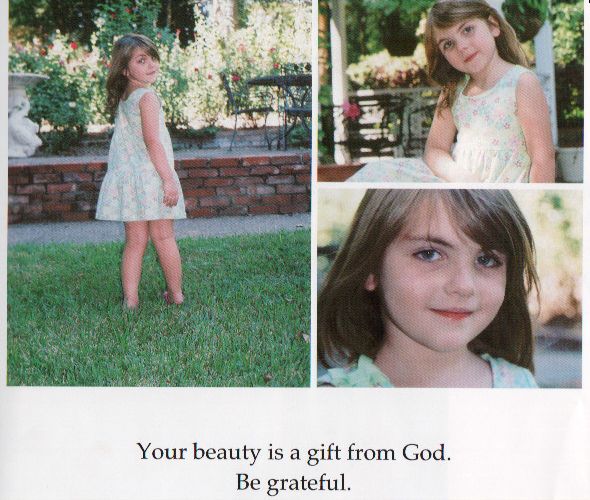
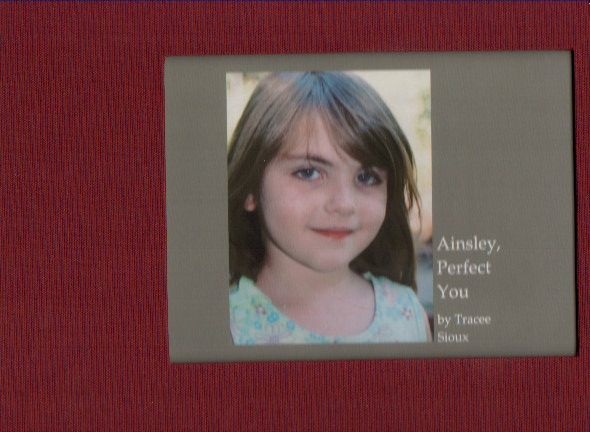
    I created a children's book for my daughter's 5th birthday titled Ainsley, Perfect You. I am practically begging you to STEAL this idea for Christmas (or birthdays).

    We read this book before the First Day of School, whenever Ainsley makes negative comments about her self, whenever she feels insecure or whenever she wants. It's a special book that sits out on a shelf and we must wash our hands before reading it.

    In the book I addressed issues of beauty, because Ainsley seemed preoccupied with what it was and exactly what criteria people were using to make the judgement about who was beautiful. I addressed school, education, intelligence and learning. I addressed self-worth and a feeling of wholeness and "enoughness." I addressed the meaning of God and her role as a Child of God. I addressed risk-taking and trying new things.

    Your family may prize different characteristics or place different values as a priority. What's important, is that you can use this tool to teach her who she is, but also influence, mold and raise or define the bar of expectation for who she will become.

    A-N-Y-O-N-E can do this if they have a computer, a camera, $30 and an imagination. You may be thinking you're short on imagination so, while Ainsley, Perfect You is copyrighted I give you permission to steal ideas, concepts, words, etc. Your daughter is every bit as cool as mine, but she may have different attributes and characteristics.

    I encourage you to use my book for ideas, but personalize them for your daughter(s). (Of course, its good for your daughter, but don't forget your sons.)

    I used www.MyPublisher.com because they were the only company who had a "storybook" feature at the time. Turns out my parents and grandparents were also interested in having a copy of this book (one project many gifts!) and My Publisher has coupons they'll send you frequently. Flickr now offers the feature, and Snapfish and probably all the other ones too.

    There are 20 pages so I'll run Ainsley, Perfect You as a series, starting with this foreword. I had to scan the pages, so please forgive the quality.


    foreword 2 rev.jpg

    You'll want to get the RSS feed or an email subscription so you don't miss any of it.

    Friday, August 22, 2008

    The Supergirl Dilemma, Girls Inc. Study

    girlsinc1.jpg

    I was waiting in the Drs. office with Ainsley analyzing a copy of Girls Inc.'s The Supergirl Dilemma. A report about what kind of stereotypes girls are still dealing with in today's world and the kinds of pressures it puts on them to measure up.

    Reading the answers to the survey I figured what I really wanted to know is how my own daughter will answer these questions. (Also, it distracted her from the incessant complaining about waiting, which was driving me bonkers.)

    So I read the quiz aloud to her:

    * People think that girls care a lot about shopping? True or False?

    True.

    Do you like that it's true?

    Yeah.

    * Girls are under a lot of pressure to dress the right way?

    True

    Do you like that it's true.

    Yeah.

    * People don't think girls are good leaders?

    False.

    * People think girls don't know how to take care of their own money?

    False

    * Teachers think it's not important for girls to be good at math?

    False.

    The next day, I heard Ainsley holding court with her friends:

    * People think that girls care a lot about shopping? True or False?

    Oh, that's True! That's so true!

    Do you like that it's true?

    Yeah, I guess so.

    What I learned about Ainsley, and her friends, is that she's pretty typical. In spite of all my going on about empowering girls she's a typical American girl.

    We're making progress in major areas like math and science and money and leadership, according to the report.

    Simultaneously, girls are feeling MORE pressure to look perfect and behave perfect and be good at everything.

    The areas where it seemed we're not making as much progress are areas where the issues become complex and nuanced.

    Questions like, Getting married and having children is the most important thing.
    Well, what's so wrong with marriage and children? We wanted to know? Nothing. It's the "most important thing" part that throws the question off.

    As a married woman I would put my family (husband and children) as my "most important thing" even though my career is pretty dang important. But then her father would answer the same way.

    Ainsley knows that.

    The question throws us both off kilter. What's progress? That it becomes not the most important thing? Or that she's not supposed to think it's the most important thing when she's 6 or 16?

    It's a core value, is it not? One we don't necessarily want to outright discard.

    I think a more informative question, for me, is whether it's still the ONLY thing that's important.

    To which, hopefully my daughter would say no. While my mother and grandmother would say yes. While I say, Intellectually I know it's not, but it's a serious challenge for me to fight the SAHM social gravity & guilt that sucks me in, especially when I talk to my mother. But, I'm working on it.

    That's the kind of generational gender progress I'm looking to achieve.

    Other questions that throw us off kilter are about the ones about being kind and caring.

    Ideally, we're teaching all our kids to be kind and caring and we're bringing the boys UP to the level we expect from girls. Not the other way around.

    If you answer false to the question it feels like you're saying you want girls to be mean and uncaring. Which we know isn't what we want.

    Girls should speak softly and not cause trouble is another question my daughter and I felt conflicted about.

    No they shouldn't have to speak softly all the time. I don't. She doesn't. A little more soft-talking and a little less yelling wouldn't kill either one of us.

    But no one should "cause trouble", is how we both felt like answering.

    I get the question - because I have 2 decades of feminist theory behind me and I've been told I'm "causing trouble" for verbalizing the same concerns any man would have plenty of times - but the question shouldn't be designed for me.

    They're designed for children who get their name and a check on the board for "causing trouble." One major focus of childhood is to devise ways to stay out of trouble, find your way out of trouble you've gotten into, or to push the envelope just enough to stay out of major trouble.

    Basically I thought the implications of the question was out of context for children.

    That said, I found the study enlightening. It tied together a pervasive feminine theme that needs to be stamped out immediately.

    Find out what the theme is in Monday's post.
    Subscribe to my RSS feed, or go up top and get an email subscription - because you don't want to miss it.

    Wednesday, August 13, 2008

    Self-Objectification and Low Self-Esteem

    1web20080807_0014.jpg

    We all know how objectification works, some men see women as an object for their sexual pleasure.

    But, what happens when girls and women begin to see themselves as an object for men's sexual pleasure?

    The Association for the American Psychological Association
    (APA) calls this self-objectification and/or self-sexualization in the Report of the APA Task Force on the Sexualization of Girls.

    There's a host of evidence that when girls are exposed to too much media that they begin to view themselves less as three dimensional human beings and more as sexual objects. When this occurs, psychologists note the increase of:

    * eating disorders

    * low self-esteem

    * depression or depressed mood

    One interesting study noted that teenage girls from Figi had great body image and self esteem - until they were exposed to Western television. Once exposed, they became preoccupied with weight and body shape, purging behavior (throwing up) and body disparagement. Prior to television the Figian culture emphasized a robust body shape and based notions of identity not on body, but on family, community and relationships. The transition between healthy self-image to the increase of eating disorders was only 3 years.

    Self-objectification is also directly linked to "diminished sexual health" among adolescent girls. One study found that when girls viewed their own bodies as objects for male pleasure condom use and sexual assertiveness, (saying "no") decreased.

    Another study found that "undergraduate women who frequently watched music videos or read women's magazines, who attribute greater realism to media content, or who identify strongly with popular TV characters were also more accepting of sexually objectifying notions of women."

    Accepting these sexually stereotypical and objectifying views manifested in negative attitudes toward breastfeeding and negative attitudes about normal body functions like menstruation and sweating.

    When I read the APA's definition of self-objectification and self-sexualization it was like a mini-awakening for me.

    That explains why, as a teen and young adult, I allowed boyfriends to treat me as their sexual object or plaything. It explains why I crossed many of my own sexual boundaries and didn't want to object "for fear of being rude" on several occasions. It explains why I allowed boys and men to make inappropriate comments about my body and its development from even the earliest age - heck, I didn't even know was "allowed to object."

    Do you think you've ever self-sexualized or self-objectified?

    Do you worry about this with your daughter?

    Read 10 Antidotes to Self-Objectification and Sexualization of Girls for ways to prevent your daughter from objectifying her own body.

    Empowering Girls: Marketing Boundaries

    APA Reports Sexualization of Girls Devastating
    Taekwondo For Girl Power

    Wednesday, July 30, 2008

    Keira Knightly Stands Up For Her Girls & Yours

    7677E71D-523D-4AF9-BA99-0A491B5D8281.jpgKeira Knightly is taking a stand against digitally enhancing her breasts for her upcoming movie, "The Dutchess."


    When she stands up and declares herself "good enough" as she is, she stands up and declares our daughters "good enough" as they are.


    Every actress who resists media pressure to conform to the beauty ideal does all girls and women a favor.


    "She has insisted that her figure stay in its natural state," an insider said. "She is proud of her body and doesn't want it altered."This according to the Daily Mail via The Huffington Post.


    Bravo Keira! You are good enough!


    Photo Source: The Huffington Post, photos of before and after digital alteration for "King Arthur."

    Wednesday, December 5, 2007

    Dove Reality Diaries


    by Tracee Sioux

    More and more I'm coming into contact with teenage girls and young women who meet the beauty ideal - 100 lbs, blond highlights, blue eyed, clear skin, fantastic fashion sense - and discovering their self-esteem is as low as anyones.

    Even those who meet the beauty ideal don't understand why I have a blank mystified stare when they tell me how they aren't pretty enough.

    What I'm thinking is, If YOU don't measure up then no one does.

    Which brings us to the core of the problem. No one does and no one can.

    The Dove Campaign for Real Beauty "aims to widen the definition of beauty and inspire positive self-image among women – in short, to help more women feel beautiful every day."

    Their newest venture in the cause to broaden beauty is the Reality Diaries.

    The press release states, "The Reality Diaries Program is a 6 week program that revolves around the lives of four real girls who share their personal self-esteem stories online. They record their journey online through the use of blogs and videos, allowing girls across the country to go behind-the-scenes on their real lives and understand the factors that impact their self-esteem. Each girl deals with a different self-esteem issue and the Diaries will reflect how the media influences their self-esteem."

    Each of the girls are 17 and seniors in high school. Each have different beauty pressures: Chelsea, the black pageant girl and becomes hyper-critical of every flaw to try to stamp it out before the other contestants single it out, Sydney; whose mother wants to fix her complex about her nose with a graduation gift of rhinoplasty, which only makes her feel worse; Jordan, who seems to meet the beauty standard but who picks herself apart because she fears the boys have unrealistically high standards she'll never meet; and Irene, the "pretty Asian girl" who overlooks racial slurs to gain social acceptance.

    The Reality Diaries is moderated by Jess, Doves Global Ambassador of Self Esteem, who, like the rest of us, doesn't measure up to today's beauty standards, but has a self esteem anyway.

    As a tool for girls the Reality Diaries will hopefully serve to make girls feel connected to other girls. Hopefully, they will realize how unrealistic the beauty ideal is and learn to have a positive self esteem regardless of cultural expectations.

    For parents and educators the Reality Diaries are a great opportunity to observe what girls are really thinking and feeling about themselves today.

    Showing posts with label beauty ideal. Show all posts
    Showing posts with label beauty ideal. Show all posts

    Monday, November 3, 2008

    Last (Lovely) Glimpse of Halloween 2008

    crystalgable1.JPG

    crystal gable2.JPG

    Bride of Frankenstein

    cheetah.jpg

    Cheetah

    Ok, I'm no longer taking entries in the contest. I'll give you a few hours to leave comments voting on all the entries I published over the weekend and then I'll announce the winner of the Seagate Go Portable Hard Drive.

    Quick jumps on these posts:

  • Real Girls' Costumes IV

  • Real Girls' Costumes V

  • Real Girls' Costumes III

  • Real Girls' Costumes II

  • Real Girls' Costumes

  • halloween 2008.jpg

    Here's a photo of us: We're Chinese. Picked them up in San Francisco's Chinatown this summer.

    halloween contest 1.jpg

    I also took a photo of the town's costume contest and here's what I can report.

    The little girls were not dressed provocatively or in an overtly sexual way.

    There were Princesses, Hannah Montanas, Super Womans, Gabriellas, and Charpeis, Cowgirls and Indians, etc. And while they were very "pretty" and "beautiful" and overtly "feminine" and "girly" - they were also modestly dressed.

    Pretty, beautiful and overtly feminine and girly do not equate to "sexy," "provocative," "slutty," "hootchy" or "sexual."

    I saw 2 very provocative costumes on older teenagers (their mothers were likely hiding at home in shame and horror) and one inappropriately short minidress on a mother who dragged that black velvet dress from her own adolescence, I'm sure. (I had one in the '90s too.)

    I realize my small East Texas town isn't indicative of the whole of America so I'm curious - did you see inappropriately dressed little girls? What about them struck you as inappropriate?

    Thursday, September 11, 2008

    Pro-Girl Book Part 2

    pg1 1.jpeg

    pg1 2.jpeg

    Pages from Ainsley, Perfect You, a book I wrote for my daughter. Steal this idea for Christmas, Please!

    Subscribe to my RSS feed and/or email subscription. You don't miss the rest of this series.

    Wednesday, September 10, 2008

    Steal This Christmas Gift Please!

    cover.jpg

    In everything we've been reading the damaging effects of media has been a central force.

    APA Report on Sexualization of Girls, Girls Inc.'s The Supergirl Dilemma, You're Amazing, Geena Davis Institute on Gender in Media all cite exposure to media as a central force in the girls beginning to define themselves as less than they truly are.

    While every one of these sources cite media as a potentially damaging influence, they also recommend fighting negative media with positive media.

    We have the power to - not just passively ban negative media, which we should definitely do - But we have the power to CREATE positive media for our daughters about girls.

    I can tell you this - my daughter thinks it's pretty cool that she's the Poster Girl for Empowering Girls: So Sioux Me. This is one of the reasons I'm inviting you to send photos of your daughter to be included as a Poster Girl on this site. It is one way to take media from outside of our world to a creative and positive medium that includes them.

    I created a children's book for my daughter's 5th birthday titled Ainsley, Perfect You. I am practically begging you to STEAL this idea for Christmas (or birthdays).

    We read this book before the First Day of School, whenever Ainsley makes negative comments about her self, whenever she feels insecure or whenever she wants. It's a special book that sits out on a shelf and we must wash our hands before reading it.

    In the book I addressed issues of beauty, because Ainsley seemed preoccupied with what it was and exactly what criteria people were using to make the judgement about who was beautiful. I addressed school, education, intelligence and learning. I addressed self-worth and a feeling of wholeness and "enoughness." I addressed the meaning of God and her role as a Child of God. I addressed risk-taking and trying new things.

    Your family may prize different characteristics or place different values as a priority. What's important, is that you can use this tool to teach her who she is, but also influence, mold and raise or define the bar of expectation for who she will become.

    A-N-Y-O-N-E can do this if they have a computer, a camera, $30 and an imagination. You may be thinking you're short on imagination so, while Ainsley, Perfect You is copyrighted I give you permission to steal ideas, concepts, words, etc. Your daughter is every bit as cool as mine, but she may have different attributes and characteristics.

    I encourage you to use my book for ideas, but personalize them for your daughter(s). (Of course, its good for your daughter, but don't forget your sons.)

    I used www.MyPublisher.com because they were the only company who had a "storybook" feature at the time. Turns out my parents and grandparents were also interested in having a copy of this book (one project many gifts!) and My Publisher has coupons they'll send you frequently. Flickr now offers the feature, and Snapfish and probably all the other ones too.

    There are 20 pages so I'll run Ainsley, Perfect You as a series, starting with this foreword. I had to scan the pages, so please forgive the quality.


    foreword 2 rev.jpg

    You'll want to get the RSS feed or an email subscription so you don't miss any of it.

    Friday, August 22, 2008

    The Supergirl Dilemma, Girls Inc. Study

    girlsinc1.jpg

    I was waiting in the Drs. office with Ainsley analyzing a copy of Girls Inc.'s The Supergirl Dilemma. A report about what kind of stereotypes girls are still dealing with in today's world and the kinds of pressures it puts on them to measure up.

    Reading the answers to the survey I figured what I really wanted to know is how my own daughter will answer these questions. (Also, it distracted her from the incessant complaining about waiting, which was driving me bonkers.)

    So I read the quiz aloud to her:

    * People think that girls care a lot about shopping? True or False?

    True.

    Do you like that it's true?

    Yeah.

    * Girls are under a lot of pressure to dress the right way?

    True

    Do you like that it's true.

    Yeah.

    * People don't think girls are good leaders?

    False.

    * People think girls don't know how to take care of their own money?

    False

    * Teachers think it's not important for girls to be good at math?

    False.

    The next day, I heard Ainsley holding court with her friends:

    * People think that girls care a lot about shopping? True or False?

    Oh, that's True! That's so true!

    Do you like that it's true?

    Yeah, I guess so.

    What I learned about Ainsley, and her friends, is that she's pretty typical. In spite of all my going on about empowering girls she's a typical American girl.

    We're making progress in major areas like math and science and money and leadership, according to the report.

    Simultaneously, girls are feeling MORE pressure to look perfect and behave perfect and be good at everything.

    The areas where it seemed we're not making as much progress are areas where the issues become complex and nuanced.

    Questions like, Getting married and having children is the most important thing.
    Well, what's so wrong with marriage and children? We wanted to know? Nothing. It's the "most important thing" part that throws the question off.

    As a married woman I would put my family (husband and children) as my "most important thing" even though my career is pretty dang important. But then her father would answer the same way.

    Ainsley knows that.

    The question throws us both off kilter. What's progress? That it becomes not the most important thing? Or that she's not supposed to think it's the most important thing when she's 6 or 16?

    It's a core value, is it not? One we don't necessarily want to outright discard.

    I think a more informative question, for me, is whether it's still the ONLY thing that's important.

    To which, hopefully my daughter would say no. While my mother and grandmother would say yes. While I say, Intellectually I know it's not, but it's a serious challenge for me to fight the SAHM social gravity & guilt that sucks me in, especially when I talk to my mother. But, I'm working on it.

    That's the kind of generational gender progress I'm looking to achieve.

    Other questions that throw us off kilter are about the ones about being kind and caring.

    Ideally, we're teaching all our kids to be kind and caring and we're bringing the boys UP to the level we expect from girls. Not the other way around.

    If you answer false to the question it feels like you're saying you want girls to be mean and uncaring. Which we know isn't what we want.

    Girls should speak softly and not cause trouble is another question my daughter and I felt conflicted about.

    No they shouldn't have to speak softly all the time. I don't. She doesn't. A little more soft-talking and a little less yelling wouldn't kill either one of us.

    But no one should "cause trouble", is how we both felt like answering.

    I get the question - because I have 2 decades of feminist theory behind me and I've been told I'm "causing trouble" for verbalizing the same concerns any man would have plenty of times - but the question shouldn't be designed for me.

    They're designed for children who get their name and a check on the board for "causing trouble." One major focus of childhood is to devise ways to stay out of trouble, find your way out of trouble you've gotten into, or to push the envelope just enough to stay out of major trouble.

    Basically I thought the implications of the question was out of context for children.

    That said, I found the study enlightening. It tied together a pervasive feminine theme that needs to be stamped out immediately.

    Find out what the theme is in Monday's post.
    Subscribe to my RSS feed, or go up top and get an email subscription - because you don't want to miss it.

    Wednesday, August 13, 2008

    Self-Objectification and Low Self-Esteem

    1web20080807_0014.jpg

    We all know how objectification works, some men see women as an object for their sexual pleasure.

    But, what happens when girls and women begin to see themselves as an object for men's sexual pleasure?

    The Association for the American Psychological Association
    (APA) calls this self-objectification and/or self-sexualization in the Report of the APA Task Force on the Sexualization of Girls.

    There's a host of evidence that when girls are exposed to too much media that they begin to view themselves less as three dimensional human beings and more as sexual objects. When this occurs, psychologists note the increase of:

    * eating disorders

    * low self-esteem

    * depression or depressed mood

    One interesting study noted that teenage girls from Figi had great body image and self esteem - until they were exposed to Western television. Once exposed, they became preoccupied with weight and body shape, purging behavior (throwing up) and body disparagement. Prior to television the Figian culture emphasized a robust body shape and based notions of identity not on body, but on family, community and relationships. The transition between healthy self-image to the increase of eating disorders was only 3 years.

    Self-objectification is also directly linked to "diminished sexual health" among adolescent girls. One study found that when girls viewed their own bodies as objects for male pleasure condom use and sexual assertiveness, (saying "no") decreased.

    Another study found that "undergraduate women who frequently watched music videos or read women's magazines, who attribute greater realism to media content, or who identify strongly with popular TV characters were also more accepting of sexually objectifying notions of women."

    Accepting these sexually stereotypical and objectifying views manifested in negative attitudes toward breastfeeding and negative attitudes about normal body functions like menstruation and sweating.

    When I read the APA's definition of self-objectification and self-sexualization it was like a mini-awakening for me.

    That explains why, as a teen and young adult, I allowed boyfriends to treat me as their sexual object or plaything. It explains why I crossed many of my own sexual boundaries and didn't want to object "for fear of being rude" on several occasions. It explains why I allowed boys and men to make inappropriate comments about my body and its development from even the earliest age - heck, I didn't even know was "allowed to object."

    Do you think you've ever self-sexualized or self-objectified?

    Do you worry about this with your daughter?

    Read 10 Antidotes to Self-Objectification and Sexualization of Girls for ways to prevent your daughter from objectifying her own body.

    Empowering Girls: Marketing Boundaries

    APA Reports Sexualization of Girls Devastating
    Taekwondo For Girl Power

    Wednesday, July 30, 2008

    Keira Knightly Stands Up For Her Girls & Yours

    7677E71D-523D-4AF9-BA99-0A491B5D8281.jpgKeira Knightly is taking a stand against digitally enhancing her breasts for her upcoming movie, "The Dutchess."


    When she stands up and declares herself "good enough" as she is, she stands up and declares our daughters "good enough" as they are.


    Every actress who resists media pressure to conform to the beauty ideal does all girls and women a favor.


    "She has insisted that her figure stay in its natural state," an insider said. "She is proud of her body and doesn't want it altered."This according to the Daily Mail via The Huffington Post.


    Bravo Keira! You are good enough!


    Photo Source: The Huffington Post, photos of before and after digital alteration for "King Arthur."

    Wednesday, December 5, 2007

    Dove Reality Diaries


    by Tracee Sioux

    More and more I'm coming into contact with teenage girls and young women who meet the beauty ideal - 100 lbs, blond highlights, blue eyed, clear skin, fantastic fashion sense - and discovering their self-esteem is as low as anyones.

    Even those who meet the beauty ideal don't understand why I have a blank mystified stare when they tell me how they aren't pretty enough.

    What I'm thinking is, If YOU don't measure up then no one does.

    Which brings us to the core of the problem. No one does and no one can.

    The Dove Campaign for Real Beauty "aims to widen the definition of beauty and inspire positive self-image among women – in short, to help more women feel beautiful every day."

    Their newest venture in the cause to broaden beauty is the Reality Diaries.

    The press release states, "The Reality Diaries Program is a 6 week program that revolves around the lives of four real girls who share their personal self-esteem stories online. They record their journey online through the use of blogs and videos, allowing girls across the country to go behind-the-scenes on their real lives and understand the factors that impact their self-esteem. Each girl deals with a different self-esteem issue and the Diaries will reflect how the media influences their self-esteem."

    Each of the girls are 17 and seniors in high school. Each have different beauty pressures: Chelsea, the black pageant girl and becomes hyper-critical of every flaw to try to stamp it out before the other contestants single it out, Sydney; whose mother wants to fix her complex about her nose with a graduation gift of rhinoplasty, which only makes her feel worse; Jordan, who seems to meet the beauty standard but who picks herself apart because she fears the boys have unrealistically high standards she'll never meet; and Irene, the "pretty Asian girl" who overlooks racial slurs to gain social acceptance.

    The Reality Diaries is moderated by Jess, Doves Global Ambassador of Self Esteem, who, like the rest of us, doesn't measure up to today's beauty standards, but has a self esteem anyway.

    As a tool for girls the Reality Diaries will hopefully serve to make girls feel connected to other girls. Hopefully, they will realize how unrealistic the beauty ideal is and learn to have a positive self esteem regardless of cultural expectations.

    For parents and educators the Reality Diaries are a great opportunity to observe what girls are really thinking and feeling about themselves today.