My blog has moved!

You should be automatically redirected in 5 seconds. If not, visit
http://thegirlrevolution.com
and update your bookmarks.

Showing posts with label body image. Show all posts

Wednesday, November 19, 2008

Body Competence vs. Body Talk

9F2C354C-2A2B-4FEF-A42A-D6823EA70A39.jpg (photo courtesy: Shaping Youth)

The more I use my body the better I feel about it. The less active I am, the worse I feel about my body. There is a definite cause and effect relationship. My feelings follow my actions.

hike1.jpg

No matter how much time I spend talking about loving my body or telling my daughter to love hers, all the talk in the world won't do as half as much as getting up and taking a hike, learning to run or mastering yoga and insisting my daughter to do the same.

82501D51-FD43-4AF1-8485-FC4D44D551F1.jpg(Photo courtesy: Mims Muddle)

What we usually value about the bodies of boys is competence and skill. Competence in athletics and things they can DO with their bodies. This probably explains why so fewer boys have body image issues that escalate to self-destruction - because their bodies are useful.

B64A6B7E-AF6D-4859-B241-0CBDF1BDE2FE.jpg

It occurs to me that the more opportunities we present to encourage our daughters to use their bodies competently the higher their self-esteem and body image will be.

4F4B797A-A479-4C07-BB9C-559F007E0540.jpg(Photo courtesy: Confessions of an It Girl)

Friday, September 12, 2008

Friday, September 5, 2008

I Hate Sarah Palin!

CB241601-4B3E-4E0F-9952-5226D1C20BB5.jpg

As an advocate for girls let me make the following plea on behalf of your daughter:

Please, please, please speak respectfully of the one and only female candidate the Repubican Party has ever put on their ticket for Vice President of the United States - Sarah Palin.

What you say about Sarah Palin has the potential to translate to your daughters as your opinion of all women (including your daughter) seeking power.

Disrespectful criticism has the potential to translate, "I only respect other women if they agree with me." Your daughter may one day disagree with you. This moment, and your reaction, won't be forgotten by her.

Your example will also teach her how she should expect to be treated by those who disagree with her and how she should treat those who disagree with her.

In other words -

Mothers - don't be a mean mommy and you won't create a mean girl.

Fathers - don't reduce her to whether you'd have sex with her and you won't create a daughter who gets her self-worth from her sexuality or appearance.

I vividly remember asking my parents what the Equal Rights Amendment was as a child. I remember them telling me that it was a bill to make women equal to men. And they were voting against it.

Here's how that translated to a six-year-old girl: "My parents are voting against ME! Why would they do that?"

I also remember criticism of Geraldine Ferraro that went something like, "We'll never elect a woman president. God wants it that way."

What you might say instead of "I Hate Sarah Palin" (or worse) might be, "I think a woman would make a wonderful Vice President, I just don't agree with this particular woman's political views on ________."

It would be helpful, for your daughter, to avoid vague negative statements about Sarah's suitability as a role model for girls. Instead you could say, "I think it's wonderful that a female has gotten this far in American politics. It's wonderful that women are becoming more powerful and ambitious in both parties. I just don't agree with her views on ________."

If you minimize and criticize the significance of Sarah Palin's presence in this race, then you minimize and criticize your daughter's potential.

It is my hope, as an advocate for girls, that they will never see another election in their lifetime where there is not a woman on either ticket.

Thanks to women's adamant support of Hillary Clinton and Sarah Palin both Republicans and Democrats have included women this year. Our top politicians have finally realized they can't win without addressing women and women's issues.

For our daughters' sakes, let's pray the inclusion of women - on all political levels and in all political parties - becomes the norm.

To be absolutely fair I made the same plea on behalf of Hillary and your daughter right before Super Tuesday. You can revisit that story in I Hate Hillary! I also advocated voting for Hillary for the sheer reason that she would be an example to my daughter of women in power for 4 years in Shut Up John Mayer, Stop Waiting For the World To Change.

For more on my personal opinion of Sarah Palin visit Blog Fabulous, I've written plenty about her politics and the emotional conflict she's causing in me personally.

Image Source: http://gov.state.ak.us/official_portraits.php


Wednesday, September 3, 2008

Face Off - Self Esteem vs. Body Dysmorphia

We went to the Exploratorium in San Francisco.

One particular exhibit had a disconcerting effect on me for days.

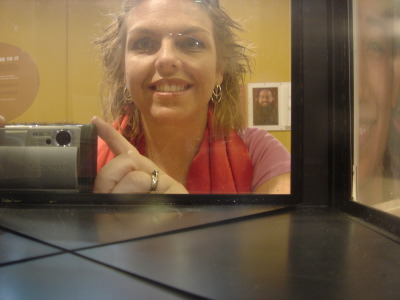
You sit in between two mirrors and look at your self.


DSC03846071520080002.jpg

One is a regular mirror and show's you how you see yourself every day. The top photo is how I see myself.

DSC03848071520080001.jpg

The other shows you what other people see every day. It shows you what you really look like.

Do you see a minute difference between the top photo and the bottom photo?

I've been fascinated by my own emotional reaction. Truly, it was unsettling to see my reflection differently than I do everyday.

The top photo, what I see in the mirror is more attractive to me.

My eyes are uneven in the second photo. The right eye, when looking at it, is slightly lower than the left one.

I find I hold my head slightly tilted in a way that makes my features more even. I think I also hold that eyebrow higher to make the eyes look more symmetrical. I compensate for the flaw I've really only noticed once in a photo when I was pregnant with Zack.

Since you are other people and it's not your face I really have no clue how you are perceiving the attractiveness of the two photos or whether you see the unevenness of my eyes at all. For all I know, everyone who sees me, may choose to make the same correction that I do for myself.

It strikes me as a kindness to myself that my subconscious mind chooses to correct my minor flaw so that I not only feel more attractive, but literally see myself as more attractive.

It also strikes me that people who suffer from eating disorders, like anorexia and bulimia or the emotional disorder of body dysmorphia for some reason they aren't subconsciously fixing their features in their minds.

They are not only seeing their minor flaw - they are focusing on it and magnifying it.

Its also likely they are expecting the outside world, other people, to treat them the way they treat themselves. Did you see how I assumed that others would treat me with the same kindness as I show myself and that others would correct or overlook the minor flaw in their own perceptions, rather than focus on it and magnify it? This assumption is likely a result of my habit of doing such a kindness for myself and for others.

Were I unkind to myself, and if I made a habit of focusing on the minor flaws of other people, I would likely assume that others were also doing so to me.

That's my theory anyway, based on everything I've read about self-esteem, self-worth, and eating disorders and related emotional disorders.

It follows then that maybe we can teach our daughters to serve their own mental health and self-esteem.

Cutting ourselves, our daughters and others some slack for our minor physical flaws teaches, by example, our daughters this emotional skill vital to their self-preservation.

Treating ourselves, our daughters, and others - especially other girls and women - with kindness is also a teachable habit.

Self-love and self-acceptance is a skill. One we learn and one we can teach.

Monday, September 1, 2008

Bikini Waxing Tweens & Early Puberty

B2962CC3-8CB8-4905-A154-A349918CBF6F.jpg

There was a story on MSNBC.com Today Show, Too young? Preteen girls get leg, bikini waxes, about how 20% of bikini wax customers at one Hollywood salon are tweens - pre-teen children.

"Nearly 20 percent of the clients that Nance Mitchell sees for bikini waxes in her Beverly Hills, Calif., salon are tweens, she says. . . 12 is the new normal."

"But nothing prepared her for being asked by one client to book a bikini wax appointment for her 8-year-old daughter."

{{{{{GASP}}}}}

Did you share my first reaction?

But, then I thought - wait, why is it the waxing that is making me gasp in shock?

Isn't it more alarming that 8 year olds have enough pubic hair to wax?

The sub head of the story is inaccurate: Moms are bringing daughters to spas for hair removal before puberty

The fact is that 50% of girls are getting their periods by age 10 and doctors now consider it within the "range of normal" for girls to develop outward signs of puberty, including breasts and pubic hair, by age 8. It's not that even medically alarming for 6 or 7 year olds to begin puberty, and many do begin developing breast buds or pubic hair.

Isn't it more emotionally alarming and worthy of a {{{{gasp}}}} that we're seeing a dramatic shift in girls' puberty development and no public health official is coming on the nightly news declaring,

"We're going to find an answer to this most disturbing development in girls, who hold the future reproductive burden for our entire species. In the meantime, don't let your daughters drink the water full of pharmaceuticals. Stop injecting milk and meat cows and other animals with hormones. Be wary that extra weight causes girls to make estrogen and develop pubic hair and boobs early. Avoid plastics. We're going to outlaw high fructose corn syrup in foods directly marketed to children. We understand the reproductive future of our entire nation depends on it!"

Instead, we hear about the early pubic hair trend in the fashion and beauty section of MSNBC's Today Show with a sexualization of girls slant.

Shouldn't those mothers be ashamed of themselves? the story basically asks.

Should they?

The story includes a quote by Philadelphia aesthetician Melanie Engle who says the 8 year old request for a bikini wax, "was about the mother's obsession with her daughter being a supermodel."

OK. I can buy that. I've seen mothers primp their daughters as a photographer and photographer's assistant. There is definite maternal beauty pressure.

Yet, if there was nothing to wax, if she were hairless, then her mother wouldn't be thinking her daughter needed to have anything removed to "look like a supermodel." Right?

Last year I did a story about Nair directly marketing to tween and teen girls with a "new" line of hair removal cream, Nair Pretty.

"It's profoundly disturbing," I wrote. It's also disturbing that Nair caught onto this early pubic hair trend and marketed to it, before I, as a parent, caught up with it.

I also went off on some radio DJ who was bashing Lordes, Madonna's young daughter, for having a unibrow and a slight mustache. I was appalled at the DJ's lack of class and placing all this beauty pressure on a young girl.

One brave mother, Athena of 1001 Petals, wrote in the comments section of that post, "I feel kind of bad now for telling my husband yesterday that if our daughter turned out to be as hairy as me, I'd start taking her to an esthetician for waxing as soon as it became evident -- unless she said she didn't care for it. This is because if you wax regularly at such a young age, you're saved a lifetime of regular waxing later on down the road. I had to take myself starting at 12 yrs of age, and now at 30 it is still practically a daily maintenance routine. . .I spend hundreds a year and a lot of time bothering with it."

Athena's right. The more I consider this hairy subject, the more I realize that I will likely assist my daughter, in some way, with her pubic hair and if she developed a mustache or side burns, for goodness sake, I'd help her eradicate it. Like I'm going to throw her to the Mean Girls and hope she survives?

Swim suits are not designed to cover the pubic area. They haven't been for about 40 years.

In "Clean" Bikini Line I wrote about my own struggle since my teen years with various methods of shaving, Nairing, one excruciating episode with Neet and a vicious chemical burn.

I'm amused by Campaign for Unshaved Snatch (CUSS), but I still keep my bush rather trimmed, as a courtesy to my husband. I wear swim shorts rather than show off my all my private hairs when we go swimming. The itching always gets to me mid-grow.

But, is my daughter really going to be into wearing one of these modest suits that would cover her bikini area? Am I going to make her be the only kid at the swim party or pool to do so?

I shave my pits and my legs. I pluck my eyebrows. I search for stray hairs on my chin and pluck them immediately.

It is only my budget that keeps me from getting all this hair waxed off. When I lived in NYC there was hair & waxing salon on every corner and it was a mere $30 to get my bikini and eyebrows done. I did it whenever I could afford it.

It's the least painful than other methods, it lasts longer and it was the ONLY thing that prevented razor or chemical burn - in other words waxing was the only solution that I didn't trade unwanted hair for an unwanted rash.

It seems to me a young daughter growing early pubic hair is an even bigger motivator for waxing.

Certainly, the minute girls develop breasts or pubic hair society treats her with less respect and she hears more negative and sexual comments about her body. The more she looks like a teenager or woman, the sooner she will be seen as an object for male entertainment, instead of the three-demensionable little girl, the young child, she really is.

What bigger incentive is there to hide pubic hair, keep it as private as possible, or have it removed?

Does the removal of hair further sexualize girls, because the latest fashion is for adult women to remove hair and get a Brazillian wax? Ironically (and a little disturbingly) making them look more like children.

Or does the removal of a symptom or sign of puberty buy a little girl some more time to be a child?

Please comment, I really am interested in exploring this issue further.

Empowering Girls: Hootchy Clothes

Second Generation Mean Girl

Empowering Girls: Ho'oponopono for Girl Fights

Empowering Girls: Breast Cancer Risks

Empowering Girls: Early Puberty

Precocious Puberty

Image Source: Ohana Swimwear

Thursday, August 14, 2008

10 Antidotes to Self-Objectification & Sexualization of Girls

1web20080807_0012.jpg

Yesterday, we discussed Self-Objectification and Low Self-Esteem.

I loath problems without solutions and complaints that make us feel powerless. So, here's a list of 10 Antidotes to Self-Objectification and Sexualization of Girls.

* Media Literacy - talk to girls about the images they see. Point it out when there is obvious digital retouching like in Keira Knightly Stands Up for Her Girls and Yours.
Watch Dove's Onslaught campaign with her and discuss it. If it's age-appropriate take her to the Natural Breast Gallery and talk about how different the images of women in media are than the bodies of real women. Tell her about Photoshop and discuss the motives of the media to sell products by misrepresenting women's bodies.

* Athletics - A focus on the body that is nonsexual, athletics focuses on competency, agency and action. As participation in sports increases, participation in risky sexual-activity decreases. Taekwondo and soccer are good choices. The report sites cheerleading and dance as less empowering types of athletics due to the focus on appearance, sexiness, and thinness.

* Extracurricular Activities - Girl Scouts, band, after-school programs like Girls Inc., drama club, band, computer or video gaming clubs give girls an alternative to activities that focus on their appearance.

* Comprehensive Sexuality Education - "A central way to help youth counteract distorted views presented by the media and culture about girls, sex and the sexualization of girls is comprehensive sex education. Programs must include accurate information about reproduction and contraception, the importance of delaying intercourse initiation for young people, and the building of communication skills, and promotes a notion of sexual responsibility that includes respect for oneself and an emphasis on consensual, non-exploitative sexual activity."

* Co-Viewing Media with Parents - Parental comment on media children are exposed to is key to altering the influence of the messages. Watch TV with girls and comment on the messages. Contradict stereo-typical behavior when you see it, share your insights on advertising and media. Co-viewing also reduces the amount of inappropriate material children see.

* Religion, Spirituality and Meditation - organized religious and other ethical instruction actively combat the values conveyed by popular culture. When parents teach girls they are "more than their bodies" girls benefit. Talk to your kids about your idea of her whole self, and that "who they are" makes them valuable outside of their sexuality or gender roles. Insisting that girls remain girls and not be pushed into a precocious sexuality is something many churches do. Encourage meditation, yoga, tai chi, and prayer to teach girls to get in touch with their bodies and themselves as spiritual beings.

* Activism by Parents and Families - encourage girls to become their own activists by being one yourself. Join Campaign for a Commercial-Free Childhood to fight sexualizing and objectifying messages in marketing. Get involved in The Geena Davis Institute on Gender in Media. Take your daughter to a Dove BodyTalk, Campaign for Real Beauty Self Esteem Workshop. Sign your daughter up for the Girl Scouts Uniquely Me program.

* Alternative Media - Cancel the Tiger Beat subscription and subscribe to Girl Zone. Get your daughter involved in writing or producing her own media - a website or blog is simple enough. Stone Soup is a literary magazine written by children. Write your daughter a book about her. Most digital photography websites like Mypublisher.com will allow you to publish a storybook about your daughter, using images of her, in a beautiful hardbound book for $30. Throw out the Disney Princess books and videos and get some empowering alternatives like Princess Bubble.

* Confront Your Body Issues - If you, the mother, have a history of self-objectification or poor body image confront it and deal with it before you pass it down. Refuse to self-deprecate or equate your own value to how thin you are or how you look.

* Be The Empowered Woman - If you find yourself buying into gender-stereotypes in your own life, being too passive, not saying "no", holding yourself to an impossible standard of perfection, running yourself ragged to be everything to everyone - Stop It. She will emulate you. A mother who radiates self-love and self-acceptance vaccinates her daughter against a low self-esteem, said Naomi Wolf.

Compiled from the APA Report on Sexualization of Girls and articles originally published on Empowering Girls: So Sioux Me.

Please subscribe to Empowering Girls: So Sioux Me via RSS or Email in the top-right corner.

Wednesday, August 13, 2008

Self-Objectification and Low Self-Esteem

1web20080807_0014.jpg

We all know how objectification works, some men see women as an object for their sexual pleasure.

But, what happens when girls and women begin to see themselves as an object for men's sexual pleasure?

The Association for the American Psychological Association
(APA) calls this self-objectification and/or self-sexualization in the Report of the APA Task Force on the Sexualization of Girls.

There's a host of evidence that when girls are exposed to too much media that they begin to view themselves less as three dimensional human beings and more as sexual objects. When this occurs, psychologists note the increase of:

* eating disorders

* low self-esteem

* depression or depressed mood

One interesting study noted that teenage girls from Figi had great body image and self esteem - until they were exposed to Western television. Once exposed, they became preoccupied with weight and body shape, purging behavior (throwing up) and body disparagement. Prior to television the Figian culture emphasized a robust body shape and based notions of identity not on body, but on family, community and relationships. The transition between healthy self-image to the increase of eating disorders was only 3 years.

Self-objectification is also directly linked to "diminished sexual health" among adolescent girls. One study found that when girls viewed their own bodies as objects for male pleasure condom use and sexual assertiveness, (saying "no") decreased.

Another study found that "undergraduate women who frequently watched music videos or read women's magazines, who attribute greater realism to media content, or who identify strongly with popular TV characters were also more accepting of sexually objectifying notions of women."

Accepting these sexually stereotypical and objectifying views manifested in negative attitudes toward breastfeeding and negative attitudes about normal body functions like menstruation and sweating.

When I read the APA's definition of self-objectification and self-sexualization it was like a mini-awakening for me.

That explains why, as a teen and young adult, I allowed boyfriends to treat me as their sexual object or plaything. It explains why I crossed many of my own sexual boundaries and didn't want to object "for fear of being rude" on several occasions. It explains why I allowed boys and men to make inappropriate comments about my body and its development from even the earliest age - heck, I didn't even know was "allowed to object."

Do you think you've ever self-sexualized or self-objectified?

Do you worry about this with your daughter?

Read 10 Antidotes to Self-Objectification and Sexualization of Girls for ways to prevent your daughter from objectifying her own body.

Empowering Girls: Marketing Boundaries

APA Reports Sexualization of Girls Devastating
Taekwondo For Girl Power

Friday, August 1, 2008

Y's Letter to My Body

Yvonne from Joy Unexpected read this as the Community Keynote at BlogHer.

I don't ever want my daughter to feel the way that I have felt most of my adult life about my body.

Bravo Y.

If you can't watch her read it, you should read her Life Change Words.

Thursday, July 31, 2008

YOU: In First Magaazine

First Magazine is looking for women who want to share body confidence stories.

One of the stories is about a gift that helped boost a woman's body confidence.

The other is about a family tradition that help's a woman feel good about her body.

The women who are featured in these stories will be professionally styled and photographed and also interviewed via phone and email.

All responses can be emailed to Helen Matatov at
HMatatov@bauerpublishing.com by Monday, August 4th.

Wednesday, July 30, 2008

Keira Knightly Stands Up For Her Girls & Yours

7677E71D-523D-4AF9-BA99-0A491B5D8281.jpgKeira Knightly is taking a stand against digitally enhancing her breasts for her upcoming movie, "The Dutchess."


When she stands up and declares herself "good enough" as she is, she stands up and declares our daughters "good enough" as they are.


Every actress who resists media pressure to conform to the beauty ideal does all girls and women a favor.


"She has insisted that her figure stay in its natural state," an insider said. "She is proud of her body and doesn't want it altered."This according to the Daily Mail via The Huffington Post.


Bravo Keira! You are good enough!


Photo Source: The Huffington Post, photos of before and after digital alteration for "King Arthur."

Thursday, July 24, 2008

Self-Loathing Sin Bank

Vacation Rerun


by Tracee Sioux

I am going to put a self-loathing sin piggy-bank (pardon the pun) on my kitchen table.

Naomi Wolf has a great quote which is taped on my bathroom mirror, "The mother who radiates self-love and self-acceptance vaccinates her daughter against low self-esteem."

I accept this as a self-evident truth. In psychology circles I think they call it "mirroring" when our children look at us as a sort of reflection of themselves. A practical example would be, "my mother thinks she's fat, therefore I too am fat." A mother who is not actually fat, but repeatedly calls herself fat must then bear the responsibility when her daughter adopts an eating disorder like anorexia, bulimia or overeating.
More posts on Dove's Campaign for Real Beauty
Beauty & Reality
Self-Loathing Sin Bank
More posts on hair:
Pink Hair Fiasco
Pink Hair Fiasco Take 2
Curl Maintenance
The Meaning of Hair

The child's perception of herself is obviously flawed using this mirroring if she looks at her thin body in the mirror and sees fat. And it breaks any mother's heart when she sees her child look at her own beautiful self with disdain, criticism or self-loathing. I think God put in us an inherent ability to see goodness and beauty in our children, whether or not they are actually beautiful.

However, I believe the function of mirroring can be done reversely with what is sometimes painful accuracy. I think when my daughter looks at her legs and says, "my legs are fat" she's telling me in a very loud voice that this is a true reflection of how she thinks I feel about my own body image.

When I had my first baby I never lost the weight because I figured I would just have to lose it after the second one. On the second one I was in my 30s and my metabolism had slowed down and I was nearing the dreaded 200 pound mark. When I realized I was going to hit 200 in a couple of months and the doctor had me on a heart monitor because of dizzy spells I decided I had to make a complete and total lifestyle change. (My heart, it turns out is just fine.) The whole family was getting chubby and I decided we had to eat healthier and get more active rather than living the lifestyle of a Kobe calf (Tajima-ushi cattle reportedly receive regular massages with Japanese rice wine and are fed hops for a well-marbled texture and tenderness).

The weight is coming off at a slow and steady rate and the muscle is bulking up and I've never felt better. This is obviously a great example to my daughter, who is now 5 and, according to her pediatrician, in the "red zone" for her BMI (body mass index).

Except for one thing. The thinner I get, the more she seems to be focusing on her own perceived flaws. The other day she said she hated her legs because they were fat.

OUCH!! Like a knife in the gut I realized that I talk about my body in a negative way to motivate myself to get to the gym. Not only that, but I use self-deprecating humor to make people laugh and to illustrate that I have the ability to laugh at myself.

When speaking directly to her I use all the healthy phrases like suggesting she eat a healthy snack. Or explain that we're eating vegetables and fish for dinner because it's a healthier choice. Directly to her I am proactive about explaining that we're off to the gym so that I can be stronger and have a healthier heart.

But to others. . . .

She has heard me call myself Kobe Beef. (Yes, I'm a fan of the esoteric references to amuse myself.) She has also heard me complain about buying the "largest girdle underwear they make, only to find out it was too small." I have bragged about going down in pants sizes, "it's taken me 8 freaking months to make it down to a size 12." I have touted the fact that I have lost "20 pounds of pure fat." I have complained about how I simply can't find shirts long enough to cover my stomach, "which wouldn't be so bad if I weren't so fat and no one needs to see blubber hanging out of my clothes." I have touted my measurements, "losing 15 inches of ugly fat, back fat, flabby boob fat, thigh fat, belly fat." She's has heard me complain about my clothes that make me "look like a total cow." I have complained that it's going to take me "40 more weeks to get rid of my fat at the rate of a pound a week." She's heard me say how surprised I am that "my neck even lost an inch of fat allowing me to wear my pearl choker again."

The thing is, I don't loath my self or my body. I wasn't even aware of how fat I was until I started seeing positive changes in my body. I still dream of myself as thin. I still think of myself as "the thin cute blond" one when I'm with my girlfriends. I have been blind to my own fat. Heck, I'm fairly sure my daughter was blind to my fat. I don't look in the mirror and hate what I see, because I don't even see what's really there - I literally look in the mirror and see myself as I was in college.

Yet, I realize that my daughter can't determine the difference between how I feel about my body and what I say about my body. To her, she will only internalize that I say I feel fat and that I say I hate my body. She only hears me criticize my looks, my self. And that is what is inevitably effecting how she will see herself for the rest of her life.

It's tragic really. It breaks my heart. It feels like damage that can't be reversed. It makes me loath myself.

My vow is to change this negative behavior. It is not worth a few laughs for the self-deprecating humor. I feel I have to hold myself accountable to her for this behavior so that she is explicitly aware that it is not okay for me to be unkind to myself, and therefore I can expect her to show her own self the kindness I want for her.

So, I'm going to put a self-loathing sin beauty bank on the kitchen table and deposit say, a quarter (hey, we're on a strict budget around here) for every self-deprecating, self-loathing remark I make about my body or my self. I will ask her to catch me calling myself unkind names. I will require her to deposit the same when she makes negative comments about herself.

To avoid making it another exercise in self-loathing (I suck so bad, I can't believe I said I'm fat again, I'm such an idiot!) it will be a requirement to write a positive attribute about our bodies to put in the bank along with the quarters. Then after a month we'll take the jar of good thoughts and our quarters and we'll go out for Chinese food and talk about our progress and how much we love our own bodies.

Alarming statistics from Dove's Campaign for Real Beauty Study
http://www.campaignforrealbeauty.com/

* 42% of 1st-3rd grade girls want to be thinner. (Collins, 1991)
* 81% of 10 year olds are afraid of being fat. (Mellin et al., 1991)
* The average American woman is 5'4" tall and weighs 140 pounds. The average American model is 5'11" tall and weighs 117 pounds. Most fashion models are thinner than 98% of American women. (Smolak, 1996)

*51% of 9 and 10 year old girls feel better about themselves if they are on a diet. (Mellin et al.,1991)
* 91% of women recently surveyed on a college campus had attempted to control their weight through dieting, 91% dieted "often" or "always." (Kurth et al., 1995)
* 95% of all dieters will regain their lost weight in 1-5 years. (Grodstein, 1996)
* 35% of "normal dieters" progress to pathological dieting. Of those, 20-25% progress to partial or full-syndrome eating disorders. (Shisslak & Crago, 1995)
* 25% of American men and 45% of American women are on a diet on any given day. (Smolak, 1996)
* Americans spend over $40 billion on dieting and diet-related products each year. (Smolak, 1996)

http://www.campaignforrealbeauty.com/DoveBeyondStereotypesWhitePaper.pdf

I've entered this article in Babylune's writing contest about parenting mistakes and lessons learned. Follow the link to enter one of your own.

Saturday, July 19, 2008

Mirrors: Ours, The Media’s, Our Cultures’ and Our Kids’

1myview.jpg

So I had my big BlogHer08 speaking panel, Mirrors: Ours, The Media’s, Our Cultures’ and Our Kids’ speaking panel yesterday and it was a rush.

The panelists were Laurie Toby Edison of Body Impolitic, Tracee Sioux of Empowering Girls: So Sioux Me, Kelly Wickham of Mocha Momma, and Glennia Campbell of The Silent I (also Mom-o-crats and Kimchi Mamas).

Laurie Toby published the transcript on her blog and I'd love if you would hop over and read it. I think it went really, really well.

Tracee: I write about empowering girls, specifically daughters. How girls internalize the media and what we as parents can do to give them tools to fight that. Daughters inherit our emotions about our bodies. So many women self-deprecate for humor; I used to do it all the time. When my 4-year-old said “I hate my fat thighs,” I said “What have I done?” Women use this to bond–I’m not perfect, you’re not perfect. I was joking, but my daughter couldn’t tell it was a joke. Daughters feel that when you criticize yourself you’re criticizing their DNA.

Truly, I had the best time. It was so encouraging to see how many women are thinking about the complex world our daughters live in and how best to approach the building/moulding of their selves.

Friday, July 18, 2008

Empowering Girls: Criticize Daughters' DNA

mybeautifulmommy.jpg

A mother who radiates self-love and self-acceptance vaccinates her daughter against low self-esteem. Naomi Wolf

The reverse is also true.

Divorce expert M. Gary Neuman says the worst thing any parent can do to their child is to criticize their other parent. Because children hear this as criticism of self. You criticize a child's DNA when you criticize their parent.

The same holds true when daughters hear their mothers criticize their own appearance. This is obvious if they share the criticized feature. Even if they don't, a "not pretty enough" feeling passes from one generation to the next.

As life coach Martha Beck says, Children feel about themselves the way we feel about ourselves. We only wish they felt about themselves the way we feel about them.

Wishing it doesn't make it so.

My Beautiful Mommy, a children's book, written by a plastic surgeon, who is incidentally depicted as a superhero who manages to make Mommy "pretty" (as both God and Mother Nature evidently could not) with a nose job, implied boob job and tummy tuck, has prompted media criticism.

As a parent, this book touches something inside us that we know intuitively is bad for kids.

What is plastic surgery if it's not the ultimate self-criticism?

What is plastic surgery if it's not the ultimate in criticizing both our children's and our parents' DNA?


The premise of this book is that we can resolve our self esteem and low self worth issues with surgery, and that we have the ability to articulate that to our children with a story book.

This can never, ever work.

What we CAN do, is grow a self esteem and teach our children how to grow a self esteem too.

The first step in feeling good about one's own reflection is to stop criticizing it. If we can learn to love how we look, our children will intuitively inherit a good self esteem.

I make it a point to compliment my own features as beautiful, especially those I share with my daughter.

Your hair is thick like mine, I love my hair.

We have perfect bow lips.

You're lucky you got my eyes, they are one of our best features.

I do it because I want to actively vaccinate my daughter against a low self esteem as Naomi Wolf suggests.

Try it. As with anything it takes practice, feels awkward at first but quickly becomes a habit.

If self-deprecation is becoming a problem in your house please read My Face/Her Face and Self-Loathing Sin Bank.

My Face/Her Face


by Tracee Sioux

I am deeply struck by this photograph which I found on About Face, a non-profit company which combats negative images of women in the media.

Without taking a right or wrong stance about plastic surgery, this photograph of a mother and her daughters speaks volumes about what self-hatred, self-criticism and self-loathing costs the collective conscience of femininity.

Remember when we found out on Friends that Rachel had a nose job? It seemed like a kind enough thing to do for herself when she was single and a completely autonomous person. But, then she had a baby girl and the issue came up again. It was quite funny to watch her consider, "What if the baby gets my old nose?"

Funny. But, in a practical sense what if she does? What if she gets your old nose? How much harder is it to learn to love yourself if you go through life with a nose even your own mother finds unacceptable?

Who then is responsible for the daughter's self esteem issue about her nose? While many might come back to a post like this and say, "Well, just give the daughter a nose job." Sure, eventually. But, she has to hate her nose until it stops growing in her late teens.

My hypothesis is that it's much more effective to learn to love our own nose, face, and breasts than to combat poor self worth in our daughters, created by our own feelings of self-loathing.

It is also notable that the feelings about my own appearance have become significantly more positive now that I can look at my daughter's face and see the beauty there. To me, she has not one single flaw. The features she shares with me have become more attractive to me by virtue of being on her.

That said, many women will get plastic surgery to fix what they perceive as "flaws." I don't want to argue the moral position that you shouldn't, certainly you have to make your own decision.

That said, I do think it's worth asking, what then do you plan to say to your daughter if she shares the same perceived flaw?

Read more about how our feelings about our own appearance deeply effect our daughters feelings about themselves in Self-Loathing Sin Bank.

Wednesday, June 18, 2008

Empowering Girls: No Name Calling

This article was originally published on Body Impolitic.
P3234059.JPG

by Tracee Sioux

It's effective to make some rules when children are still very young to ensure a healthy self-image, including body image.

Most parents forbid name calling when it comes to siblings or friends.

It's appropriate to make the same rule for name calling against themselves.

I punish my children for saying "I'm stupid" and "My legs are fat" the same as I would punish them if they said, "You are stupid" or "Your legs are fat."

Children learn to respect, accept and appreciate their bodies and skills or they learn to self-deprecate.

Respect, acceptance and appreciation doesn't lead to anorexia, self-mutilation or other self-destructive behaviors.

Self-deprecation has been shown lead to self-destructive behavior, depression, low self-worth, drug use and suicide.

Children learn from a Do As I Do as opposed to Do As I Say. Obviously mothers (and fathers) will have to forgo self-deprecation as a form of humor or bonding with other women.

Naomi Wolf said, "The mother who radiates self-love and self-acceptance vaccinates her daughter against low self-esteem."

A woman can not stand in front of the mirror annihilating her body and her reflection and expect her children to have a positive self esteem. That's just not likely to happen.

My daughter holds me to this standard. I've spoken with her about my own accountability in this area. If I cut loose with an, "I am so stupid!" she will call me on it and has actually sent me to "time out."

I did go to time out, because I want her to know that what I did by calling myself a name was very, very wrong. If I refuse to live up to the standard I set for her then essentially, the message is that it's "not really that important."

When I read the statistics about teenage girls that declare that 13% of girls are depressed, 10 million women have an eating disorder, 81% of 10 year olds are afraid of being fat, 42% of 1st-3rd grade girls want to be thinner.

All because girls never learned to be kind to oneself?

I know I must vigilantly teach my daughter how to take care of emotional self and accept and appreciate her body from a very early age.

More on Body Image at Empowering Girls: So Sioux Me

Self-Loathing Sin Bank

Monday, June 9, 2008

Empowering Girls: Body Impolitic

P3234059.JPG

Laurie Toby Edison of Body Impolitic asked me to guest blog. I submitted Body Image: No Name Calling about how I try to teach Ainsley that the habit of self-deprecation is wrong and carries a real cost to the self-esteem.

Thanks to Laurie for the opportunity. Laurie will be sitting on the BlogHer panel about body image with me in San Francisco in July.

Please stop by and read it while I decompress from my political trip and spend extra time with my kids - they missed me.

There's another reason to leave the kids every once in a while - you can't beat the experience of seeing them run towards you with pure joy to see you. Who else is that happy when they see me?

Thursday, May 29, 2008

Empowering Girls: Distorted Bodies

4974CB75-C506-4B07-811F-D696D1DA9151.jpg

by Tracee Sioux

When I was a girl, Dolly Parton had "big ones." They were big like a caricature. Dolly's were abnormal and the butt of jokes all over the media.

I was a B or C cup and my breasts were "normal." When you're a girl it's important to be "normal."

In today's terms Dolly Parton isn't even that big. As a society, we are inundated with images of overly-large, disproportionate, abnormally perky, unnaturally "perfect" breasts all over the media and marketing.

Vast numbers of the breasts we see as "perfect" and "normal" have been altered, surgically or graphically.

Where Dolly Parton's breasts were an anomaly for our generation, Dolly Parton's breasts are essentially "the norm" for our daughters. They have no other frame of reference.

Yesterday on Blog Fabulous, I wrote about how our own perception of what breasts are "supposed to look like" has been distorted. This distorted perception is creating poor body image in real women. Women tend to stand in the mirror and compare themselves to this distorted image of the media's version of "normal."

Imagine how much worse it must be for our daughters?

What I'm about to say may be radical and may seem wildly inappropriate in 1970s parenting terms.

Get ready . . .hold your breath. . .

If it is age-appropriate and you're hearing your daughter mutter dissatisfaction about the size or shape of her breasts or the color of her nipples, you might consider visiting the Normal Breasts Gallery with her.

There, I said it. You should show her pictures of non-sexualized real women's breasts to show her what real women naturally look like.

The Normal Breasts Gallery is an Internet gallery of nude photos of anonymous real women's breasts, combined with short essays exploring how these women feel about their breasts.

Without it, our daughters' only frame of reference is the distorted media representation of breasts and our own. That can't be good for making them feel normal and coming to self-acceptance.

Read more about the damage of seeing only sexualized breasts in the media in APA Reports Sexualizatuion of Girls Devastating.

Image Source: Ebay Ad - click to buy it.

Thursday, May 15, 2008

Empowering Girls: Dutch Blitz Has Body Issues

Dutch Blitz has some body image issues. She used to be a size 15 and she still feels unacceptably fat sometimes, though the scale and the tag in her clothes tell her she's not. I know this because I've read her very honest and poignant blogs about her feelings about her body. She wrote a A Letter To My Body about the betrayal girls and women can feel when their bodies defy expectations.

She wrote one called Thinner that I found particularly insightful in regards to empowering daughters.

It does no good to tell a woman "don't feel this way." I don't know why, it's just not effective. It does no good to tell a daughter, "don't feel this way." People get all proprietary about their feelings, like they have a right to them - negative ones and all.

Dutch Blitz knows there is "no good reason" to feel like crap about her very small, very socially acceptable, very healthy, very functional, perfectly-good body. But, she does anyway, 15% of the time.

"I struggle. I wish that I didn’t," Dutch Blitz writes. "I wish that the eighty-five percent became one hundred percent. That I could exude confidence and comfort. That I could stop looking at myself in such a harsh light. I want to be an example to my daughter.Then I think that maybe I am. Maybe, in my insecurity, I can show her that I am human too. That I see all of the pressure that is put onto women. That I, too, succumb to it sometimes."

The beautiful part about it is that she knows her negative body feelings are illogical and self-defeating and she's working her way out of it. She acknowledges the impact her poor body image will have on her daughter. But, she also acknowledges that adapting yet another standard of perfection, "how we must feel about ourselves," isn't much help to her daughter.

If we tell our daughters "beauty doesn't matter at all," they look at all the evidence around them and know that it's a lie or a delusion. "Don't have body issues," isn't a particularly effective strategy.

Beauty doesn't matter, beauty shouldn't matter.

Whatever.

We know that in a million ways it does. Our daughter's know it too. We're all suseptable to marketing and we all fall prey to the beauty ideal in some degree in our darkest moments.

To lie about those moments to our daughters will only make us less credible. To claim to be completely oblivious of beauty will backfire because they won't trust our perception of the world.

Even if we don't have a particularly negative self-image, we still mutter about someone's baby that is so cute or whether we think a dress pretty.

They know, whether we acknowledge it or not, that who is pretty is the same as who is popular. By preschool, they are they are assessing who is nice and who they like in terms of who is prettiest.

We don't live in isolated bubbles. And if we did most of us would opt for one that is pretty.

Beauty matters so much, in fact, that it can affect one's job performance and their future income. To pretend that it doesn't, makes our daughters stop trusting us.

We are imperfect and that is OK, appears to be Dutch Blitz's message to her own daughter.

I think Dutch Blitz is right to believe she'll have more success with the strategy of honesty.

Showing posts with label body image. Show all posts

Wednesday, November 19, 2008

Body Competence vs. Body Talk

9F2C354C-2A2B-4FEF-A42A-D6823EA70A39.jpg (photo courtesy: Shaping Youth)

The more I use my body the better I feel about it. The less active I am, the worse I feel about my body. There is a definite cause and effect relationship. My feelings follow my actions.

hike1.jpg

No matter how much time I spend talking about loving my body or telling my daughter to love hers, all the talk in the world won't do as half as much as getting up and taking a hike, learning to run or mastering yoga and insisting my daughter to do the same.

82501D51-FD43-4AF1-8485-FC4D44D551F1.jpg(Photo courtesy: Mims Muddle)

What we usually value about the bodies of boys is competence and skill. Competence in athletics and things they can DO with their bodies. This probably explains why so fewer boys have body image issues that escalate to self-destruction - because their bodies are useful.

B64A6B7E-AF6D-4859-B241-0CBDF1BDE2FE.jpg

It occurs to me that the more opportunities we present to encourage our daughters to use their bodies competently the higher their self-esteem and body image will be.

4F4B797A-A479-4C07-BB9C-559F007E0540.jpg(Photo courtesy: Confessions of an It Girl)

Friday, September 12, 2008

Pro-Girl Book Part 3

pg1 3.jpeg

pg1 5.jpeg

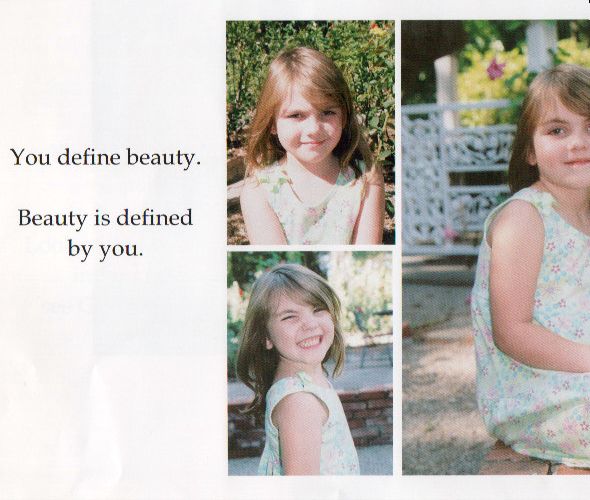
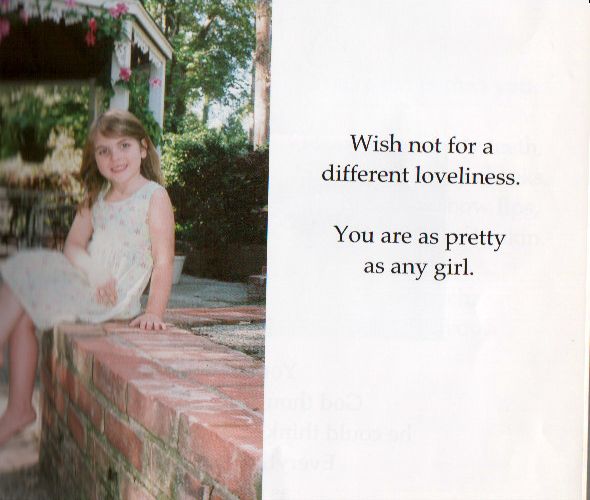
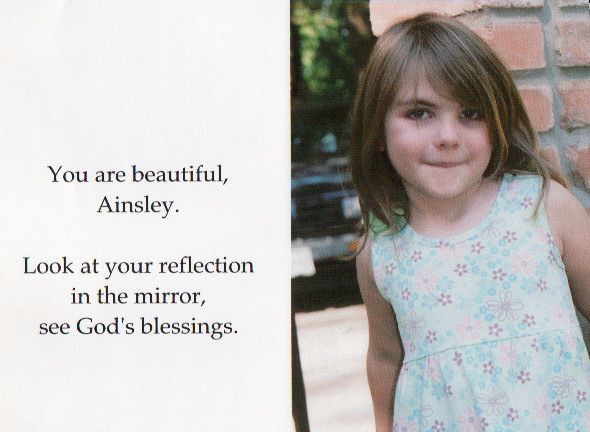
Pages from Ainsley, Perfect You, a book I wrote for my daughter. Steal this idea for Christmas, Please!

Subscribe to my RSS feed and/or email subscription. You don't miss the rest of this series.

Thursday, September 11, 2008

Pro-Girl Book Part 2

pg1 1.jpeg

pg1 2.jpeg

Pages from Ainsley, Perfect You, a book I wrote for my daughter. Steal this idea for Christmas, Please!

Subscribe to my RSS feed and/or email subscription. You don't miss the rest of this series.

Friday, September 5, 2008

I Hate Sarah Palin!

CB241601-4B3E-4E0F-9952-5226D1C20BB5.jpg

As an advocate for girls let me make the following plea on behalf of your daughter:

Please, please, please speak respectfully of the one and only female candidate the Repubican Party has ever put on their ticket for Vice President of the United States - Sarah Palin.

What you say about Sarah Palin has the potential to translate to your daughters as your opinion of all women (including your daughter) seeking power.

Disrespectful criticism has the potential to translate, "I only respect other women if they agree with me." Your daughter may one day disagree with you. This moment, and your reaction, won't be forgotten by her.

Your example will also teach her how she should expect to be treated by those who disagree with her and how she should treat those who disagree with her.

In other words -

Mothers - don't be a mean mommy and you won't create a mean girl.

Fathers - don't reduce her to whether you'd have sex with her and you won't create a daughter who gets her self-worth from her sexuality or appearance.

I vividly remember asking my parents what the Equal Rights Amendment was as a child. I remember them telling me that it was a bill to make women equal to men. And they were voting against it.

Here's how that translated to a six-year-old girl: "My parents are voting against ME! Why would they do that?"

I also remember criticism of Geraldine Ferraro that went something like, "We'll never elect a woman president. God wants it that way."

What you might say instead of "I Hate Sarah Palin" (or worse) might be, "I think a woman would make a wonderful Vice President, I just don't agree with this particular woman's political views on ________."

It would be helpful, for your daughter, to avoid vague negative statements about Sarah's suitability as a role model for girls. Instead you could say, "I think it's wonderful that a female has gotten this far in American politics. It's wonderful that women are becoming more powerful and ambitious in both parties. I just don't agree with her views on ________."

If you minimize and criticize the significance of Sarah Palin's presence in this race, then you minimize and criticize your daughter's potential.

It is my hope, as an advocate for girls, that they will never see another election in their lifetime where there is not a woman on either ticket.

Thanks to women's adamant support of Hillary Clinton and Sarah Palin both Republicans and Democrats have included women this year. Our top politicians have finally realized they can't win without addressing women and women's issues.

For our daughters' sakes, let's pray the inclusion of women - on all political levels and in all political parties - becomes the norm.

To be absolutely fair I made the same plea on behalf of Hillary and your daughter right before Super Tuesday. You can revisit that story in I Hate Hillary! I also advocated voting for Hillary for the sheer reason that she would be an example to my daughter of women in power for 4 years in Shut Up John Mayer, Stop Waiting For the World To Change.

For more on my personal opinion of Sarah Palin visit Blog Fabulous, I've written plenty about her politics and the emotional conflict she's causing in me personally.

Image Source: http://gov.state.ak.us/official_portraits.php


Wednesday, September 3, 2008

Face Off - Self Esteem vs. Body Dysmorphia

We went to the Exploratorium in San Francisco.

One particular exhibit had a disconcerting effect on me for days.

You sit in between two mirrors and look at your self.


DSC03846071520080002.jpg

One is a regular mirror and show's you how you see yourself every day. The top photo is how I see myself.

DSC03848071520080001.jpg

The other shows you what other people see every day. It shows you what you really look like.

Do you see a minute difference between the top photo and the bottom photo?

I've been fascinated by my own emotional reaction. Truly, it was unsettling to see my reflection differently than I do everyday.

The top photo, what I see in the mirror is more attractive to me.

My eyes are uneven in the second photo. The right eye, when looking at it, is slightly lower than the left one.

I find I hold my head slightly tilted in a way that makes my features more even. I think I also hold that eyebrow higher to make the eyes look more symmetrical. I compensate for the flaw I've really only noticed once in a photo when I was pregnant with Zack.

Since you are other people and it's not your face I really have no clue how you are perceiving the attractiveness of the two photos or whether you see the unevenness of my eyes at all. For all I know, everyone who sees me, may choose to make the same correction that I do for myself.

It strikes me as a kindness to myself that my subconscious mind chooses to correct my minor flaw so that I not only feel more attractive, but literally see myself as more attractive.

It also strikes me that people who suffer from eating disorders, like anorexia and bulimia or the emotional disorder of body dysmorphia for some reason they aren't subconsciously fixing their features in their minds.

They are not only seeing their minor flaw - they are focusing on it and magnifying it.

Its also likely they are expecting the outside world, other people, to treat them the way they treat themselves. Did you see how I assumed that others would treat me with the same kindness as I show myself and that others would correct or overlook the minor flaw in their own perceptions, rather than focus on it and magnify it? This assumption is likely a result of my habit of doing such a kindness for myself and for others.

Were I unkind to myself, and if I made a habit of focusing on the minor flaws of other people, I would likely assume that others were also doing so to me.

That's my theory anyway, based on everything I've read about self-esteem, self-worth, and eating disorders and related emotional disorders.

It follows then that maybe we can teach our daughters to serve their own mental health and self-esteem.

Cutting ourselves, our daughters and others some slack for our minor physical flaws teaches, by example, our daughters this emotional skill vital to their self-preservation.

Treating ourselves, our daughters, and others - especially other girls and women - with kindness is also a teachable habit.

Self-love and self-acceptance is a skill. One we learn and one we can teach.

Monday, September 1, 2008

Bikini Waxing Tweens & Early Puberty

B2962CC3-8CB8-4905-A154-A349918CBF6F.jpg

There was a story on MSNBC.com Today Show, Too young? Preteen girls get leg, bikini waxes, about how 20% of bikini wax customers at one Hollywood salon are tweens - pre-teen children.

"Nearly 20 percent of the clients that Nance Mitchell sees for bikini waxes in her Beverly Hills, Calif., salon are tweens, she says. . . 12 is the new normal."

"But nothing prepared her for being asked by one client to book a bikini wax appointment for her 8-year-old daughter."

{{{{{GASP}}}}}

Did you share my first reaction?

But, then I thought - wait, why is it the waxing that is making me gasp in shock?

Isn't it more alarming that 8 year olds have enough pubic hair to wax?

The sub head of the story is inaccurate: Moms are bringing daughters to spas for hair removal before puberty

The fact is that 50% of girls are getting their periods by age 10 and doctors now consider it within the "range of normal" for girls to develop outward signs of puberty, including breasts and pubic hair, by age 8. It's not that even medically alarming for 6 or 7 year olds to begin puberty, and many do begin developing breast buds or pubic hair.

Isn't it more emotionally alarming and worthy of a {{{{gasp}}}} that we're seeing a dramatic shift in girls' puberty development and no public health official is coming on the nightly news declaring,

"We're going to find an answer to this most disturbing development in girls, who hold the future reproductive burden for our entire species. In the meantime, don't let your daughters drink the water full of pharmaceuticals. Stop injecting milk and meat cows and other animals with hormones. Be wary that extra weight causes girls to make estrogen and develop pubic hair and boobs early. Avoid plastics. We're going to outlaw high fructose corn syrup in foods directly marketed to children. We understand the reproductive future of our entire nation depends on it!"

Instead, we hear about the early pubic hair trend in the fashion and beauty section of MSNBC's Today Show with a sexualization of girls slant.

Shouldn't those mothers be ashamed of themselves? the story basically asks.

Should they?

The story includes a quote by Philadelphia aesthetician Melanie Engle who says the 8 year old request for a bikini wax, "was about the mother's obsession with her daughter being a supermodel."

OK. I can buy that. I've seen mothers primp their daughters as a photographer and photographer's assistant. There is definite maternal beauty pressure.

Yet, if there was nothing to wax, if she were hairless, then her mother wouldn't be thinking her daughter needed to have anything removed to "look like a supermodel." Right?

Last year I did a story about Nair directly marketing to tween and teen girls with a "new" line of hair removal cream, Nair Pretty.

"It's profoundly disturbing," I wrote. It's also disturbing that Nair caught onto this early pubic hair trend and marketed to it, before I, as a parent, caught up with it.

I also went off on some radio DJ who was bashing Lordes, Madonna's young daughter, for having a unibrow and a slight mustache. I was appalled at the DJ's lack of class and placing all this beauty pressure on a young girl.

One brave mother, Athena of 1001 Petals, wrote in the comments section of that post, "I feel kind of bad now for telling my husband yesterday that if our daughter turned out to be as hairy as me, I'd start taking her to an esthetician for waxing as soon as it became evident -- unless she said she didn't care for it. This is because if you wax regularly at such a young age, you're saved a lifetime of regular waxing later on down the road. I had to take myself starting at 12 yrs of age, and now at 30 it is still practically a daily maintenance routine. . .I spend hundreds a year and a lot of time bothering with it."

Athena's right. The more I consider this hairy subject, the more I realize that I will likely assist my daughter, in some way, with her pubic hair and if she developed a mustache or side burns, for goodness sake, I'd help her eradicate it. Like I'm going to throw her to the Mean Girls and hope she survives?

Swim suits are not designed to cover the pubic area. They haven't been for about 40 years.

In "Clean" Bikini Line I wrote about my own struggle since my teen years with various methods of shaving, Nairing, one excruciating episode with Neet and a vicious chemical burn.

I'm amused by Campaign for Unshaved Snatch (CUSS), but I still keep my bush rather trimmed, as a courtesy to my husband. I wear swim shorts rather than show off my all my private hairs when we go swimming. The itching always gets to me mid-grow.

But, is my daughter really going to be into wearing one of these modest suits that would cover her bikini area? Am I going to make her be the only kid at the swim party or pool to do so?

I shave my pits and my legs. I pluck my eyebrows. I search for stray hairs on my chin and pluck them immediately.

It is only my budget that keeps me from getting all this hair waxed off. When I lived in NYC there was hair & waxing salon on every corner and it was a mere $30 to get my bikini and eyebrows done. I did it whenever I could afford it.

It's the least painful than other methods, it lasts longer and it was the ONLY thing that prevented razor or chemical burn - in other words waxing was the only solution that I didn't trade unwanted hair for an unwanted rash.

It seems to me a young daughter growing early pubic hair is an even bigger motivator for waxing.

Certainly, the minute girls develop breasts or pubic hair society treats her with less respect and she hears more negative and sexual comments about her body. The more she looks like a teenager or woman, the sooner she will be seen as an object for male entertainment, instead of the three-demensionable little girl, the young child, she really is.

What bigger incentive is there to hide pubic hair, keep it as private as possible, or have it removed?

Does the removal of hair further sexualize girls, because the latest fashion is for adult women to remove hair and get a Brazillian wax? Ironically (and a little disturbingly) making them look more like children.

Or does the removal of a symptom or sign of puberty buy a little girl some more time to be a child?

Please comment, I really am interested in exploring this issue further.

Empowering Girls: Hootchy Clothes

Second Generation Mean Girl

Empowering Girls: Ho'oponopono for Girl Fights

Empowering Girls: Breast Cancer Risks

Empowering Girls: Early Puberty

Precocious Puberty

Image Source: Ohana Swimwear

Thursday, August 14, 2008

10 Antidotes to Self-Objectification & Sexualization of Girls

1web20080807_0012.jpg

Yesterday, we discussed Self-Objectification and Low Self-Esteem.

I loath problems without solutions and complaints that make us feel powerless. So, here's a list of 10 Antidotes to Self-Objectification and Sexualization of Girls.

* Media Literacy - talk to girls about the images they see. Point it out when there is obvious digital retouching like in Keira Knightly Stands Up for Her Girls and Yours.
Watch Dove's Onslaught campaign with her and discuss it. If it's age-appropriate take her to the Natural Breast Gallery and talk about how different the images of women in media are than the bodies of real women. Tell her about Photoshop and discuss the motives of the media to sell products by misrepresenting women's bodies.

* Athletics - A focus on the body that is nonsexual, athletics focuses on competency, agency and action. As participation in sports increases, participation in risky sexual-activity decreases. Taekwondo and soccer are good choices. The report sites cheerleading and dance as less empowering types of athletics due to the focus on appearance, sexiness, and thinness.

* Extracurricular Activities - Girl Scouts, band, after-school programs like Girls Inc., drama club, band, computer or video gaming clubs give girls an alternative to activities that focus on their appearance.

* Comprehensive Sexuality Education - "A central way to help youth counteract distorted views presented by the media and culture about girls, sex and the sexualization of girls is comprehensive sex education. Programs must include accurate information about reproduction and contraception, the importance of delaying intercourse initiation for young people, and the building of communication skills, and promotes a notion of sexual responsibility that includes respect for oneself and an emphasis on consensual, non-exploitative sexual activity."

* Co-Viewing Media with Parents - Parental comment on media children are exposed to is key to altering the influence of the messages. Watch TV with girls and comment on the messages. Contradict stereo-typical behavior when you see it, share your insights on advertising and media. Co-viewing also reduces the amount of inappropriate material children see.

* Religion, Spirituality and Meditation - organized religious and other ethical instruction actively combat the values conveyed by popular culture. When parents teach girls they are "more than their bodies" girls benefit. Talk to your kids about your idea of her whole self, and that "who they are" makes them valuable outside of their sexuality or gender roles. Insisting that girls remain girls and not be pushed into a precocious sexuality is something many churches do. Encourage meditation, yoga, tai chi, and prayer to teach girls to get in touch with their bodies and themselves as spiritual beings.

* Activism by Parents and Families - encourage girls to become their own activists by being one yourself. Join Campaign for a Commercial-Free Childhood to fight sexualizing and objectifying messages in marketing. Get involved in The Geena Davis Institute on Gender in Media. Take your daughter to a Dove BodyTalk, Campaign for Real Beauty Self Esteem Workshop. Sign your daughter up for the Girl Scouts Uniquely Me program.

* Alternative Media - Cancel the Tiger Beat subscription and subscribe to Girl Zone. Get your daughter involved in writing or producing her own media - a website or blog is simple enough. Stone Soup is a literary magazine written by children. Write your daughter a book about her. Most digital photography websites like Mypublisher.com will allow you to publish a storybook about your daughter, using images of her, in a beautiful hardbound book for $30. Throw out the Disney Princess books and videos and get some empowering alternatives like Princess Bubble.

* Confront Your Body Issues - If you, the mother, have a history of self-objectification or poor body image confront it and deal with it before you pass it down. Refuse to self-deprecate or equate your own value to how thin you are or how you look.

* Be The Empowered Woman - If you find yourself buying into gender-stereotypes in your own life, being too passive, not saying "no", holding yourself to an impossible standard of perfection, running yourself ragged to be everything to everyone - Stop It. She will emulate you. A mother who radiates self-love and self-acceptance vaccinates her daughter against a low self-esteem, said Naomi Wolf.

Compiled from the APA Report on Sexualization of Girls and articles originally published on Empowering Girls: So Sioux Me.

Please subscribe to Empowering Girls: So Sioux Me via RSS or Email in the top-right corner.

Wednesday, August 13, 2008

Self-Objectification and Low Self-Esteem

1web20080807_0014.jpg

We all know how objectification works, some men see women as an object for their sexual pleasure.

But, what happens when girls and women begin to see themselves as an object for men's sexual pleasure?

The Association for the American Psychological Association
(APA) calls this self-objectification and/or self-sexualization in the Report of the APA Task Force on the Sexualization of Girls.

There's a host of evidence that when girls are exposed to too much media that they begin to view themselves less as three dimensional human beings and more as sexual objects. When this occurs, psychologists note the increase of:

* eating disorders

* low self-esteem

* depression or depressed mood

One interesting study noted that teenage girls from Figi had great body image and self esteem - until they were exposed to Western television. Once exposed, they became preoccupied with weight and body shape, purging behavior (throwing up) and body disparagement. Prior to television the Figian culture emphasized a robust body shape and based notions of identity not on body, but on family, community and relationships. The transition between healthy self-image to the increase of eating disorders was only 3 years.

Self-objectification is also directly linked to "diminished sexual health" among adolescent girls. One study found that when girls viewed their own bodies as objects for male pleasure condom use and sexual assertiveness, (saying "no") decreased.

Another study found that "undergraduate women who frequently watched music videos or read women's magazines, who attribute greater realism to media content, or who identify strongly with popular TV characters were also more accepting of sexually objectifying notions of women."

Accepting these sexually stereotypical and objectifying views manifested in negative attitudes toward breastfeeding and negative attitudes about normal body functions like menstruation and sweating.

When I read the APA's definition of self-objectification and self-sexualization it was like a mini-awakening for me.

That explains why, as a teen and young adult, I allowed boyfriends to treat me as their sexual object or plaything. It explains why I crossed many of my own sexual boundaries and didn't want to object "for fear of being rude" on several occasions. It explains why I allowed boys and men to make inappropriate comments about my body and its development from even the earliest age - heck, I didn't even know was "allowed to object."

Do you think you've ever self-sexualized or self-objectified?

Do you worry about this with your daughter?

Read 10 Antidotes to Self-Objectification and Sexualization of Girls for ways to prevent your daughter from objectifying her own body.

Empowering Girls: Marketing Boundaries

APA Reports Sexualization of Girls Devastating
Taekwondo For Girl Power

Friday, August 1, 2008

Y's Letter to My Body

Yvonne from Joy Unexpected read this as the Community Keynote at BlogHer.

I don't ever want my daughter to feel the way that I have felt most of my adult life about my body.

Bravo Y.

If you can't watch her read it, you should read her Life Change Words.

Thursday, July 31, 2008

YOU: In First Magaazine

First Magazine is looking for women who want to share body confidence stories.

One of the stories is about a gift that helped boost a woman's body confidence.

The other is about a family tradition that help's a woman feel good about her body.

The women who are featured in these stories will be professionally styled and photographed and also interviewed via phone and email.

All responses can be emailed to Helen Matatov at
HMatatov@bauerpublishing.com by Monday, August 4th.

Wednesday, July 30, 2008

Keira Knightly Stands Up For Her Girls & Yours

7677E71D-523D-4AF9-BA99-0A491B5D8281.jpgKeira Knightly is taking a stand against digitally enhancing her breasts for her upcoming movie, "The Dutchess."



When she stands up and declares herself "good enough" as she is, she stands up and declares our daughters "good enough" as they are.


Every actress who resists media pressure to conform to the beauty ideal does all girls and women a favor.


"She has insisted that her figure stay in its natural state," an insider said. "She is proud of her body and doesn't want it altered."This according to the Daily Mail via The Huffington Post.


Bravo Keira! You are good enough!


Photo Source: The Huffington Post, photos of before and after digital alteration for "King Arthur."

Thursday, July 24, 2008

Self-Loathing Sin Bank

Vacation Rerun


by Tracee Sioux

I am going to put a self-loathing sin piggy-bank (pardon the pun) on my kitchen table.

Naomi Wolf has a great quote which is taped on my bathroom mirror, "The mother who radiates self-love and self-acceptance vaccinates her daughter against low self-esteem."

I accept this as a self-evident truth. In psychology circles I think they call it "mirroring" when our children look at us as a sort of reflection of themselves. A practical example would be, "my mother thinks she's fat, therefore I too am fat." A mother who is not actually fat, but repeatedly calls herself fat must then bear the responsibility when her daughter adopts an eating disorder like anorexia, bulimia or overeating.
More posts on Dove's Campaign for Real Beauty
Beauty & Reality
Self-Loathing Sin Bank
More posts on hair:
Pink Hair Fiasco
Pink Hair Fiasco Take 2
Curl Maintenance
The Meaning of Hair

The child's perception of herself is obviously flawed using this mirroring if she looks at her thin body in the mirror and sees fat. And it breaks any mother's heart when she sees her child look at her own beautiful self with disdain, criticism or self-loathing. I think God put in us an inherent ability to see goodness and beauty in our children, whether or not they are actually beautiful.

However, I believe the function of mirroring can be done reversely with what is sometimes painful accuracy. I think when my daughter looks at her legs and says, "my legs are fat" she's telling me in a very loud voice that this is a true reflection of how she thinks I feel about my own body image.

When I had my first baby I never lost the weight because I figured I would just have to lose it after the second one. On the second one I was in my 30s and my metabolism had slowed down and I was nearing the dreaded 200 pound mark. When I realized I was going to hit 200 in a couple of months and the doctor had me on a heart monitor because of dizzy spells I decided I had to make a complete and total lifestyle change. (My heart, it turns out is just fine.) The whole family was getting chubby and I decided we had to eat healthier and get more active rather than living the lifestyle of a Kobe calf (Tajima-ushi cattle reportedly receive regular massages with Japanese rice wine and are fed hops for a well-marbled texture and tenderness).

The weight is coming off at a slow and steady rate and the muscle is bulking up and I've never felt better. This is obviously a great example to my daughter, who is now 5 and, according to her pediatrician, in the "red zone" for her BMI (body mass index).

Except for one thing. The thinner I get, the more she seems to be focusing on her own perceived flaws. The other day she said she hated her legs because they were fat.

OUCH!! Like a knife in the gut I realized that I talk about my body in a negative way to motivate myself to get to the gym. Not only that, but I use self-deprecating humor to make people laugh and to illustrate that I have the ability to laugh at myself.

When speaking directly to her I use all the healthy phrases like suggesting she eat a healthy snack. Or explain that we're eating vegetables and fish for dinner because it's a healthier choice. Directly to her I am proactive about explaining that we're off to the gym so that I can be stronger and have a healthier heart.

But to others. . . .

She has heard me call myself Kobe Beef. (Yes, I'm a fan of the esoteric references to amuse myself.) She has also heard me complain about buying the "largest girdle underwear they make, only to find out it was too small." I have bragged about going down in pants sizes, "it's taken me 8 freaking months to make it down to a size 12." I have touted the fact that I have lost "20 pounds of pure fat." I have complained about how I simply can't find shirts long enough to cover my stomach, "which wouldn't be so bad if I weren't so fat and no one needs to see blubber hanging out of my clothes." I have touted my measurements, "losing 15 inches of ugly fat, back fat, flabby boob fat, thigh fat, belly fat." She's has heard me complain about my clothes that make me "look like a total cow." I have complained that it's going to take me "40 more weeks to get rid of my fat at the rate of a pound a week." She's heard me say how surprised I am that "my neck even lost an inch of fat allowing me to wear my pearl choker again."

The thing is, I don't loath my self or my body. I wasn't even aware of how fat I was until I started seeing positive changes in my body. I still dream of myself as thin. I still think of myself as "the thin cute blond" one when I'm with my girlfriends. I have been blind to my own fat. Heck, I'm fairly sure my daughter was blind to my fat. I don't look in the mirror and hate what I see, because I don't even see what's really there - I literally look in the mirror and see myself as I was in college.

Yet, I realize that my daughter can't determine the difference between how I feel about my body and what I say about my body. To her, she will only internalize that I say I feel fat and that I say I hate my body. She only hears me criticize my looks, my self. And that is what is inevitably effecting how she will see herself for the rest of her life.

It's tragic really. It breaks my heart. It feels like damage that can't be reversed. It makes me loath myself.

My vow is to change this negative behavior. It is not worth a few laughs for the self-deprecating humor. I feel I have to hold myself accountable to her for this behavior so that she is explicitly aware that it is not okay for me to be unkind to myself, and therefore I can expect her to show her own self the kindness I want for her.

So, I'm going to put a self-loathing sin beauty bank on the kitchen table and deposit say, a quarter (hey, we're on a strict budget around here) for every self-deprecating, self-loathing remark I make about my body or my self. I will ask her to catch me calling myself unkind names. I will require her to deposit the same when she makes negative comments about herself.

To avoid making it another exercise in self-loathing (I suck so bad, I can't believe I said I'm fat again, I'm such an idiot!) it will be a requirement to write a positive attribute about our bodies to put in the bank along with the quarters. Then after a month we'll take the jar of good thoughts and our quarters and we'll go out for Chinese food and talk about our progress and how much we love our own bodies.

Alarming statistics from Dove's Campaign for Real Beauty Study
http://www.campaignforrealbeauty.com/

* 42% of 1st-3rd grade girls want to be thinner. (Collins, 1991)
* 81% of 10 year olds are afraid of being fat. (Mellin et al., 1991)
* The average American woman is 5'4" tall and weighs 140 pounds. The average American model is 5'11" tall and weighs 117 pounds. Most fashion models are thinner than 98% of American women. (Smolak, 1996)

*51% of 9 and 10 year old girls feel better about themselves if they are on a diet. (Mellin et al.,1991)
* 91% of women recently surveyed on a college campus had attempted to control their weight through dieting, 91% dieted "often" or "always." (Kurth et al., 1995)
* 95% of all dieters will regain their lost weight in 1-5 years. (Grodstein, 1996)
* 35% of "normal dieters" progress to pathological dieting. Of those, 20-25% progress to partial or full-syndrome eating disorders. (Shisslak & Crago, 1995)
* 25% of American men and 45% of American women are on a diet on any given day. (Smolak, 1996)
* Americans spend over $40 billion on dieting and diet-related products each year. (Smolak, 1996)

http://www.campaignforrealbeauty.com/DoveBeyondStereotypesWhitePaper.pdf

I've entered this article in Babylune's writing contest about parenting mistakes and lessons learned. Follow the link to enter one of your own.

Saturday, July 19, 2008

Mirrors: Ours, The Media’s, Our Cultures’ and Our Kids’

1myview.jpg

So I had my big BlogHer08 speaking panel, Mirrors: Ours, The Media’s, Our Cultures’ and Our Kids’ speaking panel yesterday and it was a rush.

The panelists were Laurie Toby Edison of Body Impolitic, Tracee Sioux of Empowering Girls: So Sioux Me, Kelly Wickham of Mocha Momma, and Glennia Campbell of The Silent I (also Mom-o-crats and Kimchi Mamas).

Laurie Toby published the transcript on her blog and I'd love if you would hop over and read it. I think it went really, really well.

Tracee: I write about empowering girls, specifically daughters. How girls internalize the media and what we as parents can do to give them tools to fight that. Daughters inherit our emotions about our bodies. So many women self-deprecate for humor; I used to do it all the time. When my 4-year-old said “I hate my fat thighs,” I said “What have I done?” Women use this to bond–I’m not perfect, you’re not perfect. I was joking, but my daughter couldn’t tell it was a joke. Daughters feel that when you criticize yourself you’re criticizing their DNA.

Truly, I had the best time. It was so encouraging to see how many women are thinking about the complex world our daughters live in and how best to approach the building/moulding of their selves.

Friday, July 18, 2008

Empowering Girls: Criticize Daughters' DNA

mybeautifulmommy.jpg

A mother who radiates self-love and self-acceptance vaccinates her daughter against low self-esteem. Naomi Wolf

The reverse is also true.

Divorce expert M. Gary Neuman says the worst thing any parent can do to their child is to criticize their other parent. Because children hear this as criticism of self. You criticize a child's DNA when you criticize their parent.

The same holds true when daughters hear their mothers criticize their own appearance. This is obvious if they share the criticized feature. Even if they don't, a "not pretty enough" feeling passes from one generation to the next.

As life coach Martha Beck says, Children feel about themselves the way we feel about ourselves. We only wish they felt about themselves the way we feel about them.

Wishing it doesn't make it so.

My Beautiful Mommy, a children's book, written by a plastic surgeon, who is incidentally depicted as a superhero who manages to make Mommy "pretty" (as both God and Mother Nature evidently could not) with a nose job, implied boob job and tummy tuck, has prompted media criticism.

As a parent, this book touches something inside us that we know intuitively is bad for kids.

What is plastic surgery if it's not the ultimate self-criticism?

What is plastic surgery if it's not the ultimate in criticizing both our children's and our parents' DNA?


The premise of this book is that we can resolve our self esteem and low self worth issues with surgery, and that we have the ability to articulate that to our children with a story book.

This can never, ever work.

What we CAN do, is grow a self esteem and teach our children how to grow a self esteem too.

The first step in feeling good about one's own reflection is to stop criticizing it. If we can learn to love how we look, our children will intuitively inherit a good self esteem.

I make it a point to compliment my own features as beautiful, especially those I share with my daughter.

Your hair is thick like mine, I love my hair.

We have perfect bow lips.

You're lucky you got my eyes, they are one of our best features.

I do it because I want to actively vaccinate my daughter against a low self esteem as Naomi Wolf suggests.

Try it. As with anything it takes practice, feels awkward at first but quickly becomes a habit.

If self-deprecation is becoming a problem in your house please read My Face/Her Face and Self-Loathing Sin Bank.

My Face/Her Face


by Tracee Sioux

I am deeply struck by this photograph which I found on About Face, a non-profit company which combats negative images of women in the media.

Without taking a right or wrong stance about plastic surgery, this photograph of a mother and her daughters speaks volumes about what self-hatred, self-criticism and self-loathing costs the collective conscience of femininity.

Remember when we found out on Friends that Rachel had a nose job? It seemed like a kind enough thing to do for herself when she was single and a completely autonomous person. But, then she had a baby girl and the issue came up again. It was quite funny to watch her consider, "What if the baby gets my old nose?"

Funny. But, in a practical sense what if she does? What if she gets your old nose? How much harder is it to learn to love yourself if you go through life with a nose even your own mother finds unacceptable?

Who then is responsible for the daughter's self esteem issue about her nose? While many might come back to a post like this and say, "Well, just give the daughter a nose job." Sure, eventually. But, she has to hate her nose until it stops growing in her late teens.

My hypothesis is that it's much more effective to learn to love our own nose, face, and breasts than to combat poor self worth in our daughters, created by our own feelings of self-loathing.

It is also notable that the feelings about my own appearance have become significantly more positive now that I can look at my daughter's face and see the beauty there. To me, she has not one single flaw. The features she shares with me have become more attractive to me by virtue of being on her.

That said, many women will get plastic surgery to fix what they perceive as "flaws." I don't want to argue the moral position that you shouldn't, certainly you have to make your own decision.

That said, I do think it's worth asking, what then do you plan to say to your daughter if she shares the same perceived flaw?

Read more about how our feelings about our own appearance deeply effect our daughters feelings about themselves in Self-Loathing Sin Bank.

Wednesday, June 18, 2008

Empowering Girls: No Name Calling

This article was originally published on Body Impolitic.
P3234059.JPG

by Tracee Sioux

It's effective to make some rules when children are still very young to ensure a healthy self-image, including body image.

Most parents forbid name calling when it comes to siblings or friends.

It's appropriate to make the same rule for name calling against themselves.

I punish my children for saying "I'm stupid" and "My legs are fat" the same as I would punish them if they said, "You are stupid" or "Your legs are fat."

Children learn to respect, accept and appreciate their bodies and skills or they learn to self-deprecate.

Respect, acceptance and appreciation doesn't lead to anorexia, self-mutilation or other self-destructive behaviors.

Self-deprecation has been shown lead to self-destructive behavior, depression, low self-worth, drug use and suicide.

Children learn from a Do As I Do as opposed to Do As I Say. Obviously mothers (and fathers) will have to forgo self-deprecation as a form of humor or bonding with other women.

Naomi Wolf said, "The mother who radiates self-love and self-acceptance vaccinates her daughter against low self-esteem."

A woman can not stand in front of the mirror annihilating her body and her reflection and expect her children to have a positive self esteem. That's just not likely to happen.

My daughter holds me to this standard. I've spoken with her about my own accountability in this area. If I cut loose with an, "I am so stupid!" she will call me on it and has actually sent me to "time out."

I did go to time out, because I want her to know that what I did by calling myself a name was very, very wrong. If I refuse to live up to the standard I set for her then essentially, the message is that it's "not really that important."

When I read the statistics about teenage girls that declare that 13% of girls are depressed, 10 million women have an eating disorder, 81% of 10 year olds are afraid of being fat, 42% of 1st-3rd grade girls want to be thinner.

All because girls never learned to be kind to oneself?

I know I must vigilantly teach my daughter how to take care of emotional self and accept and appreciate her body from a very early age.

More on Body Image at Empowering Girls: So Sioux Me

Self-Loathing Sin Bank

Monday, June 9, 2008

Empowering Girls: Body Impolitic

P3234059.JPG

Laurie Toby Edison of Body Impolitic asked me to guest blog. I submitted Body Image: No Name Calling about how I try to teach Ainsley that the habit of self-deprecation is wrong and carries a real cost to the self-esteem.

Thanks to Laurie for the opportunity. Laurie will be sitting on the BlogHer panel about body image with me in San Francisco in July.

Please stop by and read it while I decompress from my political trip and spend extra time with my kids - they missed me.

There's another reason to leave the kids every once in a while - you can't beat the experience of seeing them run towards you with pure joy to see you. Who else is that happy when they see me?

Thursday, May 29, 2008

Empowering Girls: Distorted Bodies

4974CB75-C506-4B07-811F-D696D1DA9151.jpg

by Tracee Sioux

When I was a girl, Dolly Parton had "big ones." They were big like a caricature. Dolly's were abnormal and the butt of jokes all over the media.

I was a B or C cup and my breasts were "normal." When you're a girl it's important to be "normal."

In today's terms Dolly Parton isn't even that big. As a society, we are inundated with images of overly-large, disproportionate, abnormally perky, unnaturally "perfect" breasts all over the media and marketing.

Vast numbers of the breasts we see as "perfect" and "normal" have been altered, surgically or graphically.

Where Dolly Parton's breasts were an anomaly for our generation, Dolly Parton's breasts are essentially "the norm" for our daughters. They have no other frame of reference.

Yesterday on Blog Fabulous, I wrote about how our own perception of what breasts are "supposed to look like" has been distorted. This distorted perception is creating poor body image in real women. Women tend to stand in the mirror and compare themselves to this distorted image of the media's version of "normal."

Imagine how much worse it must be for our daughters?

What I'm about to say may be radical and may seem wildly inappropriate in 1970s parenting terms.

Get ready . . .hold your breath. . .

If it is age-appropriate and you're hearing your daughter mutter dissatisfaction about the size or shape of her breasts or the color of her nipples, you might consider visiting the Normal Breasts Gallery with her.

There, I said it. You should show her pictures of non-sexualized real women's breasts to show her what real women naturally look like.

The Normal Breasts Gallery is an Internet gallery of nude photos of anonymous real women's breasts, combined with short essays exploring how these women feel about their breasts.

Without it, our daughters' only frame of reference is the distorted media representation of breasts and our own. That can't be good for making them feel normal and coming to self-acceptance.

Read more about the damage of seeing only sexualized breasts in the media in APA Reports Sexualizatuion of Girls Devastating.

Image Source: Ebay Ad - click to buy it.

Thursday, May 15, 2008

Empowering Girls: Dutch Blitz Has Body Issues

Dutch Blitz has some body image issues. She used to be a size 15 and she still feels unacceptably fat sometimes, though the scale and the tag in her clothes tell her she's not. I know this because I've read her very honest and poignant blogs about her feelings about her body. She wrote a A Letter To My Body about the betrayal girls and women can feel when their bodies defy expectations.

She wrote one called Thinner that I found particularly insightful in regards to empowering daughters.

It does no good to tell a woman "don't feel this way." I don't know why, it's just not effective. It does no good to tell a daughter, "don't feel this way." People get all proprietary about their feelings, like they have a right to them - negative ones and all.

Dutch Blitz knows there is "no good reason" to feel like crap about her very small, very socially acceptable, very healthy, very functional, perfectly-good body. But, she does anyway, 15% of the time.

"I struggle. I wish that I didn’t," Dutch Blitz writes. "I wish that the eighty-five percent became one hundred percent. That I could exude confidence and comfort. That I could stop looking at myself in such a harsh light. I want to be an example to my daughter.Then I think that maybe I am. Maybe, in my insecurity, I can show her that I am human too. That I see all of the pressure that is put onto women. That I, too, succumb to it sometimes."

The beautiful part about it is that she knows her negative body feelings are illogical and self-defeating and she's working her way out of it. She acknowledges the impact her poor body image will have on her daughter. But, she also acknowledges that adapting yet another standard of perfection, "how we must feel about ourselves," isn't much help to her daughter.

If we tell our daughters "beauty doesn't matter at all," they look at all the evidence around them and know that it's a lie or a delusion. "Don't have body issues," isn't a particularly effective strategy.

Beauty doesn't matter, beauty shouldn't matter.

Whatever.

We know that in a million ways it does. Our daughter's know it too. We're all suseptable to marketing and we all fall prey to the beauty ideal in some degree in our darkest moments.

To lie about those moments to our daughters will only make us less credible. To claim to be completely oblivious of beauty will backfire because they won't trust our perception of the world.

Even if we don't have a particularly negative self-image, we still mutter about someone's baby that is so cute or whether we think a dress pretty.

They know, whether we acknowledge it or not, that who is pretty is the same as who is popular. By preschool, they are they are assessing who is nice and who they like in terms of who is prettiest.

We don't live in isolated bubbles. And if we did most of us would opt for one that is pretty.

Beauty matters so much, in fact, that it can affect one's job performance and their future income. To pretend that it doesn't, makes our daughters stop trusting us.

We are imperfect and that is OK, appears to be Dutch Blitz's message to her own daughter.

I think Dutch Blitz is right to believe she'll have more success with the strategy of honesty.

Wednesday, April 30, 2008

Empowering Girls: I Love My Body & I'm Not Perfect