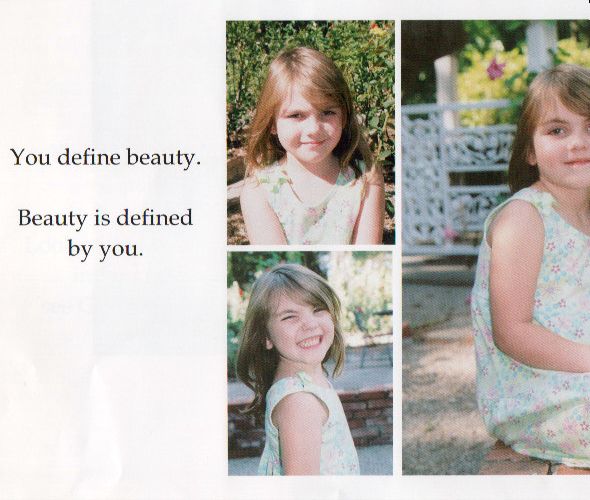
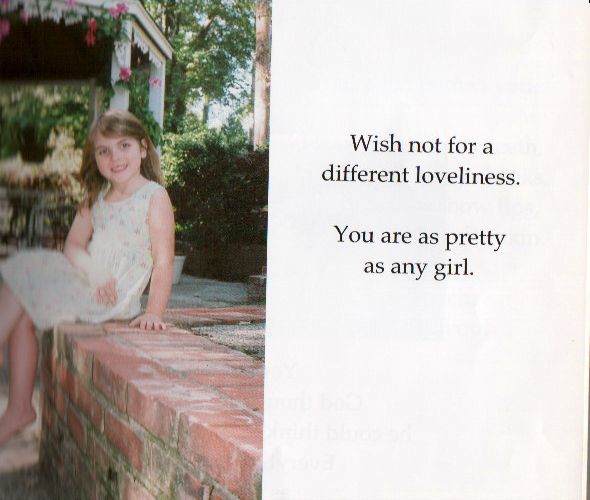
Pages from Ainsley, Perfect You, a book I wrote for my daughter. Steal this idea for Christmas, Please!
Subscribe to my RSS feed and/or email subscription. You don't miss the rest of this series.
My blog has moved!
You should be automatically redirected in 5 seconds. If not, visit
http://thegirlrevolution.com
and update your
bookmarks.
Pages from Ainsley, Perfect You, a book I wrote for my daughter. Steal this idea for Christmas, Please!
Subscribe to my RSS feed and/or email subscription. You don't miss the rest of this series.
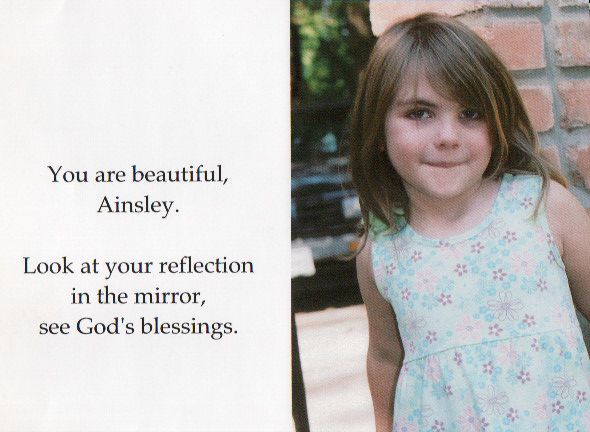
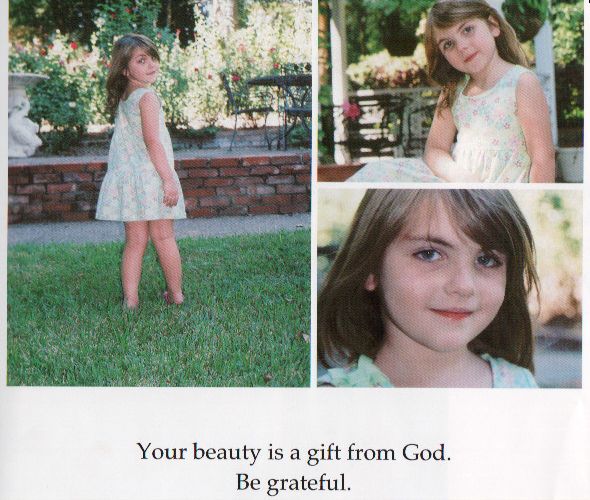
Pages from Ainsley, Perfect You, a book I wrote for my daughter. Steal this idea for Christmas, Please!
Subscribe to my RSS feed and/or email subscription. You don't miss the rest of this series.
In everything we've been reading the damaging effects of media has been a central force.
APA Report on Sexualization of Girls, Girls Inc.'s The Supergirl Dilemma, You're Amazing, Geena Davis Institute on Gender in Media all cite exposure to media as a central force in the girls beginning to define themselves as less than they truly are.
While every one of these sources cite media as a potentially damaging influence, they also recommend fighting negative media with positive media.
We have the power to - not just passively ban negative media, which we should definitely do - But we have the power to CREATE positive media for our daughters about girls.
I can tell you this - my daughter thinks it's pretty cool that she's the Poster Girl for Empowering Girls: So Sioux Me. This is one of the reasons I'm inviting you to send photos of your daughter to be included as a Poster Girl on this site. It is one way to take media from outside of our world to a creative and positive medium that includes them.
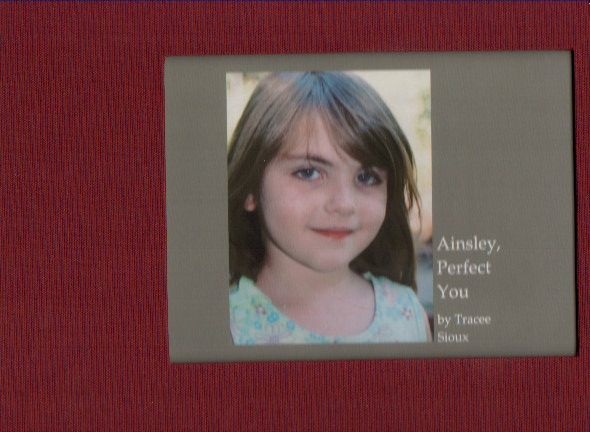
I created a children's book for my daughter's 5th birthday titled Ainsley, Perfect You. I am practically begging you to STEAL this idea for Christmas (or birthdays).
We read this book before the First Day of School, whenever Ainsley makes negative comments about her self, whenever she feels insecure or whenever she wants. It's a special book that sits out on a shelf and we must wash our hands before reading it.
In the book I addressed issues of beauty, because Ainsley seemed preoccupied with what it was and exactly what criteria people were using to make the judgement about who was beautiful. I addressed school, education, intelligence and learning. I addressed self-worth and a feeling of wholeness and "enoughness." I addressed the meaning of God and her role as a Child of God. I addressed risk-taking and trying new things.
Your family may prize different characteristics or place different values as a priority. What's important, is that you can use this tool to teach her who she is, but also influence, mold and raise or define the bar of expectation for who she will become.
A-N-Y-O-N-E can do this if they have a computer, a camera, $30 and an imagination. You may be thinking you're short on imagination so, while Ainsley, Perfect You is copyrighted I give you permission to steal ideas, concepts, words, etc. Your daughter is every bit as cool as mine, but she may have different attributes and characteristics.
I encourage you to use my book for ideas, but personalize them for your daughter(s). (Of course, its good for your daughter, but don't forget your sons.)
I used www.MyPublisher.com because they were the only company who had a "storybook" feature at the time. Turns out my parents and grandparents were also interested in having a copy of this book (one project many gifts!) and My Publisher has coupons they'll send you frequently. Flickr now offers the feature, and Snapfish and probably all the other ones too.
There are 20 pages so I'll run Ainsley, Perfect You as a series, starting with this foreword. I had to scan the pages, so please forgive the quality.

You'll want to get the RSS feed or an email subscription so you don't miss any of it.
We went to the Exploratorium in San Francisco.
One particular exhibit had a disconcerting effect on me for days.
You sit in between two mirrors and look at your self.
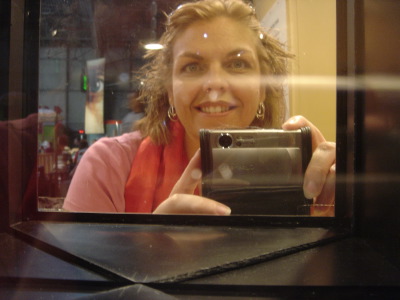
One is a regular mirror and show's you how you see yourself every day. The top photo is how I see myself.
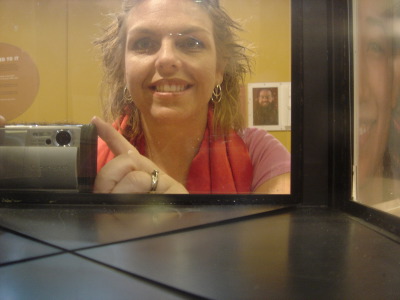
The other shows you what other people see every day. It shows you what you really look like.
Do you see a minute difference between the top photo and the bottom photo?
I've been fascinated by my own emotional reaction. Truly, it was unsettling to see my reflection differently than I do everyday.
The top photo, what I see in the mirror is more attractive to me.
My eyes are uneven in the second photo. The right eye, when looking at it, is slightly lower than the left one.
I find I hold my head slightly tilted in a way that makes my features more even. I think I also hold that eyebrow higher to make the eyes look more symmetrical. I compensate for the flaw I've really only noticed once in a photo when I was pregnant with Zack.
Since you are other people and it's not your face I really have no clue how you are perceiving the attractiveness of the two photos or whether you see the unevenness of my eyes at all. For all I know, everyone who sees me, may choose to make the same correction that I do for myself.
It strikes me as a kindness to myself that my subconscious mind chooses to correct my minor flaw so that I not only feel more attractive, but literally see myself as more attractive.
It also strikes me that people who suffer from eating disorders, like anorexia and bulimia or the emotional disorder of body dysmorphia for some reason they aren't subconsciously fixing their features in their minds.
They are not only seeing their minor flaw - they are focusing on it and magnifying it.
Its also likely they are expecting the outside world, other people, to treat them the way they treat themselves. Did you see how I assumed that others would treat me with the same kindness as I show myself and that others would correct or overlook the minor flaw in their own perceptions, rather than focus on it and magnify it? This assumption is likely a result of my habit of doing such a kindness for myself and for others.
Were I unkind to myself, and if I made a habit of focusing on the minor flaws of other people, I would likely assume that others were also doing so to me.
That's my theory anyway, based on everything I've read about self-esteem, self-worth, and eating disorders and related emotional disorders.
It follows then that maybe we can teach our daughters to serve their own mental health and self-esteem.
Cutting ourselves, our daughters and others some slack for our minor physical flaws teaches, by example, our daughters this emotional skill vital to their self-preservation.
Treating ourselves, our daughters, and others - especially other girls and women - with kindness is also a teachable habit.
Self-love and self-acceptance is a skill. One we learn and one we can teach.
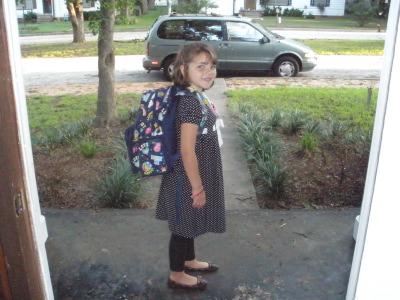
Yesterday I sent Ainsley off to First Grade.
Someone asked me, Did you cry?
Cry? I did cartwheels!
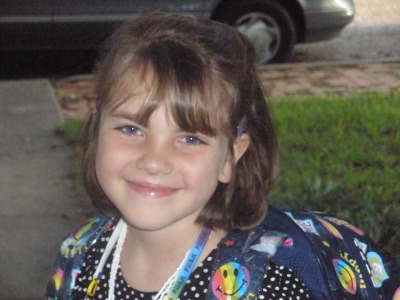
Which is an exaggeration. I felt a some relief.
Have you any idea what its like to work with two small children in your cube?
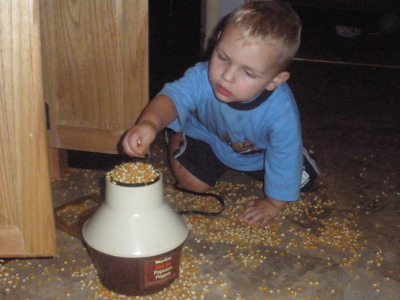
THIS is the reason I'm not doing cartwheels - Yet.
Zack is bored and lonely when his sister goes to school. He needs to go to preschool. Only I didn't realize my new town has only one and it fills up fast.
I'm praying for two biters and two separation anxieties - Zack's 4th on the list.
Mother's Day Out will give me 2 days a week to work uninterrupted. It will give him social contact with other children and stimulation. He's super smart - which is why he was trying to Make His Own Popcorn For Dinner. Check out his Potty Dance debut on YouTube.
How are ya'll managing your first day of school around the country?
 ,
,Over one hundred essays poured in from 26 states and four countries. Reading the essays shed light on the current state of the mom-mind. For example, the word 'perfect' (of a variation of it) was used over 92 times. That's almost one 'perfect' for every mom. While I think the questioning of perfection is positive (although not every essay questioned it), the frequency shows that the desire to be 'perfect' continues to loom over our sense of identity.
All too many American women are in thrall to increasingly deranged ideals of perfection. We live in a culture that constantly exhorts us to improve ourselves - and that assumes the perfectibility of virtually everything. If you don't like your nose, get a nose job! If you don't like the color of your hair, dye it! If your thighs are lumpy have liposuction! If you want abs of steel, go to the gym! Personal maintenance has become a national obsession that consumes a staggering amount of energy and resources; if American women put even a fraction of the time they spend on their appearance into working or social and political change, this country would be utterly transformed.

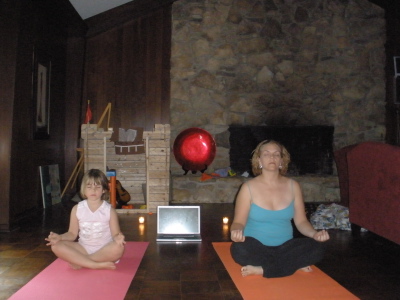
One of my goals, as a parent, is to teach my daughter coping skills and practical techniques for dealing with stress.
Personally, I've found yoga to be instrumental in building a core strength, core inner self and self worth, stress reduction and in communing with God.
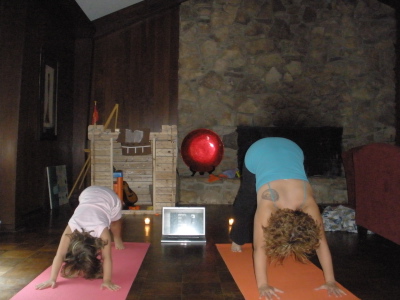
Of course I want her to have access to skills like this before she hits adolescents and all the negative coping strategies become available to her.
I used to use negative strategies like smoking cigarettes, experimenting with drugs, defining my self worth by boys and men, and a daily diet of Wellbutrin and Xanex. One of my primary objectives is to prevent the adoption of those.
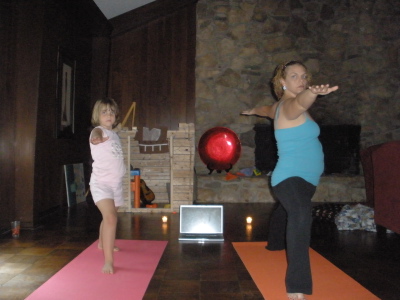
Over the summer I've been practicing yoga listening to Elsie Escobar classes on iTunes during Zack's nap. Sometimes I invite a friend. Sometimes I encourage Ainsley to try a few minutes.
She posed for these photos and then got bored before we moved out of the sitting pose. A fascination with the incense stick took over and she sat near me waving it through the air like a 4th of July sparkler.
The next afternoon I came out of the shower and found her teaching her friends yoga with a DVD, lit candles and burning incense.
Ssshhhh, Mom, we're having our relaxing quiet yoga time.
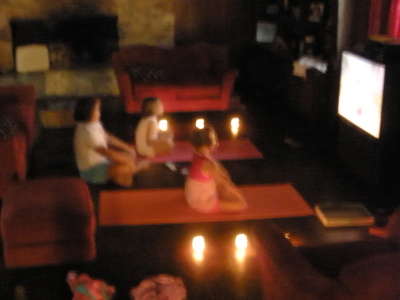
The APA's Report on Sexualization of Girls recommends teaching your children a way to center themselves, meditate, pray, and view one's body as having value beyond its appearance, beyond male entertainment. Yoga does that for me.
Hopefully, you have healthy coping methods that center and ground you and hopefully you're finding ways to teach those to your kids.
Teach what YOU know.
Yvonne from Joy Unexpected read this as the Community Keynote at BlogHer.
I don't ever want my daughter to feel the way that I have felt most of my adult life about my body.
Bravo Y.
If you can't watch her read it, you should read her Life Change Words.
First Magazine is looking for women who want to share body confidence stories.
One of the stories is about a gift that helped boost a woman's body confidence.
The other is about a family tradition that help's a woman feel good about her body.
The women who are featured in these stories will be professionally styled and photographed and also interviewed via phone and email.
All responses can be emailed to Helen Matatov at
HMatatov@bauerpublishing.com by Monday, August 4th.

Marketers are intentionally exploiting the vulnerabilities of our children. It's unacceptable. It's 100% within our rights and lies within our responsibility as citizens, as parents and as consumers to set some boundaries on marketing to kids.
* Directly marketing unhealthy food is a direct cause of childhood obesity, according to the Federal Trade Commission.
* Directly marketing credit cards by allowing credit corporations to write the curriculum or put their logo on high school signage or playgrounds or put product placement in their play cash registers is directly effecting kid's knowledge of money and credit negatively.
* Directly marketing to young girls in a beauty-obsessed way and using sexualized images of young girls in marketing and advertising sexualizes girls. It makes them believe it's okay to be consumed.
The Campaign for a Commercial-Free Childhood is making this a bi-partisan election issue.
Our campaign to get Democratic and Republican platform planks to protect children from marketers is gathering momentum. Last week, we met with the Democratic Party's National Platform Director and CCFC members around the country attended local platform meetings to advocate for a platform plank on the commercialization of childhood. This week, we need your help to demonstrate the broad support for these planks by signing petitions to the Democratic and Republican Platform Committees.
Sign the petition to the Republicans.
Sign the petition to the Democrats.
Sign both petitions and let whoever wins know they will be held accountable to you and your kids.
Forward this to your friends so they can take political action to protect our kids from direct marketing.
Why should you care?
Read more about exploitive credit tactics in, I Saw Satan on TV (and he's a little dork)
APA Sexualization of Girls Devastating
Read more about Precocious Puberty, which many experts say is food related both in the way of pesticides, hormones and obesity.
Watch a short film about how we're both allowing marketers to consume our kids and teaching them to be insatiable hyper-consumers at Consuming Kids.
 Keira Knightly is taking a stand against digitally enhancing her breasts for her upcoming movie, "The Dutchess."
When she stands up and declares herself "good enough" as she is, she stands up and declares our daughters "good enough" as they are.
Every actress who resists media pressure to conform to the beauty ideal does all girls and women a favor.
"She has insisted that her figure stay in its natural state," an insider said. "She is proud of her body and doesn't want it altered."This according to the Daily Mail via The Huffington Post.
Bravo Keira! You are good enough!
Photo Source: The Huffington Post, photos of before and after digital alteration for "King Arthur."
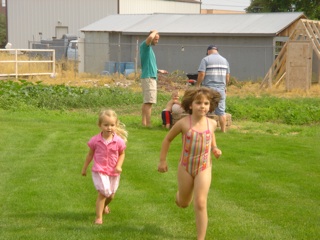
Mom can I tan?
Wait, what? What do you mean by tan?
Tan. Lay out in the sun to make my skin darker.
You're 6!
So? Stephanie and her sisters do it.
(Damn, older cheerleader sisters,) I think to myself.
Look. At. My. Face. Right. Now. Do you see those brown spots on my forehead and those speckles on my cheeks? That is sun damage. Laying out will ruin your beautiful skin, which is the perfect color as it is. Laying out also causes cancer. You can die from cancer.
So, no?
So, yes. You can lay out in the sun to relax by the pool, but you better have broad spectrum SPF 50 sunscreen on when you do it.
Tanning is one of my biggest regrets as I have spent far too much time and money trying to correct and hide the melasma, brown spots, on my face that resulted.
Is there a parenting phenomenon where our deepest and biggest regrets surface again in our children? Would that be Parenting Karma or God presenting an opportunity to us to resolve our past or correct our mistakes? And is this phenomenon on fast forward?
Anyone else notice this type of phenomenon?
Read more about melasma and sun damage here: Can a Leapord Change Her Spots?
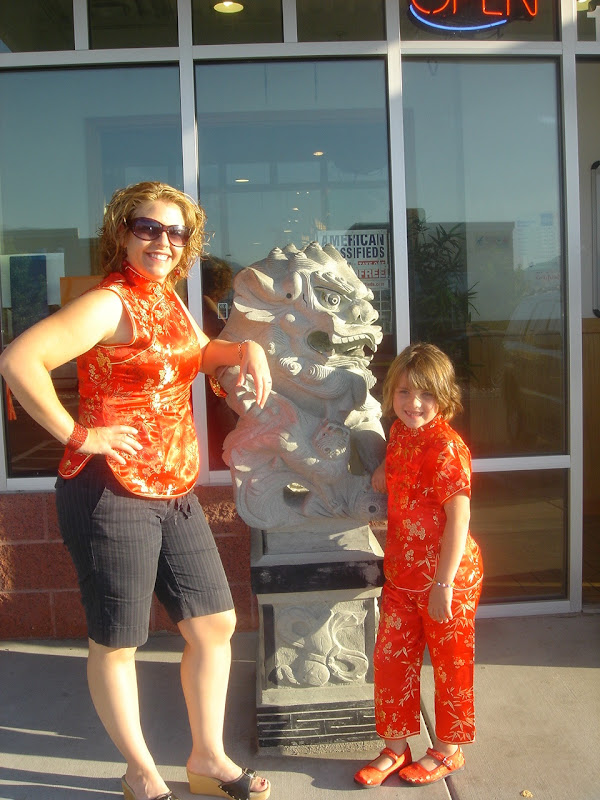
Mom, can we wear our matching Chinese outfits to the Chinese Restaurant?
Yes.
On a very basic and fundamental level childhood should be F-U-N.

by Tracee Sioux
I am going to put a self-loathing sin piggy-bank (pardon the pun) on my kitchen table.
Naomi Wolf has a great quote which is taped on my bathroom mirror, "The mother who radiates self-love and self-acceptance vaccinates her daughter against low self-esteem."
I accept this as a self-evident truth. In psychology circles I think they call it "mirroring" when our children look at us as a sort of reflection of themselves. A practical example would be, "my mother thinks she's fat, therefore I too am fat." A mother who is not actually fat, but repeatedly calls herself fat must then bear the responsibility when her daughter adopts an eating disorder like anorexia, bulimia or overeating.
More posts on Dove's Campaign for Real Beauty
Beauty & Reality
Self-Loathing Sin Bank
More posts on hair:
Pink Hair Fiasco
Pink Hair Fiasco Take 2
Curl Maintenance
The Meaning of Hair
The child's perception of herself is obviously flawed using this mirroring if she looks at her thin body in the mirror and sees fat. And it breaks any mother's heart when she sees her child look at her own beautiful self with disdain, criticism or self-loathing. I think God put in us an inherent ability to see goodness and beauty in our children, whether or not they are actually beautiful.
However, I believe the function of mirroring can be done reversely with what is sometimes painful accuracy. I think when my daughter looks at her legs and says, "my legs are fat" she's telling me in a very loud voice that this is a true reflection of how she thinks I feel about my own body image.
When I had my first baby I never lost the weight because I figured I would just have to lose it after the second one. On the second one I was in my 30s and my metabolism had slowed down and I was nearing the dreaded 200 pound mark. When I realized I was going to hit 200 in a couple of months and the doctor had me on a heart monitor because of dizzy spells I decided I had to make a complete and total lifestyle change. (My heart, it turns out is just fine.) The whole family was getting chubby and I decided we had to eat healthier and get more active rather than living the lifestyle of a Kobe calf (Tajima-ushi cattle reportedly receive regular massages with Japanese rice wine and are fed hops for a well-marbled texture and tenderness).
The weight is coming off at a slow and steady rate and the muscle is bulking up and I've never felt better. This is obviously a great example to my daughter, who is now 5 and, according to her pediatrician, in the "red zone" for her BMI (body mass index).
Except for one thing. The thinner I get, the more she seems to be focusing on her own perceived flaws. The other day she said she hated her legs because they were fat.
OUCH!! Like a knife in the gut I realized that I talk about my body in a negative way to motivate myself to get to the gym. Not only that, but I use self-deprecating humor to make people laugh and to illustrate that I have the ability to laugh at myself.
When speaking directly to her I use all the healthy phrases like suggesting she eat a healthy snack. Or explain that we're eating vegetables and fish for dinner because it's a healthier choice. Directly to her I am proactive about explaining that we're off to the gym so that I can be stronger and have a healthier heart.
But to others. . . .
She has heard me call myself Kobe Beef. (Yes, I'm a fan of the esoteric references to amuse myself.) She has also heard me complain about buying the "largest girdle underwear they make, only to find out it was too small." I have bragged about going down in pants sizes, "it's taken me 8 freaking months to make it down to a size 12." I have touted the fact that I have lost "20 pounds of pure fat." I have complained about how I simply can't find shirts long enough to cover my stomach, "which wouldn't be so bad if I weren't so fat and no one needs to see blubber hanging out of my clothes." I have touted my measurements, "losing 15 inches of ugly fat, back fat, flabby boob fat, thigh fat, belly fat." She's has heard me complain about my clothes that make me "look like a total cow." I have complained that it's going to take me "40 more weeks to get rid of my fat at the rate of a pound a week." She's heard me say how surprised I am that "my neck even lost an inch of fat allowing me to wear my pearl choker again."
The thing is, I don't loath my self or my body. I wasn't even aware of how fat I was until I started seeing positive changes in my body. I still dream of myself as thin. I still think of myself as "the thin cute blond" one when I'm with my girlfriends. I have been blind to my own fat. Heck, I'm fairly sure my daughter was blind to my fat. I don't look in the mirror and hate what I see, because I don't even see what's really there - I literally look in the mirror and see myself as I was in college.
Yet, I realize that my daughter can't determine the difference between how I feel about my body and what I say about my body. To her, she will only internalize that I say I feel fat and that I say I hate my body. She only hears me criticize my looks, my self. And that is what is inevitably effecting how she will see herself for the rest of her life.
It's tragic really. It breaks my heart. It feels like damage that can't be reversed. It makes me loath myself.
My vow is to change this negative behavior. It is not worth a few laughs for the self-deprecating humor. I feel I have to hold myself accountable to her for this behavior so that she is explicitly aware that it is not okay for me to be unkind to myself, and therefore I can expect her to show her own self the kindness I want for her.
So, I'm going to put a self-loathing sin beauty bank on the kitchen table and deposit say, a quarter (hey, we're on a strict budget around here) for every self-deprecating, self-loathing remark I make about my body or my self. I will ask her to catch me calling myself unkind names. I will require her to deposit the same when she makes negative comments about herself.
To avoid making it another exercise in self-loathing (I suck so bad, I can't believe I said I'm fat again, I'm such an idiot!) it will be a requirement to write a positive attribute about our bodies to put in the bank along with the quarters. Then after a month we'll take the jar of good thoughts and our quarters and we'll go out for Chinese food and talk about our progress and how much we love our own bodies.
Alarming statistics from Dove's Campaign for Real Beauty Study
http://www.campaignforrealbeauty.com/
* 42% of 1st-3rd grade girls want to be thinner. (Collins, 1991)
* 81% of 10 year olds are afraid of being fat. (Mellin et al., 1991)
* The average American woman is 5'4" tall and weighs 140 pounds. The average American model is 5'11" tall and weighs 117 pounds. Most fashion models are thinner than 98% of American women. (Smolak, 1996)
*51% of 9 and 10 year old girls feel better about themselves if they are on a diet. (Mellin et al.,1991)
* 91% of women recently surveyed on a college campus had attempted to control their weight through dieting, 91% dieted "often" or "always." (Kurth et al., 1995)
* 95% of all dieters will regain their lost weight in 1-5 years. (Grodstein, 1996)
* 35% of "normal dieters" progress to pathological dieting. Of those, 20-25% progress to partial or full-syndrome eating disorders. (Shisslak & Crago, 1995)
* 25% of American men and 45% of American women are on a diet on any given day. (Smolak, 1996)
* Americans spend over $40 billion on dieting and diet-related products each year. (Smolak, 1996)
http://www.campaignforrealbeauty.com/DoveBeyondStereotypesWhitePaper.pdf
I've entered this article in Babylune's writing contest about parenting mistakes and lessons learned. Follow the link to enter one of your own.
Another reason to leave your kids every once in a while - if you don't you'll miss the moment of reuniting. This is a pretty good moment.


Vacation Rerun from May 2007
by Tracee Sioux
I signed my daughter up for indoor soccer this season. The coach called me to invite me to a meeting of the parents and girls to determine the team colors and discuss when and where practices would be. As an after-thought she mentioned the team's new name would be
The Bratz.
What?
Bratz, you know like the dolls.
Are you kidding?
Well, no, it's called The Bratz.
Do we have to call them the brats?
Well, we have to have a name.
Well, can't we pick something positive? I would prefer about any other name than the Bratz. I mean, do we want to be yelling to our preschoolers, "Go Brats Go, be the best little brats you can be? I mean, I don't even let my daughter play with those Bratz dolls and I certainly don't want to encourage her to act like a brat or be a brat.
Well, no one else has looked at it like that, we can discuss it at the meeting and talk to the commissioner about changing the name.
Okay, so I was a little apprehensive about going to the meeting yesterday. I even thought it might be easier to not let my daughter play soccer than face that poor coach who got an ear full of my anti-Bratz propaganda.
Really, I was concerned that this fellow mother would hate me for making such a big deal about this. I was also more than a little worried that I would handle the situation very poorly and look hysterical and crazy because they wanted to brand my daughter a brat. Then who would look like a brat? Me. And all the other parents would band against me and decide that I was just the trouble-maker who wouldn't let anyone have any fun at all.
So, I go up to this strikingly beautiful woman at the meeting and introduce myself and the baby. Of course, hoping that the cute, fat baby would endear me to her. I even start up a banal conversation about whether or not she has to wear heals to work. Stupid and awkward.
The meeting starts and she says, Okay, who here objects to the name Bratz?
I alone raised my hand high. Everyone looks around and I feel like caving to avoid this confrontation with every other parent on the team."
Look, I said. I'm very uncomfortable with this name because I don't think we should be yelling Go Brats Go, Be the best little brat you can be. Brats Rule. I try all week long to NOT encourage my daughter to be a brat. I don't want her to act like those dolls and I don't let her dress like those dolls and I don't even let her play with the dolls. I'm just very uncomfortable with the name.
I was so grateful that I avoided saying they looked like whores who grew out of their clothes, which is what I usually say about those attrocious little beasts. And I didn't get into the symbolism of why their heads are so freakishly large - to fit their self-absorbed massive egos inside. Little battles for maturity inside myself.
Several people had warned me that I had better come up with a better name to subs awkward with parents trying to think up a better name - I suggested Kickers but it wasn't cute enough. Someone suggested the Shortcakes, and I was agreeable. Then I suggested the Pink Panthers, but then it looked like there were several other teams with pink shirts and so we thought we should go with purple.
Every now and then some parent would glare at me and say, Are you sure you don't like the name Bratz?
And I would shrug and say, yeah, I just don't think that's a great name for our girls.
A few parents wanted to point out that they don't let their daughters wear the make-up or dress like that - they're "just dolls."
But, I guess that's my problem, I don't think they are just dolls. I think they're a negative message about who the girls should emulate.
In the end we settled, quite unenthusiastically on Butterflies.
Okay, nothing great about that, but nothing horrible about it either. Butterflies are nice, they embrace change and they are pretty and all the little four- and five-year-olds like butterflies.
Of course, the girls weren't as enthusiastic about butterflies as they had been about The Bratz. But, then I figure the girls are enthusiastic about what Matel, or in this case MGA Entertainment markets to them, which doesn't necessarily make it a good thing.
I did volunteer to arrange all the snacks for the season and we'll see if the other parents will hold a grudge or cooperate with my efforts.
I have to give props to the coach however. She was very nice when I went up and thanked her for volunteering to change the name. After all I am only one parent and they could have just shunned me. Hopefully the season will be a good experience for my daughter.
I do feel triumphant, if a little embarrassed, for standing up for what I believe even though it's hugely unpopular and I want my daughter to learn to do that.
Of course, later the Soccer Commission overrode our decision and guess what I did? Read No Bratz No! Tantrum or Go with the Flow?
Read the outcome at Happy Feet Beats Bratz
And you should watch this hilarious YouTube film, Slutz, Bratz Parody, which is so not appropriate for children - but then neither are those dolls.

So I had my big BlogHer08 speaking panel, Mirrors: Ours, The Media’s, Our Cultures’ and Our Kids’ speaking panel yesterday and it was a rush.
The panelists were Laurie Toby Edison of Body Impolitic, Tracee Sioux of Empowering Girls: So Sioux Me, Kelly Wickham of Mocha Momma, and Glennia Campbell of The Silent I (also Mom-o-crats and Kimchi Mamas).
Laurie Toby published the transcript on her blog and I'd love if you would hop over and read it. I think it went really, really well.
Tracee: I write about empowering girls, specifically daughters. How girls internalize the media and what we as parents can do to give them tools to fight that. Daughters inherit our emotions about our bodies. So many women self-deprecate for humor; I used to do it all the time. When my 4-year-old said “I hate my fat thighs,” I said “What have I done?” Women use this to bond–I’m not perfect, you’re not perfect. I was joking, but my daughter couldn’t tell it was a joke. Daughters feel that when you criticize yourself you’re criticizing their DNA.
Truly, I had the best time. It was so encouraging to see how many women are thinking about the complex world our daughters live in and how best to approach the building/moulding of their selves.

A mother who radiates self-love and self-acceptance vaccinates her daughter against low self-esteem. Naomi Wolf
The reverse is also true.
Divorce expert M. Gary Neuman says the worst thing any parent can do to their child is to criticize their other parent. Because children hear this as criticism of self. You criticize a child's DNA when you criticize their parent.
The same holds true when daughters hear their mothers criticize their own appearance. This is obvious if they share the criticized feature. Even if they don't, a "not pretty enough" feeling passes from one generation to the next.
As life coach Martha Beck says, Children feel about themselves the way we feel about ourselves. We only wish they felt about themselves the way we feel about them.
Wishing it doesn't make it so.
My Beautiful Mommy, a children's book, written by a plastic surgeon, who is incidentally depicted as a superhero who manages to make Mommy "pretty" (as both God and Mother Nature evidently could not) with a nose job, implied boob job and tummy tuck, has prompted media criticism.
As a parent, this book touches something inside us that we know intuitively is bad for kids.
What is plastic surgery if it's not the ultimate self-criticism?
What is plastic surgery if it's not the ultimate in criticizing both our children's and our parents' DNA?
The premise of this book is that we can resolve our self esteem and low self worth issues with surgery, and that we have the ability to articulate that to our children with a story book.
This can never, ever work.
What we CAN do, is grow a self esteem and teach our children how to grow a self esteem too.
The first step in feeling good about one's own reflection is to stop criticizing it. If we can learn to love how we look, our children will intuitively inherit a good self esteem.
I make it a point to compliment my own features as beautiful, especially those I share with my daughter.
Your hair is thick like mine, I love my hair.
We have perfect bow lips.
You're lucky you got my eyes, they are one of our best features.
I do it because I want to actively vaccinate my daughter against a low self esteem as Naomi Wolf suggests.
Try it. As with anything it takes practice, feels awkward at first but quickly becomes a habit.
If self-deprecation is becoming a problem in your house please read My Face/Her Face and Self-Loathing Sin Bank.

I am deeply struck by this photograph which I found on About Face, a non-profit company which combats negative images of women in the media.
Without taking a right or wrong stance about plastic surgery, this photograph of a mother and her daughters speaks volumes about what self-hatred, self-criticism and self-loathing costs the collective conscience of femininity.
Remember when we found out on Friends that Rachel had a nose job? It seemed like a kind enough thing to do for herself when she was single and a completely autonomous person. But, then she had a baby girl and the issue came up again. It was quite funny to watch her consider, "What if the baby gets my old nose?"
Funny. But, in a practical sense what if she does? What if she gets your old nose? How much harder is it to learn to love yourself if you go through life with a nose even your own mother finds unacceptable?
Who then is responsible for the daughter's self esteem issue about her nose? While many might come back to a post like this and say, "Well, just give the daughter a nose job." Sure, eventually. But, she has to hate her nose until it stops growing in her late teens.
My hypothesis is that it's much more effective to learn to love our own nose, face, and breasts than to combat poor self worth in our daughters, created by our own feelings of self-loathing.
It is also notable that the feelings about my own appearance have become significantly more positive now that I can look at my daughter's face and see the beauty there. To me, she has not one single flaw. The features she shares with me have become more attractive to me by virtue of being on her.
That said, many women will get plastic surgery to fix what they perceive as "flaws." I don't want to argue the moral position that you shouldn't, certainly you have to make your own decision.
That said, I do think it's worth asking, what then do you plan to say to your daughter if she shares the same perceived flaw?
Read more about how our feelings about our own appearance deeply effect our daughters feelings about themselves in Self-Loathing Sin Bank.

Lucy, today's guest blogger, is a mother of three who lives in the UK. Lucy blogs at Free From , about gluten free food because her oldest child is a ceoliac.She observes the behaviour of the tribes of youth in her free time. But what was she doing at McD's? That's not very gluten free.
He Loves Me . . . He Loves Me Not .. .
I skirted around the group of young people sitting outside, and went in to order. We sat and while he munched chicken nuggets and played with the free toy I watched the gang.
The group had a core group of five males, who sat together at a bench table, being loud. There were some stragglers, all female, who perched on the surrounding tables, occasionally talking to each other, but mostly silent, inspecting their nails. The boys were scruffy and unkempt; the girls were made up and dressed up. They can only have been about 15.
Periodically, the girls tried to join in the core group conversation, tried to attract attention from the table of boys, but were met with abuse. Mostly along the lines of 'shut up, you fat slag'.
The girls were beautiful, in that heartbreaking, young, 'tried-a-bit-hard' fashion. No way did any of those unpleasant boys deserve their attention. These girls should have walked away, done something more interesting, generated their own fun together ... but of course they didn't. Eventually the group got up and wandered off, most of the boys collecting a girl each as they passed.
This sad little scenario is played out night after night in small towns (and larger ones) across the country, and it bothers me. The girls have little or no self-esteem beyond their hair and nails; the boys treat them as worthless, except as a trophy.
It more than bothers me. How many years have women – yes, generations of young women – been struggling to gain equality?
How can I show my young daughters as they grow up that they deserve better than this? How to explain that they do not have to be defined as somebody's girl, but can be strong individuals who know their own intrinsic worth?
How can I show my young son as he grows up that he, too, is worth, and can be, more than this?
I wanted to say to those girls “you're worth more than this” - but I couldn't. How could I, some random interfering stranger? But someone at home should have told them how valuable they are. Daily. And not just for their hair and nails ...
Pages from Ainsley, Perfect You, a book I wrote for my daughter. Steal this idea for Christmas, Please!
Subscribe to my RSS feed and/or email subscription. You don't miss the rest of this series.
Pages from Ainsley, Perfect You, a book I wrote for my daughter. Steal this idea for Christmas, Please!
Subscribe to my RSS feed and/or email subscription. You don't miss the rest of this series.
In everything we've been reading the damaging effects of media has been a central force.
APA Report on Sexualization of Girls, Girls Inc.'s The Supergirl Dilemma, You're Amazing, Geena Davis Institute on Gender in Media all cite exposure to media as a central force in the girls beginning to define themselves as less than they truly are.
While every one of these sources cite media as a potentially damaging influence, they also recommend fighting negative media with positive media.
We have the power to - not just passively ban negative media, which we should definitely do - But we have the power to CREATE positive media for our daughters about girls.
I can tell you this - my daughter thinks it's pretty cool that she's the Poster Girl for Empowering Girls: So Sioux Me. This is one of the reasons I'm inviting you to send photos of your daughter to be included as a Poster Girl on this site. It is one way to take media from outside of our world to a creative and positive medium that includes them.
I created a children's book for my daughter's 5th birthday titled Ainsley, Perfect You. I am practically begging you to STEAL this idea for Christmas (or birthdays).
We read this book before the First Day of School, whenever Ainsley makes negative comments about her self, whenever she feels insecure or whenever she wants. It's a special book that sits out on a shelf and we must wash our hands before reading it.
In the book I addressed issues of beauty, because Ainsley seemed preoccupied with what it was and exactly what criteria people were using to make the judgement about who was beautiful. I addressed school, education, intelligence and learning. I addressed self-worth and a feeling of wholeness and "enoughness." I addressed the meaning of God and her role as a Child of God. I addressed risk-taking and trying new things.
Your family may prize different characteristics or place different values as a priority. What's important, is that you can use this tool to teach her who she is, but also influence, mold and raise or define the bar of expectation for who she will become.
A-N-Y-O-N-E can do this if they have a computer, a camera, $30 and an imagination. You may be thinking you're short on imagination so, while Ainsley, Perfect You is copyrighted I give you permission to steal ideas, concepts, words, etc. Your daughter is every bit as cool as mine, but she may have different attributes and characteristics.
I encourage you to use my book for ideas, but personalize them for your daughter(s). (Of course, its good for your daughter, but don't forget your sons.)
I used www.MyPublisher.com because they were the only company who had a "storybook" feature at the time. Turns out my parents and grandparents were also interested in having a copy of this book (one project many gifts!) and My Publisher has coupons they'll send you frequently. Flickr now offers the feature, and Snapfish and probably all the other ones too.
There are 20 pages so I'll run Ainsley, Perfect You as a series, starting with this foreword. I had to scan the pages, so please forgive the quality.
You'll want to get the RSS feed or an email subscription so you don't miss any of it.
We went to the Exploratorium in San Francisco.
One particular exhibit had a disconcerting effect on me for days.
You sit in between two mirrors and look at your self.
One is a regular mirror and show's you how you see yourself every day. The top photo is how I see myself.
The other shows you what other people see every day. It shows you what you really look like.
Do you see a minute difference between the top photo and the bottom photo?
I've been fascinated by my own emotional reaction. Truly, it was unsettling to see my reflection differently than I do everyday.
The top photo, what I see in the mirror is more attractive to me.
My eyes are uneven in the second photo. The right eye, when looking at it, is slightly lower than the left one.
I find I hold my head slightly tilted in a way that makes my features more even. I think I also hold that eyebrow higher to make the eyes look more symmetrical. I compensate for the flaw I've really only noticed once in a photo when I was pregnant with Zack.
Since you are other people and it's not your face I really have no clue how you are perceiving the attractiveness of the two photos or whether you see the unevenness of my eyes at all. For all I know, everyone who sees me, may choose to make the same correction that I do for myself.
It strikes me as a kindness to myself that my subconscious mind chooses to correct my minor flaw so that I not only feel more attractive, but literally see myself as more attractive.
It also strikes me that people who suffer from eating disorders, like anorexia and bulimia or the emotional disorder of body dysmorphia for some reason they aren't subconsciously fixing their features in their minds.
They are not only seeing their minor flaw - they are focusing on it and magnifying it.
Its also likely they are expecting the outside world, other people, to treat them the way they treat themselves. Did you see how I assumed that others would treat me with the same kindness as I show myself and that others would correct or overlook the minor flaw in their own perceptions, rather than focus on it and magnify it? This assumption is likely a result of my habit of doing such a kindness for myself and for others.
Were I unkind to myself, and if I made a habit of focusing on the minor flaws of other people, I would likely assume that others were also doing so to me.
That's my theory anyway, based on everything I've read about self-esteem, self-worth, and eating disorders and related emotional disorders.
It follows then that maybe we can teach our daughters to serve their own mental health and self-esteem.
Cutting ourselves, our daughters and others some slack for our minor physical flaws teaches, by example, our daughters this emotional skill vital to their self-preservation.
Treating ourselves, our daughters, and others - especially other girls and women - with kindness is also a teachable habit.
Self-love and self-acceptance is a skill. One we learn and one we can teach.
Yesterday I sent Ainsley off to First Grade.
Someone asked me, Did you cry?
Cry? I did cartwheels!
Which is an exaggeration. I felt a some relief.
Have you any idea what its like to work with two small children in your cube?
THIS is the reason I'm not doing cartwheels - Yet.
Zack is bored and lonely when his sister goes to school. He needs to go to preschool. Only I didn't realize my new town has only one and it fills up fast.
I'm praying for two biters and two separation anxieties - Zack's 4th on the list.
Mother's Day Out will give me 2 days a week to work uninterrupted. It will give him social contact with other children and stimulation. He's super smart - which is why he was trying to Make His Own Popcorn For Dinner. Check out his Potty Dance debut on YouTube.
How are ya'll managing your first day of school around the country?
,Over one hundred essays poured in from 26 states and four countries. Reading the essays shed light on the current state of the mom-mind. For example, the word 'perfect' (of a variation of it) was used over 92 times. That's almost one 'perfect' for every mom. While I think the questioning of perfection is positive (although not every essay questioned it), the frequency shows that the desire to be 'perfect' continues to loom over our sense of identity.
All too many American women are in thrall to increasingly deranged ideals of perfection. We live in a culture that constantly exhorts us to improve ourselves - and that assumes the perfectibility of virtually everything. If you don't like your nose, get a nose job! If you don't like the color of your hair, dye it! If your thighs are lumpy have liposuction! If you want abs of steel, go to the gym! Personal maintenance has become a national obsession that consumes a staggering amount of energy and resources; if American women put even a fraction of the time they spend on their appearance into working or social and political change, this country would be utterly transformed.
One of my goals, as a parent, is to teach my daughter coping skills and practical techniques for dealing with stress.
Personally, I've found yoga to be instrumental in building a core strength, core inner self and self worth, stress reduction and in communing with God.
Of course I want her to have access to skills like this before she hits adolescents and all the negative coping strategies become available to her.
I used to use negative strategies like smoking cigarettes, experimenting with drugs, defining my self worth by boys and men, and a daily diet of Wellbutrin and Xanex. One of my primary objectives is to prevent the adoption of those.
Over the summer I've been practicing yoga listening to Elsie Escobar classes on iTunes during Zack's nap. Sometimes I invite a friend. Sometimes I encourage Ainsley to try a few minutes.
She posed for these photos and then got bored before we moved out of the sitting pose. A fascination with the incense stick took over and she sat near me waving it through the air like a 4th of July sparkler.
The next afternoon I came out of the shower and found her teaching her friends yoga with a DVD, lit candles and burning incense.
Ssshhhh, Mom, we're having our relaxing quiet yoga time.
The APA's Report on Sexualization of Girls recommends teaching your children a way to center themselves, meditate, pray, and view one's body as having value beyond its appearance, beyond male entertainment. Yoga does that for me.
Hopefully, you have healthy coping methods that center and ground you and hopefully you're finding ways to teach those to your kids.
Teach what YOU know.
Yvonne from Joy Unexpected read this as the Community Keynote at BlogHer.
I don't ever want my daughter to feel the way that I have felt most of my adult life about my body.
Bravo Y.
If you can't watch her read it, you should read her Life Change Words.
First Magazine is looking for women who want to share body confidence stories.
One of the stories is about a gift that helped boost a woman's body confidence.
The other is about a family tradition that help's a woman feel good about her body.
The women who are featured in these stories will be professionally styled and photographed and also interviewed via phone and email.
All responses can be emailed to Helen Matatov at
HMatatov@bauerpublishing.com by Monday, August 4th.
Marketers are intentionally exploiting the vulnerabilities of our children. It's unacceptable. It's 100% within our rights and lies within our responsibility as citizens, as parents and as consumers to set some boundaries on marketing to kids.
* Directly marketing unhealthy food is a direct cause of childhood obesity, according to the Federal Trade Commission.
* Directly marketing credit cards by allowing credit corporations to write the curriculum or put their logo on high school signage or playgrounds or put product placement in their play cash registers is directly effecting kid's knowledge of money and credit negatively.
* Directly marketing to young girls in a beauty-obsessed way and using sexualized images of young girls in marketing and advertising sexualizes girls. It makes them believe it's okay to be consumed.
The Campaign for a Commercial-Free Childhood is making this a bi-partisan election issue.
Our campaign to get Democratic and Republican platform planks to protect children from marketers is gathering momentum. Last week, we met with the Democratic Party's National Platform Director and CCFC members around the country attended local platform meetings to advocate for a platform plank on the commercialization of childhood. This week, we need your help to demonstrate the broad support for these planks by signing petitions to the Democratic and Republican Platform Committees.
Sign the petition to the Republicans.
Sign the petition to the Democrats.
Sign both petitions and let whoever wins know they will be held accountable to you and your kids.
Forward this to your friends so they can take political action to protect our kids from direct marketing.
Why should you care?
Read more about exploitive credit tactics in, I Saw Satan on TV (and he's a little dork)
APA Sexualization of Girls Devastating
Read more about Precocious Puberty, which many experts say is food related both in the way of pesticides, hormones and obesity.
Watch a short film about how we're both allowing marketers to consume our kids and teaching them to be insatiable hyper-consumers at Consuming Kids.
Keira Knightly is taking a stand against digitally enhancing her breasts for her upcoming movie, "The Dutchess."
When she stands up and declares herself "good enough" as she is, she stands up and declares our daughters "good enough" as they are.
Every actress who resists media pressure to conform to the beauty ideal does all girls and women a favor.
"She has insisted that her figure stay in its natural state," an insider said. "She is proud of her body and doesn't want it altered."This according to the Daily Mail via The Huffington Post.
Bravo Keira! You are good enough!
Photo Source: The Huffington Post, photos of before and after digital alteration for "King Arthur."
Mom can I tan?
Wait, what? What do you mean by tan?
Tan. Lay out in the sun to make my skin darker.
You're 6!
So? Stephanie and her sisters do it.
(Damn, older cheerleader sisters,) I think to myself.
Look. At. My. Face. Right. Now. Do you see those brown spots on my forehead and those speckles on my cheeks? That is sun damage. Laying out will ruin your beautiful skin, which is the perfect color as it is. Laying out also causes cancer. You can die from cancer.
So, no?
So, yes. You can lay out in the sun to relax by the pool, but you better have broad spectrum SPF 50 sunscreen on when you do it.
Tanning is one of my biggest regrets as I have spent far too much time and money trying to correct and hide the melasma, brown spots, on my face that resulted.
Is there a parenting phenomenon where our deepest and biggest regrets surface again in our children? Would that be Parenting Karma or God presenting an opportunity to us to resolve our past or correct our mistakes? And is this phenomenon on fast forward?
Anyone else notice this type of phenomenon?
Read more about melasma and sun damage here: Can a Leapord Change Her Spots?
Mom, can we wear our matching Chinese outfits to the Chinese Restaurant?
Yes.
On a very basic and fundamental level childhood should be F-U-N.
by Tracee Sioux
I am going to put a self-loathing sin piggy-bank (pardon the pun) on my kitchen table.
Naomi Wolf has a great quote which is taped on my bathroom mirror, "The mother who radiates self-love and self-acceptance vaccinates her daughter against low self-esteem."
I accept this as a self-evident truth. In psychology circles I think they call it "mirroring" when our children look at us as a sort of reflection of themselves. A practical example would be, "my mother thinks she's fat, therefore I too am fat." A mother who is not actually fat, but repeatedly calls herself fat must then bear the responsibility when her daughter adopts an eating disorder like anorexia, bulimia or overeating.
More posts on Dove's Campaign for Real Beauty
Beauty & Reality
Self-Loathing Sin Bank
More posts on hair:
Pink Hair Fiasco
Pink Hair Fiasco Take 2
Curl Maintenance
The Meaning of Hair
The child's perception of herself is obviously flawed using this mirroring if she looks at her thin body in the mirror and sees fat. And it breaks any mother's heart when she sees her child look at her own beautiful self with disdain, criticism or self-loathing. I think God put in us an inherent ability to see goodness and beauty in our children, whether or not they are actually beautiful.
However, I believe the function of mirroring can be done reversely with what is sometimes painful accuracy. I think when my daughter looks at her legs and says, "my legs are fat" she's telling me in a very loud voice that this is a true reflection of how she thinks I feel about my own body image.
When I had my first baby I never lost the weight because I figured I would just have to lose it after the second one. On the second one I was in my 30s and my metabolism had slowed down and I was nearing the dreaded 200 pound mark. When I realized I was going to hit 200 in a couple of months and the doctor had me on a heart monitor because of dizzy spells I decided I had to make a complete and total lifestyle change. (My heart, it turns out is just fine.) The whole family was getting chubby and I decided we had to eat healthier and get more active rather than living the lifestyle of a Kobe calf (Tajima-ushi cattle reportedly receive regular massages with Japanese rice wine and are fed hops for a well-marbled texture and tenderness).
The weight is coming off at a slow and steady rate and the muscle is bulking up and I've never felt better. This is obviously a great example to my daughter, who is now 5 and, according to her pediatrician, in the "red zone" for her BMI (body mass index).
Except for one thing. The thinner I get, the more she seems to be focusing on her own perceived flaws. The other day she said she hated her legs because they were fat.
OUCH!! Like a knife in the gut I realized that I talk about my body in a negative way to motivate myself to get to the gym. Not only that, but I use self-deprecating humor to make people laugh and to illustrate that I have the ability to laugh at myself.
When speaking directly to her I use all the healthy phrases like suggesting she eat a healthy snack. Or explain that we're eating vegetables and fish for dinner because it's a healthier choice. Directly to her I am proactive about explaining that we're off to the gym so that I can be stronger and have a healthier heart.
But to others. . . .
She has heard me call myself Kobe Beef. (Yes, I'm a fan of the esoteric references to amuse myself.) She has also heard me complain about buying the "largest girdle underwear they make, only to find out it was too small." I have bragged about going down in pants sizes, "it's taken me 8 freaking months to make it down to a size 12." I have touted the fact that I have lost "20 pounds of pure fat." I have complained about how I simply can't find shirts long enough to cover my stomach, "which wouldn't be so bad if I weren't so fat and no one needs to see blubber hanging out of my clothes." I have touted my measurements, "losing 15 inches of ugly fat, back fat, flabby boob fat, thigh fat, belly fat." She's has heard me complain about my clothes that make me "look like a total cow." I have complained that it's going to take me "40 more weeks to get rid of my fat at the rate of a pound a week." She's heard me say how surprised I am that "my neck even lost an inch of fat allowing me to wear my pearl choker again."
The thing is, I don't loath my self or my body. I wasn't even aware of how fat I was until I started seeing positive changes in my body. I still dream of myself as thin. I still think of myself as "the thin cute blond" one when I'm with my girlfriends. I have been blind to my own fat. Heck, I'm fairly sure my daughter was blind to my fat. I don't look in the mirror and hate what I see, because I don't even see what's really there - I literally look in the mirror and see myself as I was in college.
Yet, I realize that my daughter can't determine the difference between how I feel about my body and what I say about my body. To her, she will only internalize that I say I feel fat and that I say I hate my body. She only hears me criticize my looks, my self. And that is what is inevitably effecting how she will see herself for the rest of her life.
It's tragic really. It breaks my heart. It feels like damage that can't be reversed. It makes me loath myself.
My vow is to change this negative behavior. It is not worth a few laughs for the self-deprecating humor. I feel I have to hold myself accountable to her for this behavior so that she is explicitly aware that it is not okay for me to be unkind to myself, and therefore I can expect her to show her own self the kindness I want for her.
So, I'm going to put a self-loathing sin beauty bank on the kitchen table and deposit say, a quarter (hey, we're on a strict budget around here) for every self-deprecating, self-loathing remark I make about my body or my self. I will ask her to catch me calling myself unkind names. I will require her to deposit the same when she makes negative comments about herself.
To avoid making it another exercise in self-loathing (I suck so bad, I can't believe I said I'm fat again, I'm such an idiot!) it will be a requirement to write a positive attribute about our bodies to put in the bank along with the quarters. Then after a month we'll take the jar of good thoughts and our quarters and we'll go out for Chinese food and talk about our progress and how much we love our own bodies.
Alarming statistics from Dove's Campaign for Real Beauty Study
http://www.campaignforrealbeauty.com/
* 42% of 1st-3rd grade girls want to be thinner. (Collins, 1991)
* 81% of 10 year olds are afraid of being fat. (Mellin et al., 1991)
* The average American woman is 5'4" tall and weighs 140 pounds. The average American model is 5'11" tall and weighs 117 pounds. Most fashion models are thinner than 98% of American women. (Smolak, 1996)
*51% of 9 and 10 year old girls feel better about themselves if they are on a diet. (Mellin et al.,1991)
* 91% of women recently surveyed on a college campus had attempted to control their weight through dieting, 91% dieted "often" or "always." (Kurth et al., 1995)
* 95% of all dieters will regain their lost weight in 1-5 years. (Grodstein, 1996)
* 35% of "normal dieters" progress to pathological dieting. Of those, 20-25% progress to partial or full-syndrome eating disorders. (Shisslak & Crago, 1995)
* 25% of American men and 45% of American women are on a diet on any given day. (Smolak, 1996)
* Americans spend over $40 billion on dieting and diet-related products each year. (Smolak, 1996)
http://www.campaignforrealbeauty.com/DoveBeyondStereotypesWhitePaper.pdf
I've entered this article in Babylune's writing contest about parenting mistakes and lessons learned. Follow the link to enter one of your own.
Another reason to leave your kids every once in a while - if you don't you'll miss the moment of reuniting. This is a pretty good moment.
Vacation Rerun from May 2007
by Tracee Sioux
I signed my daughter up for indoor soccer this season. The coach called me to invite me to a meeting of the parents and girls to determine the team colors and discuss when and where practices would be. As an after-thought she mentioned the team's new name would be
The Bratz.
What?
Bratz, you know like the dolls.
Are you kidding?
Well, no, it's called The Bratz.
Do we have to call them the brats?
Well, we have to have a name.
Well, can't we pick something positive? I would prefer about any other name than the Bratz. I mean, do we want to be yelling to our preschoolers, "Go Brats Go, be the best little brats you can be? I mean, I don't even let my daughter play with those Bratz dolls and I certainly don't want to encourage her to act like a brat or be a brat.
Well, no one else has looked at it like that, we can discuss it at the meeting and talk to the commissioner about changing the name.
Okay, so I was a little apprehensive about going to the meeting yesterday. I even thought it might be easier to not let my daughter play soccer than face that poor coach who got an ear full of my anti-Bratz propaganda.
Really, I was concerned that this fellow mother would hate me for making such a big deal about this. I was also more than a little worried that I would handle the situation very poorly and look hysterical and crazy because they wanted to brand my daughter a brat. Then who would look like a brat? Me. And all the other parents would band against me and decide that I was just the trouble-maker who wouldn't let anyone have any fun at all.
So, I go up to this strikingly beautiful woman at the meeting and introduce myself and the baby. Of course, hoping that the cute, fat baby would endear me to her. I even start up a banal conversation about whether or not she has to wear heals to work. Stupid and awkward.
The meeting starts and she says, Okay, who here objects to the name Bratz?
I alone raised my hand high. Everyone looks around and I feel like caving to avoid this confrontation with every other parent on the team."
Look, I said. I'm very uncomfortable with this name because I don't think we should be yelling Go Brats Go, Be the best little brat you can be. Brats Rule. I try all week long to NOT encourage my daughter to be a brat. I don't want her to act like those dolls and I don't let her dress like those dolls and I don't even let her play with the dolls. I'm just very uncomfortable with the name.
I was so grateful that I avoided saying they looked like whores who grew out of their clothes, which is what I usually say about those attrocious little beasts. And I didn't get into the symbolism of why their heads are so freakishly large - to fit their self-absorbed massive egos inside. Little battles for maturity inside myself.
Several people had warned me that I had better come up with a better name to subs awkward with parents trying to think up a better name - I suggested Kickers but it wasn't cute enough. Someone suggested the Shortcakes, and I was agreeable. Then I suggested the Pink Panthers, but then it looked like there were several other teams with pink shirts and so we thought we should go with purple.
Every now and then some parent would glare at me and say, Are you sure you don't like the name Bratz?
And I would shrug and say, yeah, I just don't think that's a great name for our girls.
A few parents wanted to point out that they don't let their daughters wear the make-up or dress like that - they're "just dolls."
But, I guess that's my problem, I don't think they are just dolls. I think they're a negative message about who the girls should emulate.
In the end we settled, quite unenthusiastically on Butterflies.
Okay, nothing great about that, but nothing horrible about it either. Butterflies are nice, they embrace change and they are pretty and all the little four- and five-year-olds like butterflies.
Of course, the girls weren't as enthusiastic about butterflies as they had been about The Bratz. But, then I figure the girls are enthusiastic about what Matel, or in this case MGA Entertainment markets to them, which doesn't necessarily make it a good thing.
I did volunteer to arrange all the snacks for the season and we'll see if the other parents will hold a grudge or cooperate with my efforts.
I have to give props to the coach however. She was very nice when I went up and thanked her for volunteering to change the name. After all I am only one parent and they could have just shunned me. Hopefully the season will be a good experience for my daughter.
I do feel triumphant, if a little embarrassed, for standing up for what I believe even though it's hugely unpopular and I want my daughter to learn to do that.
Of course, later the Soccer Commission overrode our decision and guess what I did? Read No Bratz No! Tantrum or Go with the Flow?
Read the outcome at Happy Feet Beats Bratz
And you should watch this hilarious YouTube film, Slutz, Bratz Parody, which is so not appropriate for children - but then neither are those dolls.
So I had my big BlogHer08 speaking panel, Mirrors: Ours, The Media’s, Our Cultures’ and Our Kids’ speaking panel yesterday and it was a rush.
The panelists were Laurie Toby Edison of Body Impolitic, Tracee Sioux of Empowering Girls: So Sioux Me, Kelly Wickham of Mocha Momma, and Glennia Campbell of The Silent I (also Mom-o-crats and Kimchi Mamas).
Laurie Toby published the transcript on her blog and I'd love if you would hop over and read it. I think it went really, really well.
Tracee: I write about empowering girls, specifically daughters. How girls internalize the media and what we as parents can do to give them tools to fight that. Daughters inherit our emotions about our bodies. So many women self-deprecate for humor; I used to do it all the time. When my 4-year-old said “I hate my fat thighs,” I said “What have I done?” Women use this to bond–I’m not perfect, you’re not perfect. I was joking, but my daughter couldn’t tell it was a joke. Daughters feel that when you criticize yourself you’re criticizing their DNA.
Truly, I had the best time. It was so encouraging to see how many women are thinking about the complex world our daughters live in and how best to approach the building/moulding of their selves.
A mother who radiates self-love and self-acceptance vaccinates her daughter against low self-esteem. Naomi Wolf
The reverse is also true.
Divorce expert M. Gary Neuman says the worst thing any parent can do to their child is to criticize their other parent. Because children hear this as criticism of self. You criticize a child's DNA when you criticize their parent.
The same holds true when daughters hear their mothers criticize their own appearance. This is obvious if they share the criticized feature. Even if they don't, a "not pretty enough" feeling passes from one generation to the next.
As life coach Martha Beck says, Children feel about themselves the way we feel about ourselves. We only wish they felt about themselves the way we feel about them.
Wishing it doesn't make it so.
My Beautiful Mommy, a children's book, written by a plastic surgeon, who is incidentally depicted as a superhero who manages to make Mommy "pretty" (as both God and Mother Nature evidently could not) with a nose job, implied boob job and tummy tuck, has prompted media criticism.
As a parent, this book touches something inside us that we know intuitively is bad for kids.
What is plastic surgery if it's not the ultimate self-criticism?
What is plastic surgery if it's not the ultimate in criticizing both our children's and our parents' DNA?
The premise of this book is that we can resolve our self esteem and low self worth issues with surgery, and that we have the ability to articulate that to our children with a story book.
This can never, ever work.
What we CAN do, is grow a self esteem and teach our children how to grow a self esteem too.
The first step in feeling good about one's own reflection is to stop criticizing it. If we can learn to love how we look, our children will intuitively inherit a good self esteem.
I make it a point to compliment my own features as beautiful, especially those I share with my daughter.
Your hair is thick like mine, I love my hair.
We have perfect bow lips.
You're lucky you got my eyes, they are one of our best features.
I do it because I want to actively vaccinate my daughter against a low self esteem as Naomi Wolf suggests.
Try it. As with anything it takes practice, feels awkward at first but quickly becomes a habit.
If self-deprecation is becoming a problem in your house please read My Face/Her Face and Self-Loathing Sin Bank.
I am deeply struck by this photograph which I found on About Face, a non-profit company which combats negative images of women in the media.
Without taking a right or wrong stance about plastic surgery, this photograph of a mother and her daughters speaks volumes about what self-hatred, self-criticism and self-loathing costs the collective conscience of femininity.
Remember when we found out on Friends that Rachel had a nose job? It seemed like a kind enough thing to do for herself when she was single and a completely autonomous person. But, then she had a baby girl and the issue came up again. It was quite funny to watch her consider, "What if the baby gets my old nose?"
Funny. But, in a practical sense what if she does? What if she gets your old nose? How much harder is it to learn to love yourself if you go through life with a nose even your own mother finds unacceptable?
Who then is responsible for the daughter's self esteem issue about her nose? While many might come back to a post like this and say, "Well, just give the daughter a nose job." Sure, eventually. But, she has to hate her nose until it stops growing in her late teens.
My hypothesis is that it's much more effective to learn to love our own nose, face, and breasts than to combat poor self worth in our daughters, created by our own feelings of self-loathing.
It is also notable that the feelings about my own appearance have become significantly more positive now that I can look at my daughter's face and see the beauty there. To me, she has not one single flaw. The features she shares with me have become more attractive to me by virtue of being on her.
That said, many women will get plastic surgery to fix what they perceive as "flaws." I don't want to argue the moral position that you shouldn't, certainly you have to make your own decision.
That said, I do think it's worth asking, what then do you plan to say to your daughter if she shares the same perceived flaw?
Read more about how our feelings about our own appearance deeply effect our daughters feelings about themselves in Self-Loathing Sin Bank.
Lucy, today's guest blogger, is a mother of three who lives in the UK. Lucy blogs at Free From , about gluten free food because her oldest child is a ceoliac.She observes the behaviour of the tribes of youth in her free time. But what was she doing at McD's? That's not very gluten free.
He Loves Me . . . He Loves Me Not .. .
I skirted around the group of young people sitting outside, and went in to order. We sat and while he munched chicken nuggets and played with the free toy I watched the gang.
The group had a core group of five males, who sat together at a bench table, being loud. There were some stragglers, all female, who perched on the surrounding tables, occasionally talking to each other, but mostly silent, inspecting their nails. The boys were scruffy and unkempt; the girls were made up and dressed up. They can only have been about 15.
Periodically, the girls tried to join in the core group conversation, tried to attract attention from the table of boys, but were met with abuse. Mostly along the lines of 'shut up, you fat slag'.
The girls were beautiful, in that heartbreaking, young, 'tried-a-bit-hard' fashion. No way did any of those unpleasant boys deserve their attention. These girls should have walked away, done something more interesting, generated their own fun together ... but of course they didn't. Eventually the group got up and wandered off, most of the boys collecting a girl each as they passed.
This sad little scenario is played out night after night in small towns (and larger ones) across the country, and it bothers me. The girls have little or no self-esteem beyond their hair and nails; the boys treat them as worthless, except as a trophy.
It more than bothers me. How many years have women – yes, generations of young women – been struggling to gain equality?
How can I show my young daughters as they grow up that they deserve better than this? How to explain that they do not have to be defined as somebody's girl, but can be strong individuals who know their own intrinsic worth?
How can I show my young son as he grows up that he, too, is worth, and can be, more than this?
I wanted to say to those girls “you're worth more than this” - but I couldn't. How could I, some random interfering stranger? But someone at home should have told them how valuable they are. Daily. And not just for their hair and nails ...